‘Every Minute Counts:’ Ohio launches CPR campaign
Spectrum News highlights statewide effort with UC ties

Ohio Gov. Mike DeWine recently signed a law requiring automatic external defibrillator (AED) devices to be placed in Ohio schools, part of the new "Every Minute Counts" campaign launched by Ohio Emergency Medical Services and the Ohio Department of Public Safety.
At a kickoff press conference in Columbus highlighted by Spectrum News, doctors and cardiac arrest survivors encouraged all Ohioans to learn CPR and for more organizations statewide to teach CPR skills and empower people to learn and use the technique.
The University of Cincinnati's Justin Benoit, MD, who also serves as the chairman of the Ohio Cardiac Arrest Registry to Enhance Survival (CARES), said 30 Ohioans every day undergo a sudden cardiac arrest, but only 10% survive.
“It happens to both adults and kids, the sick and the healthy,” said Benoit, associate professor in the Department of Emergency Medicine in UC's College of Medicine and a UC Health physician.
Benoit said cardiac arrest is one of the most time sensitive and devastating acute disease processes in medicine, with a person’s chance of survival decreasing by 10% every minute.
“If witnesses do nothing, that means in 10 minutes, it’s over,” he said.
Bystanders should take action, even if it's not perfect, experts said.
Read or watch the Spectrum News story.
Learn more about the Every Minute Counts campaign.
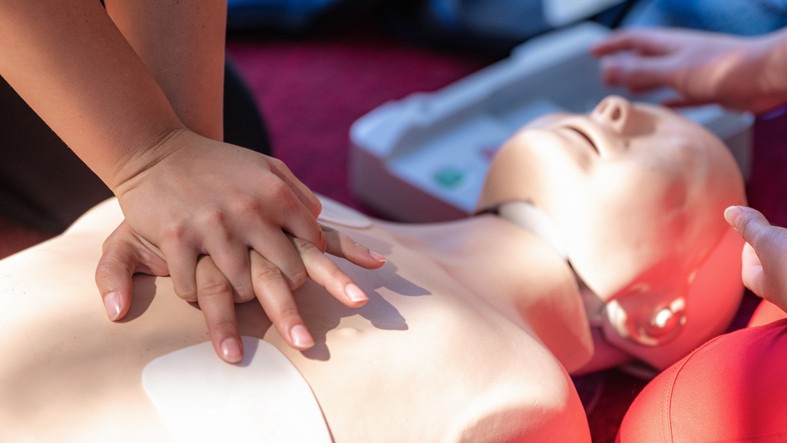
Featured photo at top of a person practicing CPR on a dummy. Photo/microgen/iStock.
What to do in an emergency cardiac arrest situation
If you notice someone collapse or become unresponsive, experts recommend the following tips to take control of the situation:
- First, point to someone and tell them to call 911 and get an AED
- Perform hands-only CPR until the device and paramedics arrive by placing your thumbs under the person’s armpits with your fingers, reaching across their chest. That helps to find the proper position for the compressions.
- Using the heel of your hand with your arms locked and one hand on top of the other, start steadily compressing the person’s chest, pressing about two inches down and up to a tempo of about 120 beats per minute.
- The songs “Baby Shark,” “Girls Just Wanna Have Fun,” and “Stayin’ Alive” are examples of songs to sing while performing compressions.
- If an AED is available, they are designed to talk you through necessary next steps while waiting on first responders.
Related Stories
Bidirectional link between oral, kidney health calls for patient education, access
August 4, 2026

Despite growing awareness of the connection between oral health and chronic health conditions, patient awareness and access to dental care remain limited, according to University of Cincinnati experts who recently spoke with Healio | Nephrology News & Issues.
'Be human in it': UC College of Medicine welcomes Class of 2030 at 31st White Coat Ceremony
August 4, 2026
The University of Cincinnati College of Medicine welcomed 185 first-year medical students in the Class of 2030 at the 31st annual White Coat Ceremony.
UC-built detector at CERN looks for enticing evidence to explain dark matter
August 4, 2026
A physicist from the University of Cincinnati and his research partners from around the world conducted an experiment at CERN’s Large Hadron Collider in Switzerland to look for evidence that might help explain one of science’s most baffling questions: dark matter.