Tracking TBI: neuromonitoring for brain injuries
UC expert discusses advances in neurocritical care with Albany, Georgia's WALB

The University of Cincinnati's Brandon Foreman, MD, discussed advances in multimodal neuromonitoring with Albany, Georgia's WALB-TV.
Like traditional monitoring of a patient's heart rate, blood pressure and oxygen levels, multimodal neuromonitoring tracks similar brain health data points for patients with traumatic brain injuries. Measurements like blood flow, pressure, oxygen and glucose levels in the brain give actionable information over time when treating patients with severe brain trauma.
"What’s happening in the patient on day one is often very different compared to what’s happening to that patient on day three," said Foreman, associate professor of neurology and associate director of neurocritical care research in the Department of Neurology and Rehabilitation Medicine in UC’s College of Medicine and a UC Gardner Neuroscience Institute physician. "We’re learning a lot about what those patterns look like, how individual they are and how we can treat them in a more precise way tailored to that patient."
Read more about multimodal neuromonitoring work at UC.
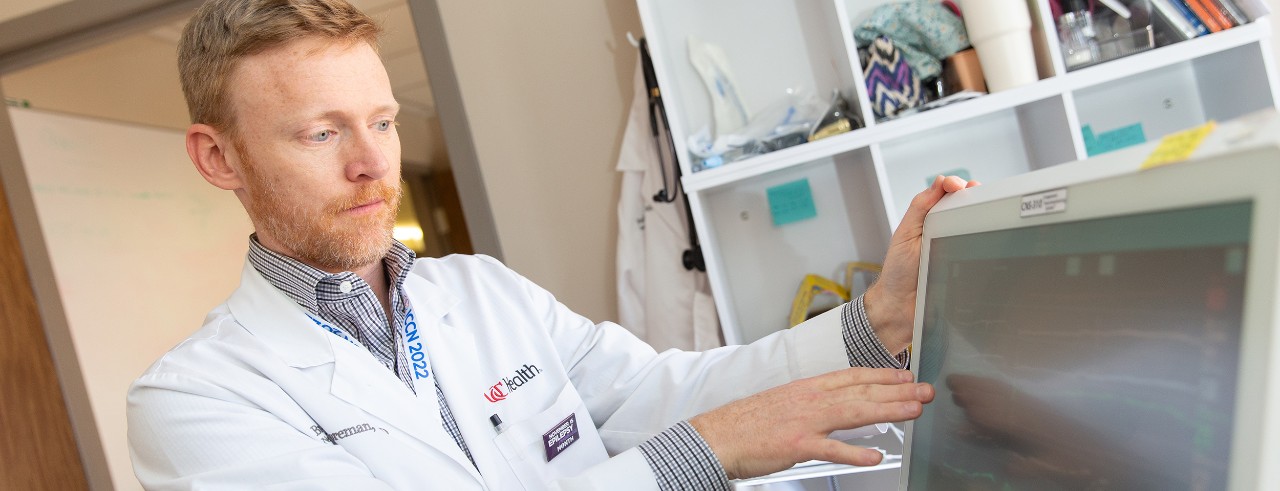
Featured photo at top of Foreman reviewing brain data on a monitor. Photo/Andrew Higley/UC Marketing + Brand.
Related Stories
Bidirectional link between oral, kidney health calls for patient education, access
August 4, 2026

Despite growing awareness of the connection between oral health and chronic health conditions, patient awareness and access to dental care remain limited, according to University of Cincinnati experts who recently spoke with Healio | Nephrology News & Issues.
'Be human in it': UC College of Medicine welcomes Class of 2030 at 31st White Coat Ceremony
August 4, 2026
The University of Cincinnati College of Medicine welcomed 185 first-year medical students in the Class of 2030 at the 31st annual White Coat Ceremony.
UC-built detector at CERN looks for enticing evidence to explain dark matter
August 4, 2026
A physicist from the University of Cincinnati and his research partners from around the world conducted an experiment at CERN’s Large Hadron Collider in Switzerland to look for evidence that might help explain one of science’s most baffling questions: dark matter.