
UC kicks off BearcatGPT OpenAI Service pilot

The University of Cincinnati's Digital Technology Solutions recently kicked off the university-wide BearcatGPT Microsoft Azure OpenAI Pilot.
BearcatGPT is UC’s private instance of OpenAI’s ChatGPT natural language processing model. The limited-use BearcatGPT Pilot provides the university community with a unique opportunity to explore OpenAI/GPT in a private, UC-only environment.
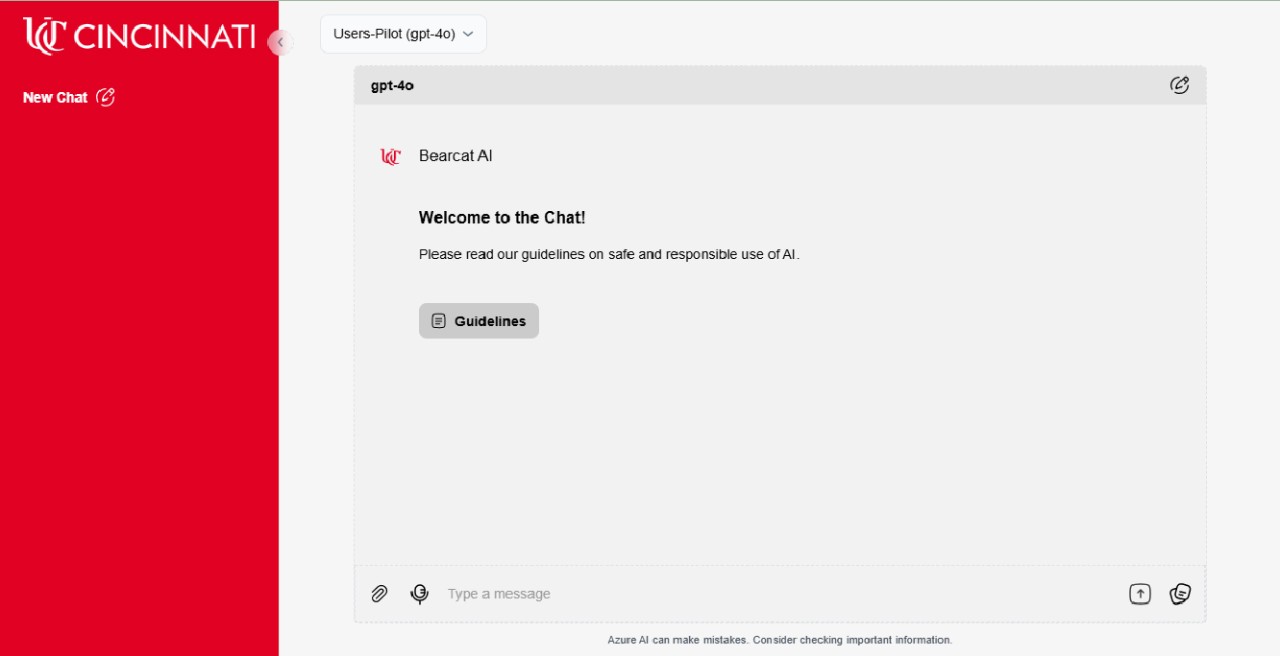
BearcatGPT pilot participants can type, record or upload prompts into the chat.
DTS partnered with designated approvers in each college and unit to include in the pilot a broad representation of faculty and staff with use cases in teaching, learning, research and process automation.
“Data used in BearcatGPT does not contribute to the publicly available OpenAI/GPT,” said UC Vice President & Chief Digital Officer Bharath Prabhakaran. “The innovative configuration of this AI tool allows UC to maintain full control of data and ensure compliance with data and security guidelines.”
For more information about AI initiatives and how we’re working to support AI-driven innovation across UC, visit uc.edu/ai.
Featured image at top: UC is taking part in a pilot project through Azure OpenAI. Photo/Andrew Higley/UC Marketing + Brand
Related Stories
UC Foundation celebrates 2026 philanthropy winners
October 23, 2026
The University of Cincinnati Foundation recognized its Outstanding Philanthropic Volunteer Award honorees at the George Rieveschl Recognition Dinner on October 22, 2026.
AI breast cancer survival model from Cancer Center could improve accuracy and personalize care
October 23, 2026
UC Cancer Center researchers, including lead author Wedad Alatebi, developed a deep learning survival model for breast cancer that combines detailed clinical and genetic information, potentially offering physicians a more accurate tool to guide treatment decisions.
UC aerospace engineer leads global computational fluid dynamics taskforce
October 21, 2026
The American Institute of Aeronautics and Astronautics' CFD 2030 Integration Committee has announced the formation of the Computational Fluid Dynamics (CFD) Vision 2045 Team, a multi-institution working group tasked with defining where the field of computational fluid dynamics should be by 2045 to align with the changing and evolving needs of the aerospace industry. The University of Cincinnati's Prashant Khare, Bradley Jones professor and head of the Department of Aerospace Engineering, is leading this specialized group.