
Building reuse is goal in board game
Holding Pattern game lends a creative approach for collective action on vacant building reuse

Building reuse activity in Cincinnati is energized via creative workshops, says a University of Cincinnati professor.
Such workshops can play a vital role in fostering collaboration, encouraging innovation and empowering communities, says De Peter Yi, a UC assistant professor of architecture who leads the Cincinnati Reuse Collective.
The collective is a research lab and workshop incubator at UC’s College of Design, Architecture, Art, and Planning (DAAP) dedicated to studying the link between Cincinnati’s unique built heritage and current challenges of vacancy, housing and reuse.
Cincinnati Reuse Collective is part urban research course and part survey course, which includes a survey of buildings under the city’s historic structure stabilization program. Students visit diverse neighborhoods and learn about buildings in various phases of the program, many of which are under repair.
This fall, the collective hosted a public workshop at the Smoke House in nearby Camp Washington, a vacant building currently being transformed by artist Mark de Jong. The workshop focus was to launch a board game called Holding Pattern, designed to teach participants about the often-complex process of vacant building reuse.
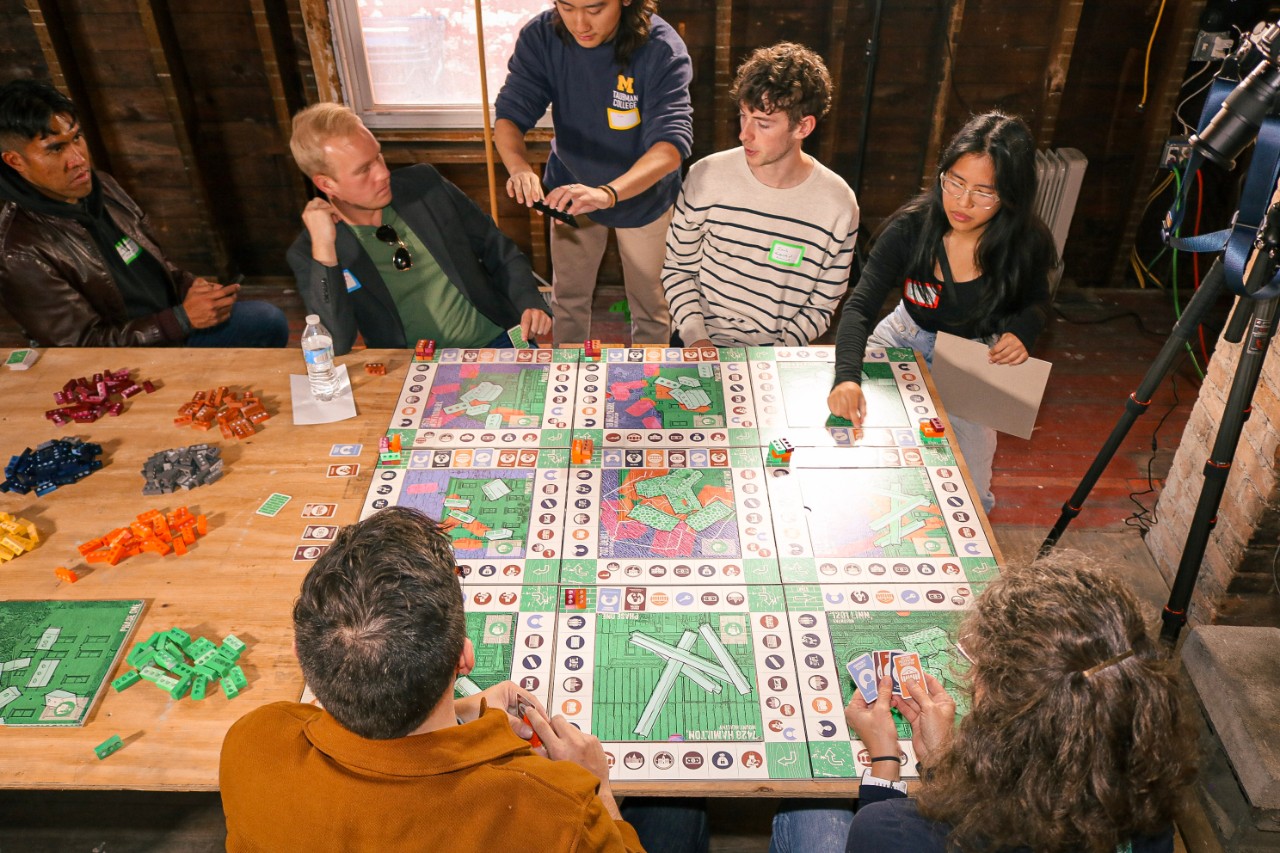
The board game Holding Pattern was put into play at a workshop in Camp Washington. Players here are members of the Cincinnati Reuse Collective and community leaders. Photo/An Le.
Connect with Cincy Reuse Collective
Follow @cincinatireusecollective on Instagram or visit the research lab website.
In the game, participants take on the roles of various actors navigating the phases of vacant building reuse: acquiring ownership, determining use, securing financing and completing construction.
The game board itself is a mosaic of individual tiles, each representing a vacant building in Cincinnati that has been stabilized for reuse. The custom-designed tiles feature augmented reality models that transform before players' eyes, allowing them to see how a building's appearance evolves as it progresses through the different reuse stages.
These digital models can be viewed on a mobile device or projected onto a large screen, creating a powerful visual experience of Cincinnati’s architectural heritage. University of Michigan assistant professor Cyrus Peñarroyo led the original development of the augmented reality experience.
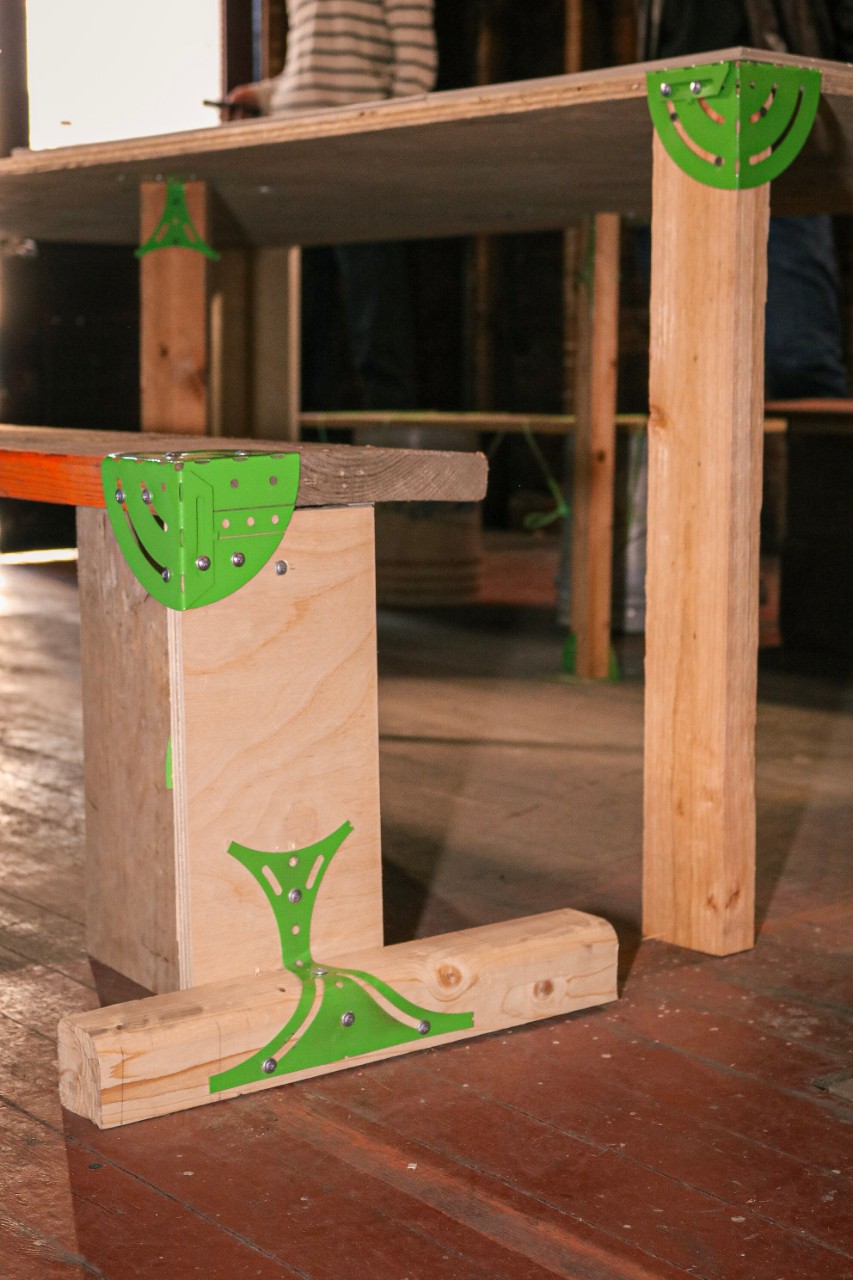
Workshop participants built their own game table and seating out of wood scraps used in the renovation of the building where the event was held. Photo/An Le
To further enhance the experience, Yi and his team designed the workshop environment to make use of the vacant space itself. The game table, seating and information displays were crafted from salvaged materials found inside the Smoke House, creatively held together by custom-designed steel connectors. These connectors encouraged participants to engage with the materials in new and unexpected ways. After the event, the furniture was disassembled, and the materials were returned to their original locations, keeping the cycle of reuse alive.
The workshop, Yi says, brought together a diverse group of local leaders — including community activists, nonprofit organizers, city officials and business innovators — to exchange ideas, share their expertise and engage in a fun, hands-on learning experience.
“The workshop applies architectural techniques toward public understanding of Cincinnati’s built heritage and provides fundamental knowledge to participate in its reuse. The components of the workshop create a framework that is adaptable to new sites, audiences and inputs,” he says.
The board game launch was the result of more than a year of research, collaboration and conversations with organizations across the city. The project team included UC student researchers Wendy Hahn, James Hummeldorf, Zach Lewis and Liv Adkins and University of Michigan student researcher Xuanshu Lin.
Vacant building reuse is a necessary shift from a resource-based economy to a circular economy.
Wendy Hahn Student researcher at DAAP
“Working on this project has informed my interdisciplinary environmental studies BS degree, which considers the nuanced interrelationships between humans and the environment,” says Hahn.
Vacant building reuse, Hahn says, is a necessary shift from a resource-based economy to a circular economy by maximizing existing resources, conserving landfill space and revitalizing local communities.
The feedback gathered from this pilot event will shape future workshops, which will bring the collective’s attention to more vacant buildings throughout Cincinnati, continuing to build momentum for this exciting movement of urban transformation, says Yi.
Impact Lives Here
The University of Cincinnati is leading public urban universities into a new era of innovation and impact. Our faculty, staff and students are saving lives, changing outcomes and bending the future in our city's direction Next Lives Here.
Related Stories
Almaamar Alkiyumi
BEARCATS FOR LIFE
For Almaamar Alkiyumi, being a Bearcat for Life is not just a phrase, but a responsibility shaped by gratitude, growth and purpose.
UC Biomedical Engineering student launches mobile healthcare platform
October 22, 2026
As a fifth-year biomedical engineering student at the University of Cincinnati College of Engineering and Applied Science, Amelia Wares has been a trailblazer in nearly every area imaginable — and this is only the beginning of her journey.
Still the top ‘cat
October 20, 2026

The University of Cincinnati Bearcat mascot was voted Cincinnati’s favorite mascot in a Cincinnati Enquirer reader poll, earning 45.1% of the vote and topping other local favorites.