UC’s Taft Research Center offers new public humanities seminars
Opportunities launch this spring with credit-bearing courses on race, data and atmospheres
This spring, the Charles Phelps Taft Research Center at the University of Cincinnati will offer two hands-on, credit-bearing research courses designed for students to read, think and work collaboratively across the humanities and social sciences.
The seminars, open to advanced undergraduate and graduate students across the university, provide opportunities for students to reflect on their own disciplinary training. Students will be exposed to new methods of thinking, learning how to explore broader concepts through their research. Some will present their findings at the Carnegie, Northern Kentucky’s largest multidisciplinary arts venue.
The courses are the latest addition to Taft’s programming, reimagined by recently appointed director and faculty chair Stephanie Sadre-Orafai. She hopes the new, thematic seminars will raise awareness of the Taft Research Center among students, increase their engagement with the center’s diverse programming, and demonstrate the importance of the classroom as a key site where humanities and social science research takes place.
The seminars will give students “the opportunity to work alongside public humanities scholars and practitioners building their professional networks beyond UC,” Sadre-Orafai says.
Seminars to benefit both students and postdocs
Taft Research Seminars are designed to align with the center’s annual theme and provide postdoctoral fellows a platform to offer timely courses based on their research expertise. Taft’s newest postdoctoral fellows, Harshavardhan Bhat and Megan Gette, will lead seminars related to the 2024–25 theme “Worldbuilding and Radical Worldmaking.”
Bhat joined UC from The Ohio State University, where he was a postdoctoral fellow on race and responsible data science at the Translational Data Analytics Institute. His seminar “Race and Data” draws on his interest in “data analytics of liberation in a time of climate change.” He aims to create a learning environment where students can reflect on human relationships with the earth, matter, and each other through social and environmental lenses.
Leveraging her background in poetry and anthropology, Gette will bring a “sensory ethnographic approach” to her seminar “Atmospheres,” treating the senses as both an object to analyze and a mode used to conduct research.

Megan Gette shows workshop participants how to use a balloon as a DIY geophone during a dream machine session on seismicity. Credit/Stephanie Sadre-Orafai
The course will incorporate her own research and creative practice in sound studies and environmental humanities by looking at phenomena generally examined through a scientific or quantifiable lens with a more humanistic and social approach.
“Each class will be a mix of theory and thinking about the atmospheric,” says Gette. “We will think through what’s at the center of matter and material and explore ways of sensing and sensualizing these broader, more dynamic forms of atmosphere.”
She hopes the class attracts students “interested in making as a process of thinking,” an interactive approach meant to encourage experimentation with a variety of research methods and creative approaches to exploring atmospheres as a broader concept.
Hands-on research and public-facing projects
In both seminars, the first half of the semester will be dedicated to interdisciplinary discussions of theories, methods and frameworks for studying the course theme.
These discussions will be designed to push students to critically examine their own academic backgrounds and consider how different fields can contribute to a deeper, more nuanced understanding of the subject matter.
The second half of the semester will shift to collaborative research design. Students will actively apply a variety of research methods and creative approaches, with some culminating in public-facing projects that extend conversations beyond the classroom.
For Gette’s seminar, this will look like material experiments with the DAAP Printmaking Lab, field excursions including soundwalks, and a partnership with The Carnegie. While the chance to publicly present their research at the conclusion of the course is an exciting prospect for students, Gette emphasizes that this should be seen as a means for students to expand their learning and methods beyond what they already know.
Select students will host public programming at The Carnegie Galleries in April in conjunction with their spring exhibition “Notations on Ritual,” curated by Sso-Rha Kang. Of the partnership, Kang says, “Gette’s seminar couldn’t be a more exciting point of collaboration. It resonates with the world building aspects of how we’re exploring ‘ritual’ in this exhibition, and the cross-disciplinary collaboration between the students and The Carnegie will add further nuance to our conversations.”
Learn more about the seminars and Center’s thematic programming here: https://multisite.uc.edu/taft/research/research-seminars
https://multisite.uc.edu/taft/events/center-thematic-programming
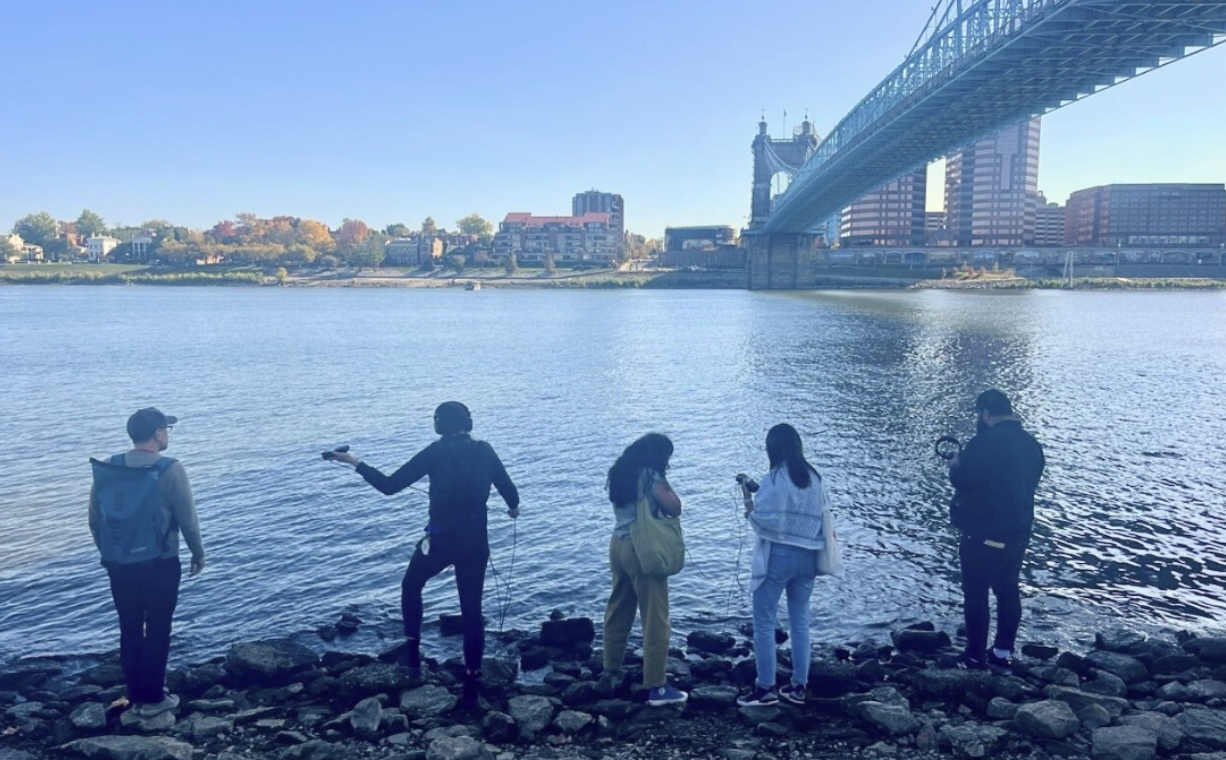
Featured image at top: Students conducting research as part of a new Taft Research Center project. Credit/Chondra Frank

By Rikki Reese
Digital Marketing Specialist, Taft Research Center
artscinews@ucmail.uc.edu
Related Stories
These teeny spiders are social media stars
August 28, 2026

The New York Times turned to a University of Cincinnati professor to explain the appeal of jumping spiders on social media.
UC, NKU renew longstanding partnership supporting Army ROTC cadets
August 26, 2026
The University of Cincinnati Army ROTC and Northern Kentucky University (NKU) have renewed a longstanding partnership that supports students preparing to become Army officers and leaders in their communities. The universities formalized the renewed agreement during a signing event Aug. 11 at NKU.
Roman law expert pieces together ancient legal history
August 25, 2026
UC Classics scholar Matthijs Wibier reconstructed and translated a 1,600-year-old Latin legal text from Egyptian parchment fragments at the Penn Museum, revealing previously unknown Roman tax laws.