Primary care systems are under pressure, but new models could alleviate the strain
UC College of Medicine expert shares perspectives with Crain's Cleveland Business

Patient access is just one of a host of issues facing the primary care discipline. The workforce is not growing fast enough to meet the needs of the U.S. population, and the country continues to underinvest in primary care, according to the nonprofit Milbank Memorial Fund’s 2024 scorecard on the health of primary care in the U.S.
Yet primary care is essential to good health, Barbara Tobias, MD, professor emerita in the Department of Family and Community Medicine at the University of Cincinnati College of Medicine recently told Crain's Cleveland Business.
“We know that when individuals have access to primary care that is both longitudinal, continuous and personal, that morbidity and mortality go down,” she said. “We've seen that over and over again, as our peer countries, who do have that access to primary care, enjoy greater lifespans, lower maternal morbidity and mortality and a whole host of other health metrics.”
So, Crain’s looked at some of the models being practiced outside of the traditional health system, including independent physician groups, direct primary care and partnerships between employers and independent providers.
Doctors who want to practice outside of the traditional health system setting might join an independent physician group or a network of independent providers who come under one entity to share resources and create opportunities for care coordination. It’s a model that gives providers more control as they negotiate directly with private insurance companies and other payers.
Another model that has seen growing interest is direct primary care (DPC), a framework in which patients pay a monthly fee in exchange for enhanced access to their primary care provider.
A DPC doctor generally has a much smaller patient panel (200-600) than primary care doctors employed in a traditional health system (2,000-3,000).
“The idea for patients is that you provide a substantial savings with greater access to your primary care physician,” said Tobias. “For the physician, it allows the doctor to spend more time with patients if they have a smaller panel.”
Another route being explored is employers partnering directly with primary care providers to provide access to employees. These services typically act as a complement to an employer’s existing benefits. Providers offer on-site or near-site clinics and virtual care options that address primary care and acute care needs. They claim to offer quicker, more convenient access, which keeps patients from making unnecessary trips to urgent cares and hospitals' emergency departments, ultimately reducing health care costs for employers.
Tobias said there are “a lot of flavors” of these models. Some have nurse practitioners acting as patients' frontline providers, while others function more like urgent care locations. She said she’s “all for” these types of services for urgent access, but that overall it’s better for a primary care physician to see their patients.
“I still think that we do best when we work in teams with physicians and nurses, and pharmacists and others, each of us working to the highest extent of our license,” she said.
NOTE: Crain's Cleveland Business utilizes a paywall on its site. Those who are interested in a PDF of the article featuring Tobias can email Megan Burgasser at burgasma@ucmail.uc.edu.
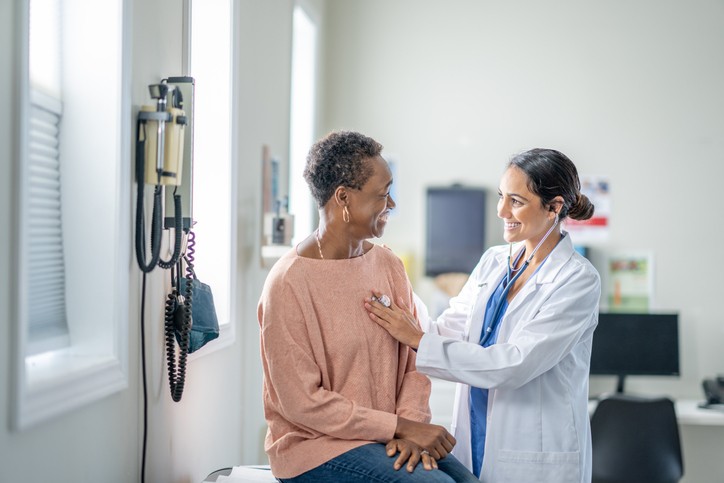
Featured image at top: A woman sits on an exam table as her female doctor listens to her heart. Photo/istock/FatCamera.
Related Stories
These teeny spiders are social media stars
August 28, 2026

The New York Times turned to a University of Cincinnati professor to explain the appeal of jumping spiders on social media.
An internal divide among unions on AI impacts the Wisconsin gubernatorial race
August 28, 2026

Anne Lofaso, a professor in the Donald P. Klekamp College of Law at UC, spoke with Wisconsin Public Radio, about the schism among unions over AI and whether it is a plus, a negative, or somewhere in between when looking at job creation.
On-site training in Speech & Hearing Clinic sets UC’s programs apart
August 27, 2026
At the University of Cincinnati’s Speech & Hearing Clinic, Doctor of Audiology and Speech-Language Pathology graduate students gain real-world experience while providing free speech and hearing services to the community.