
Some fruit flies avoid parasites at expense of sleep
UC biologists say this hypervigilance comes at a cost

If you think doomscrolling leads to sleepless nights, imagine waking up in bed with a blood-sucking monster the size of a basset hound.
That’s the waking nightmare one species of Australian fruit fly must contend with each night as hungry mites stalk and attach themselves like a tick while the fly is sleeping in the fruit orchards and rainforests of Queensland.
Biologists at the University of Cincinnati examined the benefits and costs of avoiding these parasites in a study published in the Nature journal Biological Timing and Sleep.
It may sound trivial, but the parasite Gamasodes queenslandicus poses a potentially deadly threat to fruit flies, UC professor and study co-author Michal Polak said.
“If they have too many mites, they can get ripped apart. It’s very detrimental to them,” Polak said.
He captured wild flies in Queensland and bred 16 generations in his UC biology lab, selecting only males that were able to survive a night’s close exposure to the mites unscathed.
“At night when the flies are quiet and sleeping, they become a good target for the mites,” Polak said.
But the flies that were adroit at evading the mites’ efforts to latch on at night did so at the expense of losing valuable sleep. The energy and sleeplessness this effort requires has consequences of its own, said UC Professor Joshua Benoit, the study’s lead author.
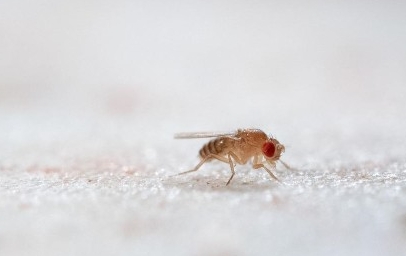
Fruit flies are a model system with many genes similar to people's. UC researchers examined the effects that sleeplessness has over multiple generations of fruit flies. They found that flies that were wakeful avoided parasites but expended more energy that made them more likely to starve. Photo/Andrew Higley/UC Marketing + Brand
This is not the first study to observe behavioral adjustments in animals exposed to external parasites. Researchers have found that parasitism also affects the sleep patterns of bats and birds.
UC biologists examined changes in gene expression relating to the flies’ metabolism in the mite-resistance population. Mite-resistant flies were more prone to starvation and leaned more on their nutrient reserves than other flies, they found.
These hypervigilant flies were more active, slept less and consumed more oxygen at night.
“When we measured it, we found that more than 30 metabolism genes were differently expressed in these flies suggesting they were burning their energy a little faster than you’d expect,” Benoit said.
Sleep in all higher animals is important.
Joshua Benoit, UC professor of biology
“Sleep in all higher animals is important,” Benoit said. “Usually, over a long period of time, you can observe detrimental effects where sleep-deprived animals are not as healthy and start making poor choices. Their behavior is impacted.”
Ironically, Benoit said, sleep is usually beneficial to animals infected with internal parasites such as malaria.
Polak said once fruit flies are bitten by mites, their immune system kicks into high gear. Parasitized flies often have less mating success and quickly deplete their fat reserves.
“The mites cause a massive up-regulation or down-regulation of hundreds of genes. These defense mechanisms can be very costly to the fly,” he said. “So it behooves the fly to avoid getting parasitized in the first place.”
The study was supported by grants from the National Science Foundation.
Featured image at top: UC Professor Michal Polak and his students are studying the genetic responses to parasitism in his biology lab. Photo/Andrew Higley/UC Marketing + Brand

UC Professor Michal Polak and his students are learning more about host-parasite evolutionary ecology in his biology lab. Photo/Andrew Higley/UC Marketing + Brand
Impact Lives Here
The University of Cincinnati is leading public urban universities into a new era of innovation and impact. Our faculty, staff and students are saving lives, changing outcomes and bending the future in our city's direction. Next Lives Here.
Related Stories
Should we appreciate bats?
October 6, 2026
UC associate professor Joe Johnson explains why bats matter during Bat Appreciation Month and invites the public to Ohio Bat Fest, where families can learn about bat conservation, ecology and wildlife research.
UC emergency physician receives $2.5 million NIH research grant
October 6, 2026
University of Cincinnati emergency medicine physician Natalie Kreitzer, MD, received a $2.5 million National Institutes of Health R01 grant to lead a clinical trial testing a wellness program for family caregivers of traumatic brain injury patients.
UC launches Center for Environmental Engagement
October 5, 2026
UC’s College of Arts and Sciences is launching the Center for Environmental Engagement (CEE), a new interdisciplinary initiative focused on supporting communities that face disproportionate environmental risks. Faculty, students, community partners and environmental practitioners will work together to develop solutions to complex environmental challenges. The center’s mission is to serve the public by connecting communities with resources, subject matter expertise and community-engaged scholarship.