UC researcher develops at-home diagnostic test for endometriosis
Expert's story featured in overseas publication

Katherine Burns, PhD, has been suffering from endometriosis, an often painful, chronic condition, since childhood.
Currently, the University of Cincinnati College of Medicine associate professor and director of the Division of Environmental Genetics and Molecular Toxicology in the Department of Environmental and Public Health Sciences works in her faculty research lab studying the development of endometriosis.
Burns has created a non-invasive diagnostic test that can be used in the comfort of one’s home.
As she recently told Happiest Health based in India, Burns has suffered from the condition since she was about 11 — but did not get it diagnosed until her 20s. She had to visit several doctors and wait for a decade for an endometriosis diagnosis.
Endometriosis is a condition in which tissue similar to the endometrium (lining of the uterus) grows outside of the uterus. It can cause debilitating pain and can even potentially lead to infertility. Diagnosis of the condition is often delayed.
Surgical procedures are currently used to diagnose endometriosis, but the Burns Lab has developed a non-invasive diagnostic test that collects menstrual fluid for analysis.
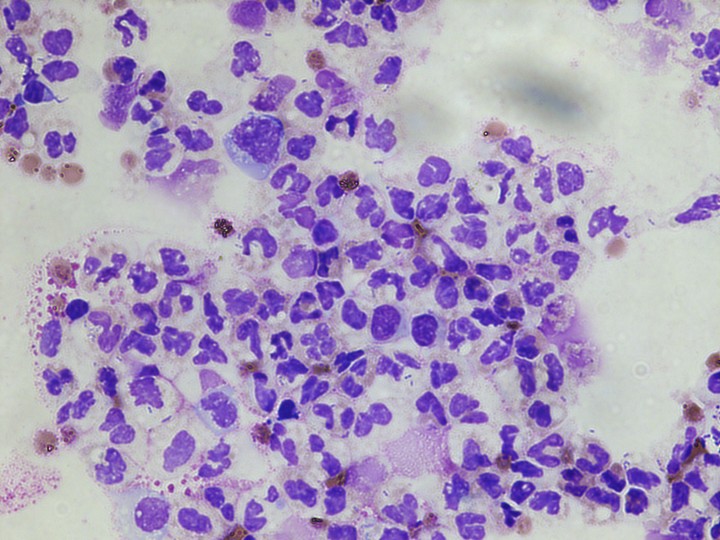
“By looking specifically at the immune cells in menstrual fluid, we were able to physiologically and morphologically find stark differences in the cells in women with endometriosis compared to healthy women,” said Burns.
Several women who suffer from the condition donated their menstrual fluid for the lab’s research.
“They show that there are specific phenotypes and sub-populations of cells in the menstrual fluid of women with endometriosis that are different from healthy women," said Burns.
Featured image at top: Menstrual fluid under a microscope. Photo/Provided by Burns Lab.
Related Stories
What is preconception care, and should you care before you're even pregnant?
September 11, 2026
A University of Cincinnati College of Nursing nurse-midwifery expert explains how the health care you get before pregnancy can shape outcomes for parents and babies alike.
Broadway composer and lyricist Stephen Schwartz visits CCM
September 11, 2026
UC College-Conservatory of Music's BFA Musical Theatre students received advice and words of wisdom from one of the most influential composer and lyricists in America in a master class on Thursday, Sept. 10. From Broadway's Wicked, Godspell and Pippin to Disney's Pocahontas and The Hunchback of Notre Dame (and many, many more), Schwartz's work has moved generations of music and theatre lovers. Dozens of CCM students got to learn from his mentorship up close in a 2-hour workshop and Q&A in Cohen Family Studio Theater.
From Classroom to Community: The Jones Center Expands Its Impact
September 10, 2026
The Jones Center for Race, Gender, and Social Justice is building on its legacy by focusing on the future--beyond the classroom and into the community.