
UC hosts workshop on neutrinos and new physics
International experts will shape next questions in neutrino research

The University of Cincinnati will play host to a workshop on the future direction for possible new discoveries in high-energy physics research.
UC Physics Professor Alexandre Sousa was part of a research group from 2021 to 2023 that mapped out the next 10 years of global research into neutrinos, particles so tiny that they pass through virtually everything by the trillions every second at nearly the speed of light.
Dozens of physicists from labs around the world will meet at UC this week to discuss how facilities conducting neutrino research can open doors to new physics discoveries.
“This workshop is dedicated to devising probes for yet undiscovered new physics beyond the very successful Standard Model of particle physics, using current and upcoming experimental facilities dedicated to studying neutrinos,” Sousa said.
They also will examine collaborations with complementary high-energy physics projects taking place at labs such as CERN’s Large Hadron Collider.
“There is a very health exchange of ideas,“ Sousa said.
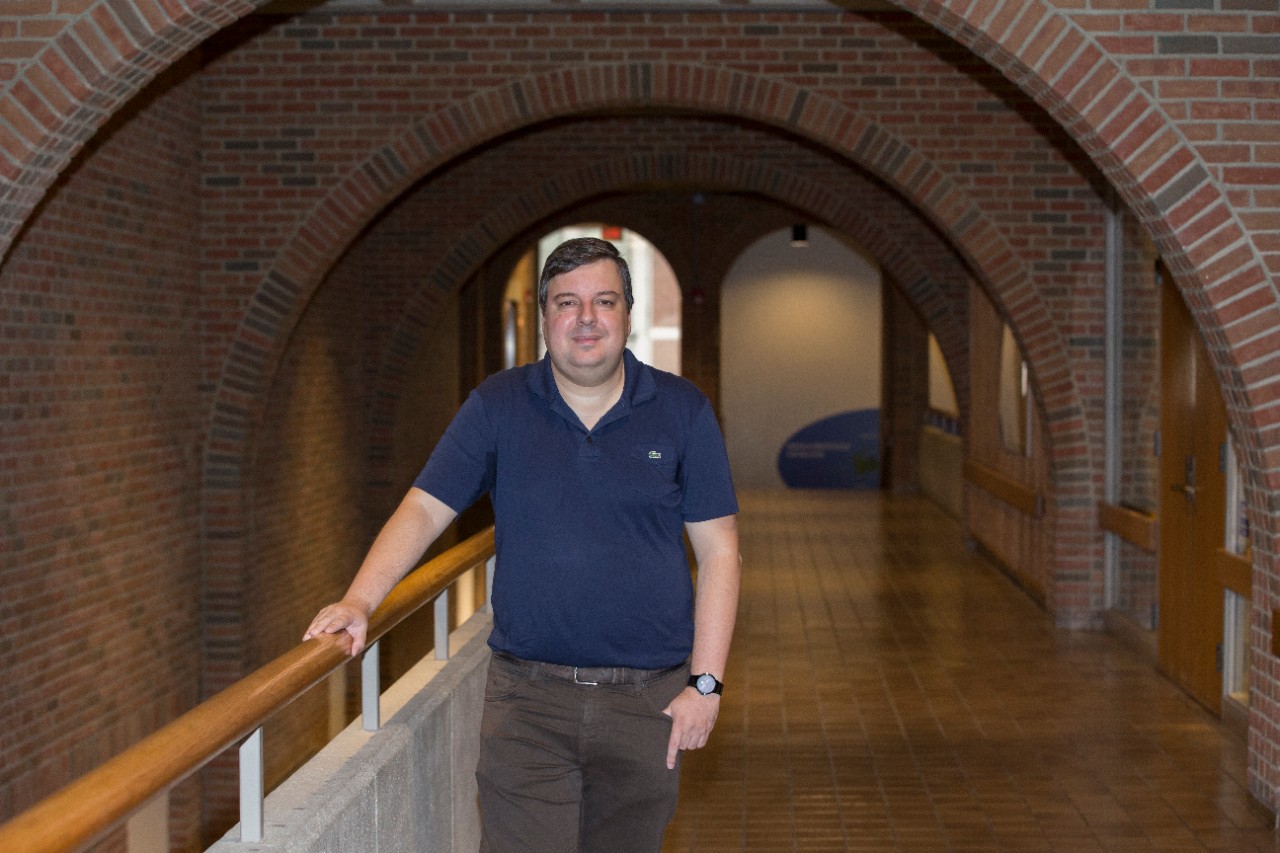
UC Professor Alexandre Sousa organized the fifth periodic New Physics Opportunities at Neutrino Facilities workshop at UC to examine the future of neutrino research. Photo/Joe Fuqua II/UC
Neutrinos are the most abundant particles with mass in the universe, so scientists want to know more about them.
They are created by nuclear fusion reactions in the sun, radioactive decay in nuclear reactors or the Earth’s crust or in particle accelerator labs. As they travel, they can transition between one of three types or “flavors” of neutrinos and back.
But unexpected experimental results made physicists suspect there might be another neutrino flavor, called a sterile neutrino because it appears immune to three of the four known “forces.”
In a white paper published in December in the Journal of Physics G, Sousa and his co-authors discuss experimental anomalies in neutrino exploration that have baffled researchers.
Representatives in high energy physics gather every 10 years to collaborate on the future of particle physics in the United States and its international partners. They articulated their collective vision to a panel that made research funding recommendations to Congress.
UC's workshop invited physicists on both the theoretical and experimental sides. And Sousa said what’s particularly exciting about this conference is that more than half of the participants are students, early-career scientists and postdoctoral scholars who will be shaping the future of the field for years to come.
His postdoctoral researcher, Luiz Prais, is a presenter, he said.
“What we really wanted to do with this workshop is bring together as many early-career researchers with fresh ideas so they can network. They will be the future leaders of this field so we want to expose them to all that is going on,” Sousa said.
Sousa got his start as a theoretical physicist while earning a doctoral degree at Tufts University.
But today he and his students contribute to experiments at labs around the world. Sousa is part of one of the most ambitious neutrino projects, the Deep Underground Neutrino Experiment based at Fermilab outside Chicago.
Researchers put the detectors deep underground to shield them from cosmic rays and background radiation. This makes it easier to isolate the particles measured by the experiments.
The experiment is set to begin in 2031. Researchers at the Fermi National Accelerator Laboratory in Illinois will shoot a high-energy beam of neutrinos 800 miles through the Earth to the waiting detector in South Dakota and a much closer one in Illinois. The project is a collaboration of more than 1,000 international engineers, physicists and other scientists.
“Experiments that are coming are going to be much, much more precise in measuring some of these Standard Model phenomena, so it will be easier to see a deviation,“ Sousa said.
The fifth New Physics Opportunities at Neutrino Facilities workshop runs Wednesday through Friday at UC’s Clifton Court Hall.
Featured image at top: The James Webb Space Telescope captures an image of a nebula. Photo/JPL/NASA
Next Lives Here
The University of Cincinnati is leading public urban universities into a new era of innovation and impact. Our faculty, staff and students are saving lives, changing outcomes and bending the future in our city's direction. Next Lives Here.
Related Stories
UC aerospace engineer leads global computational fluid dynamics taskforce
October 21, 2026
The American Institute of Aeronautics and Astronautics' CFD 2030 Integration Committee has announced the formation of the Computational Fluid Dynamics (CFD) Vision 2045 Team, a multi-institution working group tasked with defining where the field of computational fluid dynamics should be by 2045 to align with the changing and evolving needs of the aerospace industry. The University of Cincinnati's Prashant Khare, Bradley Jones professor and head of the Department of Aerospace Engineering, is leading this specialized group.
Still the top ‘cat
October 20, 2026

The University of Cincinnati Bearcat mascot was voted Cincinnati’s favorite mascot in a Cincinnati Enquirer reader poll, earning 45.1% of the vote and topping other local favorites.
Researchers test gene therapy as less invasive treatment for hydrocephalus
October 20, 2026

Researchers at the University of Cincinnati College of Medicine say an experimental gene therapy could eventually lead to a less invasive treatment for hydrocephalus, a condition in which excess fluid accumulates in the brain. The early-stage study, led by Agnes (Yu) Luo, PhD, professor and vice chair for research, was published in the journal Fluids and Barriers of the CNS. Yahoo! News recently featured it.