During a mental health epidemic, this UC alum answers the call with care
Zach Schmucker, Director of School Counseling at La Salle, advocates for mental support

Data in the article included the staggering finding that more than a quarter (28 percent) of boys ages 3 to 17 live with a mental, emotional, behavioral or developmental disorder. The article cited CDC findings that the 2023 suicide rate for males ages 15 to 24 was 21 per 100,000, an almost twofold increase over the 11 per 100,000 rate recorded in 1968.
And in a related story from the same author published in mid-2025, the Times reported on the lack of professional male role models in the daily lives of many young men. In one glaring example, the report found that only 21 percent of school counselors were male.
Zach Schmucker knows all of this too well. As the Director of School Counseling at La Salle, an all-male Catholic high school in Monfort Heights, he works on the front lines in the battle for better mental health in male populations.
“I know these young men need me. There's a mental health crisis going on in our country right now, and we need more mental health professionals,” says Schmucker. “I get so much more than money out of my job because these young men look up to me. We need young men that are willing to go into this role and help us pay it forward. Young guys are out there struggling to understand what masculinity looks like in this world, with social media and everything else.”
Building a career in care
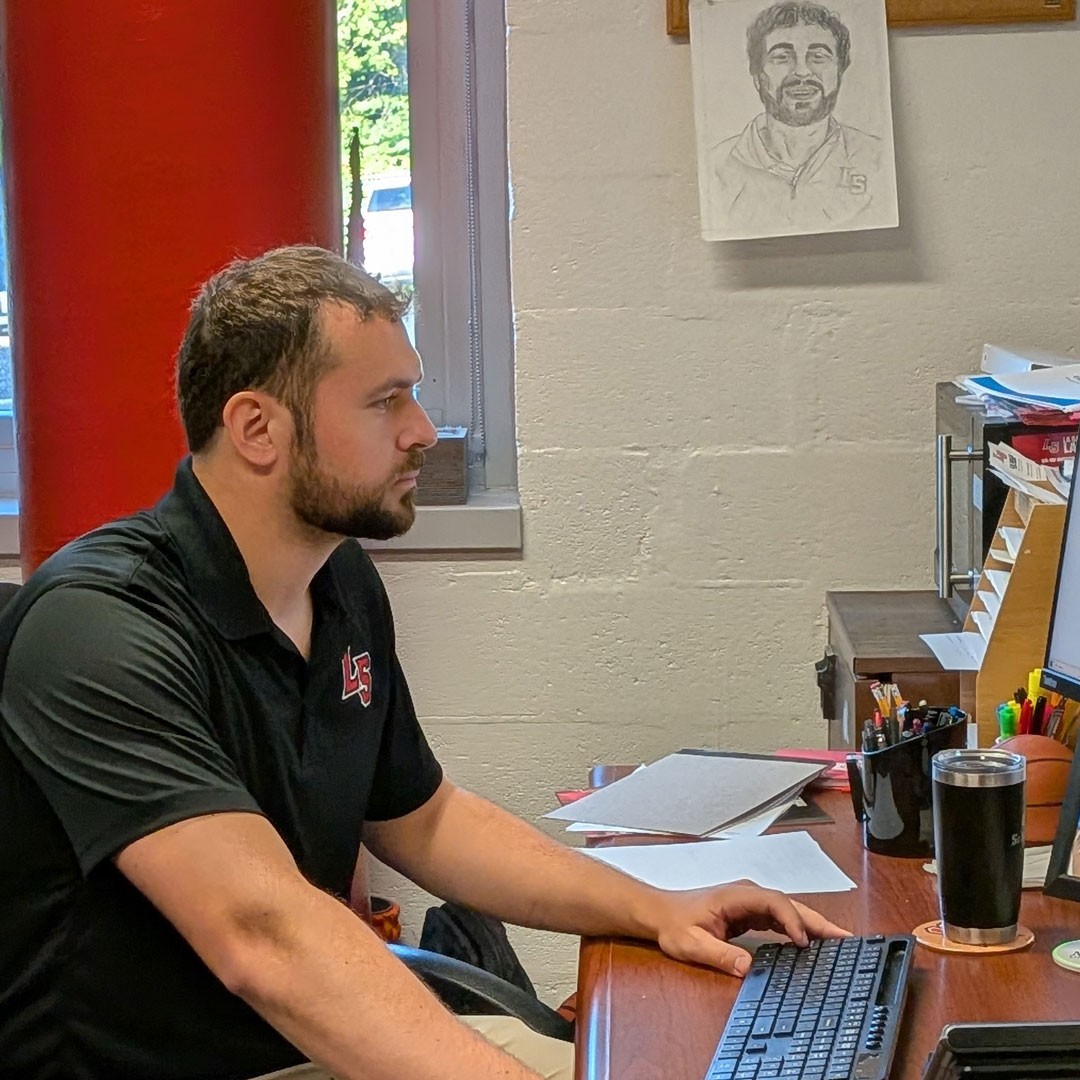
La Salle High School Director of School Counseling Zach Schmucker works in his office. Photo by Rodney Wilson, CECH Marketing
Schmucker understands that the career path he champions requires some financial self-sacrifice. The son of an engineer father and school counselor mother, Schmucker didn’t set out to pursue the counselor path, initially entering undergraduate studies at Centre College in Danville, Kentucky, as an economics major.
“I thought I wanted to go in the business world and make a lot of money,” he explains. “But I quickly realized that, while I was good at that, it wasn't my passion.” All it took was a psychology course for him to realize he was drawn to helping others more than helping himself to large paychecks. “I've always been a very empathetic person, able to connect with people very easily on deep level. I wanted a profession that connected with what was in my heart, which is really helping people.”
So he switched his major to psychology with a minor in education then, during his senior year of college, applied to UC’s Master of Education in School Counseling program. “I realized, you know what? It's OK to follow my mom's footsteps.”
Coming home to Cincinnati, the St. Xavier High School graduate set to work at UC, learning the skills and techniques he’d ultimately put to work in his career. He cites Professor of Counseling and Associate Director Michael Brubaker as a major influence, teaching the group counseling techniques that Schmucker uses to this day.
“They just always were really good at meeting me where I was and pushing me to another level,” he says. He had a graduate assistantship with the Ombuds office and learned critical conflict resolution skills. Adding an internship at Sycamore High School helped him develop time management. And the cohort he graduated with – he was one of seven, though notably the only male – bonded over the experience of completing the program together and remain close to this day.
“We really got into the weeds about what made us uncomfortable as professionals,” he says. “You had to grow in front of your classmates, and there were a couple times where tears were shed with classmates. But that's what counseling is. You have to be able to be there for yourself so you can be there for others.”
“A heck of a ride”
Upon completion of the program, which he did during the height of COVID-19 in 2020, Schmucker was immediately hired by Hamilton County ESC and placed at La Salle High School during a particularly challenging point in time.
“I was thrown into a school district that was trying to recover from the pandemic and bring everybody back. It was very challenging,” he says. “Two months into my career, I was the only counselor in my building because the other counselors got COVID.”
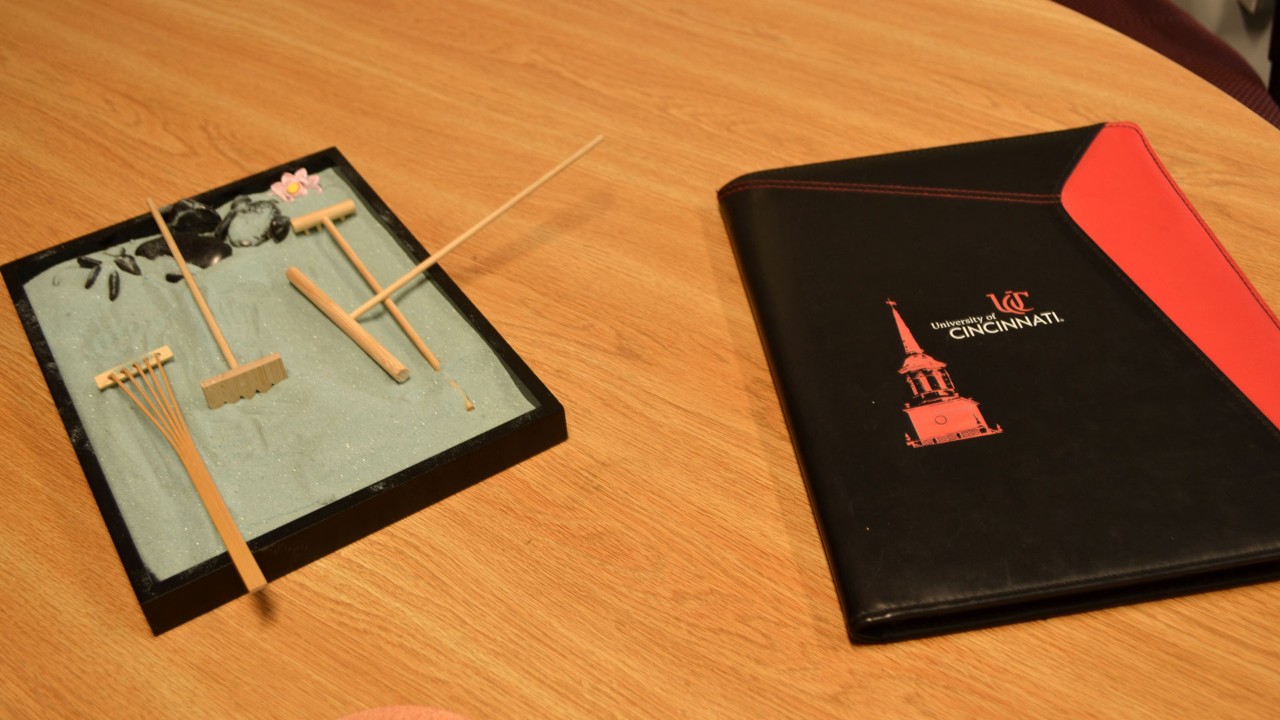
Mindfulness tools sit beside Schmucker's UC reference material in his office at La Salle. Photo by Rodney Wilson, CECH Marketing
Just two years later, tragedy struck La Salle as the longtime Director of School Counseling passed away; Schmucker was approached by school leadership about filling the position. “They were like, hey, we know you're really early on in your role, but we think you have a lot of potential and you're perfect for the job,” he recounts. “I thought about it for a long time because it's a community I wasn't super familiar with at the time, and that's a lot of responsibility. But ultimately I felt called to step into the role. The rest is history. It's been a heck of a ride.”
In his role as Director of School Counseling, Schmucker organizes the mental health support at the school, acting as liaison between counselors and administration, and advocating for student needs across academics, social/emotional support and college and career needs.
“I help organize counseling groups, which I'm very passionate about,” he explains. “I also investigate different pathways for students to help prepare them for after high school, whether that’s trade programs or college dual-enrollment classes that we're partnering with through UC.”
Building community
Schmucker is quick to point to his experience at UC as helping him develop the skills to succeed in his leadership role. “[They] drilled into me a lot about making sure that I'm doing counseling responsibilities. That's something I continue to fight for. How can I give more of my time to be with the students? Because that's really what I feel like is needed right now, using evidence-based practices to make sure I'm using the right techniques, in individual work and in group work.”
And Schmucker once again points to the relationships formed amongst his Master of Education in School Counseling cohort as an invaluable benefit of his UC education.
“UC does a great job of making sure you build a team mentality in your co-work."
Zach Schmucker Director of Counseling, La Salle High School
"Some of my best friends were members of the cohort," he says. "They were at my wedding – that's, you know, five years after graduation."
These cherished friendships also provide him with a professional network to better help the community he’s tasked with serving. “l reach out to them with questions, and they always get back to me,” he says. “And I'm able to refer kids now to those counselors outside of my building if they need additional support.
“It's super awesome to have that community.”
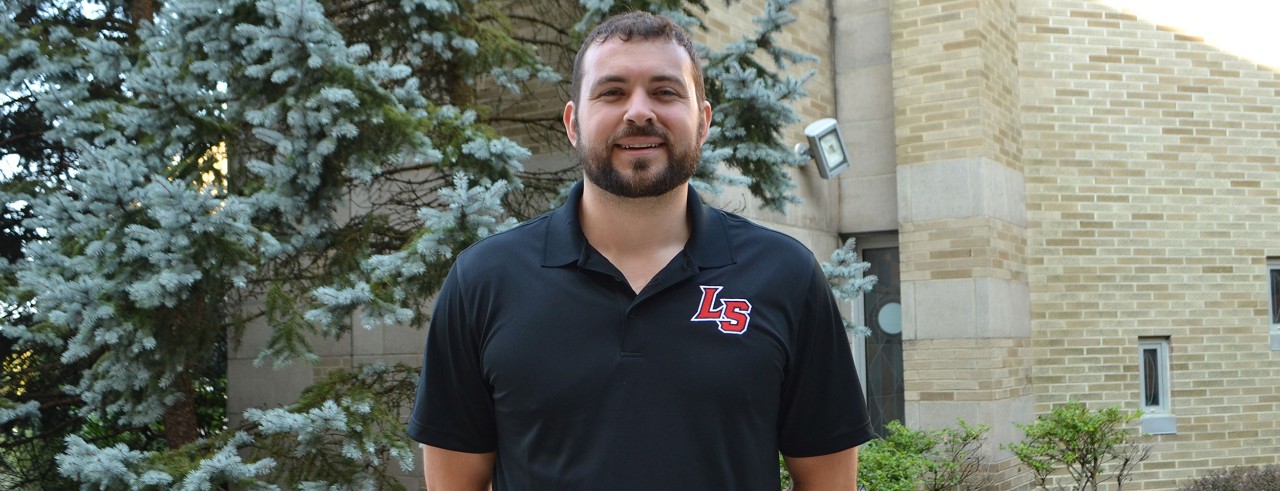
Featured image at top: La Salle Director of School Counseling Zach Schmucker smiles as he stands in the school courtyard. Photo by Rodney Wilson, CECH Marketing
Next Lives Here
The School of Human Services, located in the College of Education, Criminal Justice, Human Services, and Information Technology, is a dynamic and innovative program committed to excellence in raising the next generation of industry professionals. The School of Human Services offers a range of certificates, undergraduate, master's and doctoral programs to prepare students for their futures in the field of health and wellness.
Related Stories
Campus buzz returns as UC students experience their first week
August 27, 2026
Near-perfect weather, record first-year enrollment, Thrifty Move-In and a packed Involvement Fair mark the University of Cincinnati’s first week back as thousands of Bearcats move into campus housing.
UC, NKU renew longstanding partnership supporting Army ROTC cadets
August 26, 2026
The University of Cincinnati Army ROTC and Northern Kentucky University (NKU) have renewed a longstanding partnership that supports students preparing to become Army officers and leaders in their communities. The universities formalized the renewed agreement during a signing event Aug. 11 at NKU.
A new year, a shared purpose: President Pinto welcomes Bearcats to UC’s 208th fall
August 24, 2026
President Neville G. Pinto welcomes students, faculty and staff back to UC's 208th academic year.