
Politics follow you on the road
People are more likely to honk at bad drivers with political bumper stickers

Nobody wants to admit that a lowly bumper sticker can influence their behavior.
But researchers at the University of Cincinnati found that drivers were far more likely to honk after being cut off by a vehicle bearing a political bumper sticker, particularly one for the opposing political party.
“Bumper stickers are a meaningful way in which partisan divides are reinforced in everyday life,” UC researchers concluded. “They have tangible impacts on road safety. Partisan bumper stickers may be mundane, but they are not trivial.”
For a study published in the journal Frontiers in Political Science, UC Assistant Professors Rachel Torres and Ben Farrer explored political polarization in apolitical settings — like driving.
They conducted attitude surveys with paid volunteers who then took part in a short driving simulation. In half of the simulations, another vehicle cuts off participants without signaling. The offending vehicle featured either no sticker or one of three bumper stickers: “Proud Democrat,” “Proud Republican” or the neutral “I love my dog.”
In the other half of simulations, the other vehicle stays in its own lane before making an unremarkable left turn.
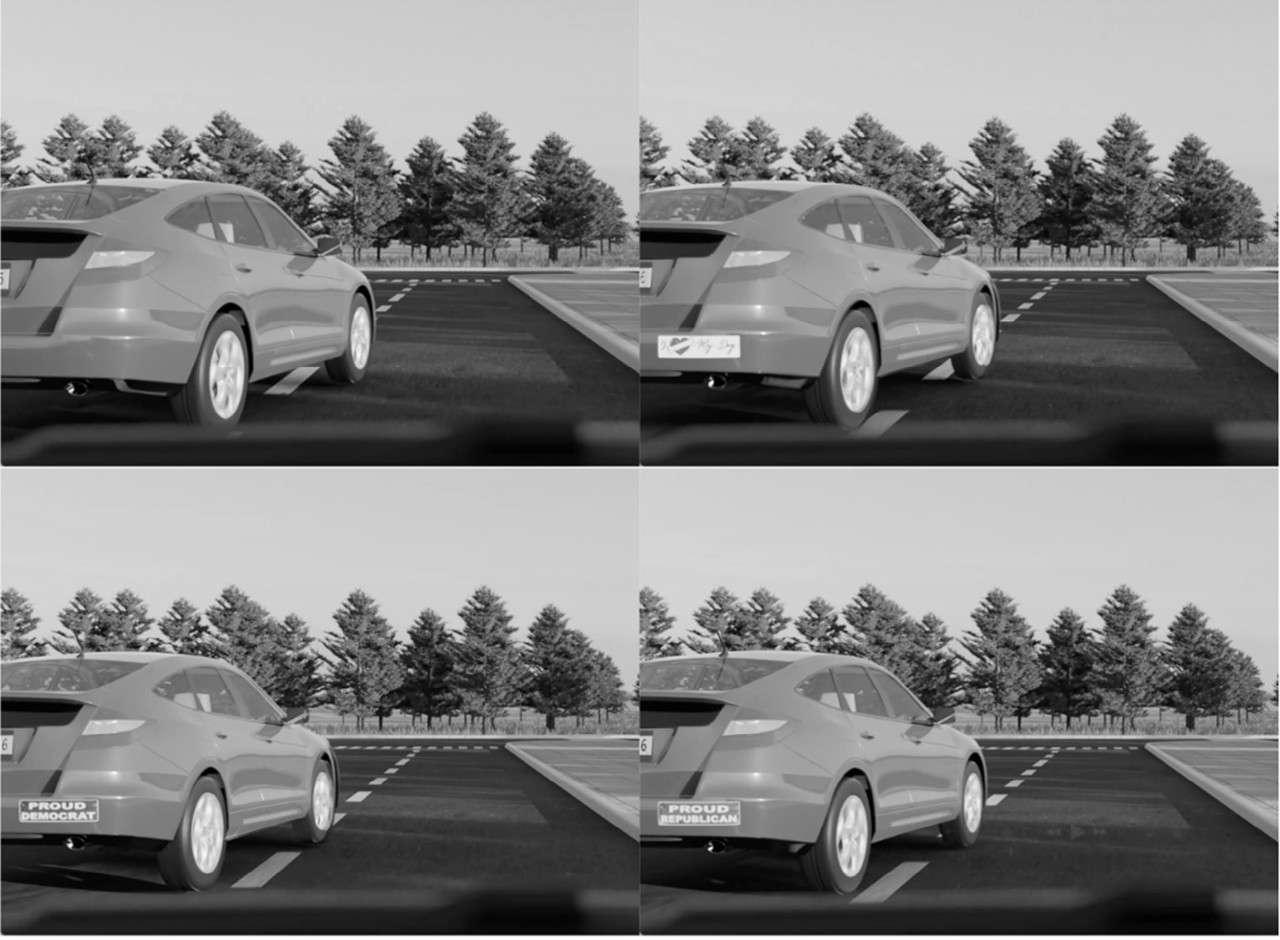
For a new study published in the journal Frontiers in Political Science, survey respondents watched a driving simulation in which they are cut off by a vehicle. Researchers found that respondents were significantly more likely to say they would honk at the vehicles bearing political bumper stickers, particularly if the sticker supported their opposing party. Graphic/UC School of Public and International Affairs
A follow-up survey found that drivers said they were significantly more likely to honk in the videos where the offending vehicles expressed support for the opposition party compared to those sporting stickers supporting their own party or a love for dogs.
“It activated their partisan hostilities,” said Torres, who teaches political science in UC’s School of Public and International Affairs.
“We have a unique car culture in the United States. American identity is often tied to owning a car and how you choose to decorate it,” she said. “So we wanted to ask: Has American car culture been politicized? Has it become more partisan?”
The answer, it turns out, is yes.
“These feelings are just below the surface for many people,” Torres said.
Researchers recruited U.S. adult residents who answered a questionnaire with identifying information about gender, age, race, education and partisan identity. They also completed a personality test to find out how agreeable and authoritarian they are since both how nice and how sensitive one is to rule-breaking can be relevant to driving habits. Nondrivers were dropped from the study population.
Participants watched a short digitally animated dashcam video of a vehicle driving in the right lane of an empty four-lane road when a sport utility vehicle driving just out of frame swerves into their lane briefly before returning to its lane.
Participants then were asked on a five-point scale how likely they were to honk in their given scenario. And they took a final survey to measure their feelings toward the other driver. That survey found that partisan bumper stickers do not trigger more patience or grace toward drivers of the same political affiliation but did trigger more hostility toward those of the opposing ideology.
“We never found bumper stickers to have a positive impact. They didn’t improve people’s perceptions of their group or other groups,” she said.
Featured image at top: According to a new study by the University of Cincinnati, drivers are more likely to honk when they are cut off in traffic by vehicles with political bumper stickers. Photo/Goran Jakus Photography
The next groundbreaking discovery
UC is a powerhouse of discovery and impact as a Carnegie 1 research institution. From pioneering medical research to transformative engineering and social innovation, our faculty and students drive progress that reaches across the world.
Related Stories
'There's a strong community here:' UC transfer student finds place in College of Arts and Sciences
October 23, 2026
This week marks National Transfer Students Week, and the College of Arts and Sciences celebrated those students Thursday. Olivia White, assistant director of recruitment, said around 13-15% of students at UC are transfer students, and with that comes its own set of challenges.
UC Foundation celebrates 2026 philanthropy winners
October 23, 2026
The University of Cincinnati Foundation recognized its Outstanding Philanthropic Volunteer Award honorees at the George Rieveschl Recognition Dinner on October 22, 2026.
AI breast cancer survival model from Cancer Center could improve accuracy and personalize care
October 23, 2026
UC Cancer Center researchers, including lead author Wedad Alatebi, developed a deep learning survival model for breast cancer that combines detailed clinical and genetic information, potentially offering physicians a more accurate tool to guide treatment decisions.