
'Sound bulb' research by UC Blue Ash team featured as editor’s pick
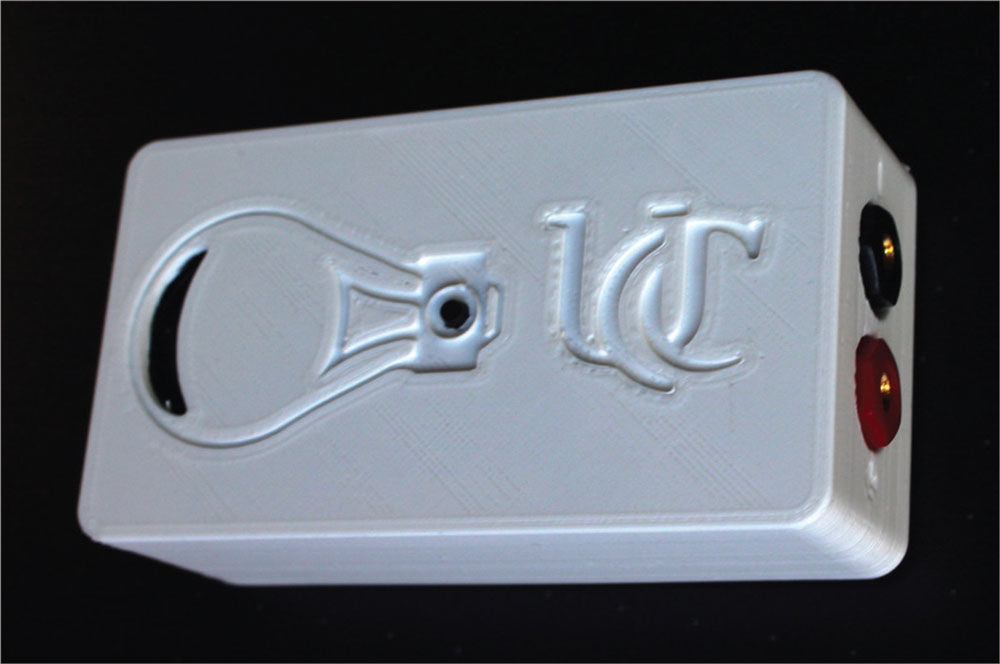
The "sound bulb" prototype was designed to increase accessibility for all students who are interested in physics. Photo/provided.
A research paper on new technology being developed by a professor and students at the University of Cincinnati Blue Ash College is being highlighted as the editor’s pick in a prominent physics journal.
The research focuses on the development of an audible light bulb or “sound bulb” that could make physics experiments more accessible for students who are blind or sight impaired.
Dean Stocker, PhD, is a professor of physics at UC Blue Ash. When introducing circuit labs to his students, he has them collect data based on visual observations of the brightness of incandescent light bulbs in various configurations.
“In my physics lectures I have occasionally had students who are blind or visually impaired,” said Stocker. “We found ways to make the lecture work for them, but it really made me wonder what would happen if I had a sight-impaired student in a lab.”
Stocker began working on the concept of a bulb that could use increasing and decreasing sound frequencies to mimic the varying brightness in a light bulb, depending on changes in voltage. He soon began collaborating on the research project with Mayumi and Richard Chinchihualpa, siblings and engineering students who worked on the project while attending UC Blue Ash. They have both transitioned to UC’s College of Engineering & Applied Sciences to finish their bachelor’s degrees.
Professor Stocker, Mayumi and Richard developed prototypes of the “sound bulb” and summarized the research and their findings in an article that they submitted to The Physics Teacher, a peer-reviewed journal that features papers on physics research.
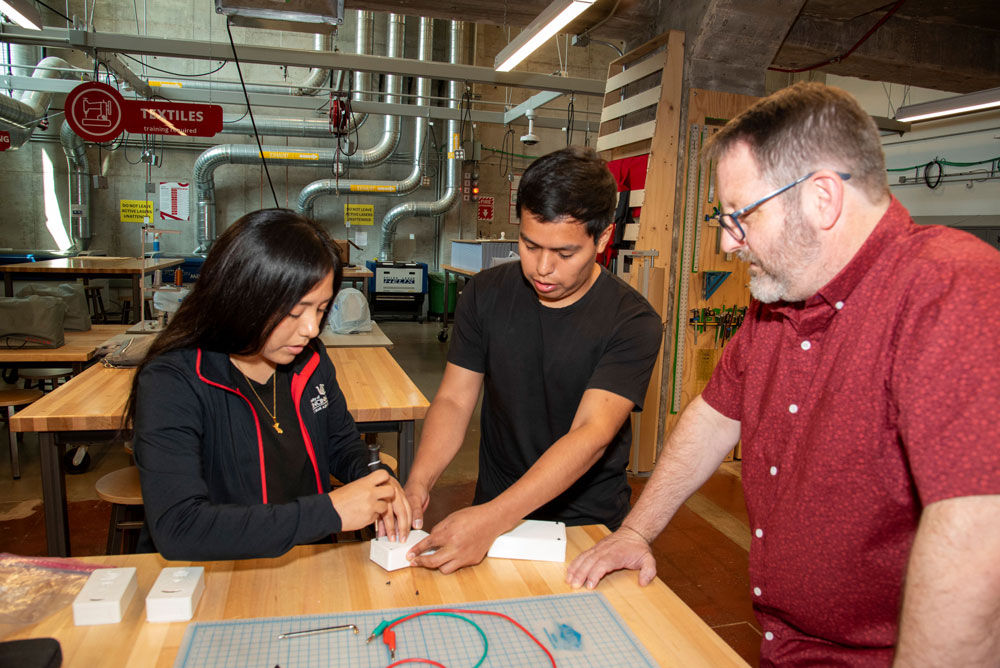
Professor Dean Stocker (right) works with Mayumi and Richard Chinchihualpa work on a "sound bulb" prototype at the 1819 Innovation Hub.
They were notified a while ago that their article would be published in the highly respected journal. The news got even better when they recently learned that their paper was selected as an editor’s pick for the December issue of the journal.
This designation means the research was recognized as noteworthy by the journal’s editorial board and is featured on the journal’s home page with a special editor’s pick icon next to the article title. You can see the article on The Physics Teacher website.
“We are truly honored that the editorial board recognized our project as innovative and valuable,” said Mayumi, who is a double major in biomedical engineering and neurobiology. “This reinforces how important accessibility is in science education. We hope it encourages more educators to explore creative strategies to help every student engage fully with physics concepts. We’re very grateful for the support and mentorship from Dr. Stocker throughout this project.”
Both students say the experience has been invaluable as they prepare for high-level careers in engineering.
“Working on this project taught me how important curiosity, communication, and trust are in research,” said Richard. “As an engineering student in the aerospace field, I brought simple ideas like 3D modeling, practicality and usability to the table. Sharing those ideas while learning from the scientific insight around me showed me how to work through challenges with patience and clarity.”
This important invention will open new opportunities to blind or sight-impaired students who have an interest in physics, and it might be useful in developing experiments for sighted students. Stocker notes that he has a used the “sound bulb” a few times in his lectures.
“The students were able to make predictions and then verify their predictions about the way current behaves in different electric circuits by listening to the ‘sound bulb’ as I opened and closed a switch,” he said.
As far as next steps in the project, the group is working with Arbor Scientific, a physics and chemistry lab equipment company, to commercialize the “sound bulb” with the goal of making it available to physics teachers around the world.
About UC Blue Ash College
UC Blue Ash College is a regional college of the University of Cincinnati. It combines the resources and academic excellence of UC with low tuition, personal attention and a welcoming campus community that is nationally recognized for advancing student success. The college is located on a scenic 135-acre wooded campus in the heart of Blue Ash, Ohio. To learn more, visit us online, call 513-558-9495, like us on Facebook, or follow us on X and Instagram.
Related Stories
How the University of Cincinnati co-op program is shaping the future of work at SXSW
March 17, 2026
The University of Cincinnati served as a 2026 Workplace Track sponsor at the annual South by Southwest (SXSW) Innovation Conference March 12-18 in Austin, Texas, showcasing how co-op is redesigning the future of work.
Learning by doing: internships, co-ops provide invaluable experience as students find their career path
July 30, 2026
More students at the University of Cincinnati Blue Ash College are pursuing summer internships and co-ops to go beyond the classroom, explore potential careers, and step into a professional environment where real-world experiences help provide a new perspective.
University of Cincinnati gets $1.1M for AI physician training
January 30, 2026

The University of Cincinnati College of Medicine has received a four-year, $1.1 million grant to explore using artificial intelligence and personalized learning to improve physician education.