
How our universe expands
UC physicist contributes to global effort to unlock mysteries of dark energy

Researchers have mapped the night sky in the most detail yet in a bid to explain the mysteries of dark energy.
Led by the U.S. Department of Energy’s Fermi National Accelerator Laboratory, the Dark Energy Survey released the results of six years of data examining how the universe behaves.

Jessica Muir. Photo/Provided
University of Cincinnati physicist Jessica Muir is among the more than 400 scientists across seven countries taking part in the project, which crunches data recorded by telescopes and high-resolution cameras high in the Andes mountains of Chile.
Researchers say a repulsive force they call dark energy is behind the universe’s accelerating expansion, overcoming gravity which would be expected to slow the expansion. By mapping hundreds of millions of galaxies, detecting thousands of supernovae, researchers are using patterns of cosmic structure to get closer to understanding the phenomenon.
Between 2013 and 2019, the project surveyed about one-eighth of the sky over the course of 758 nights of observation. During that time, researchers have catalogued hundreds of millions of galaxies to make some of the most precise measurements yet of the distribution of matter in the universe.
“Galaxies form in regions where there's a lot of matter, so studying how galaxies cluster and how their light is distorted by gravitational lensing tells us about how structures grow over the history of the universe,” said Muir, an assistant professor in UC’s College of Arts and Sciences. “So over time we went from a universe that was uniform to one in which galaxies cluster together.”
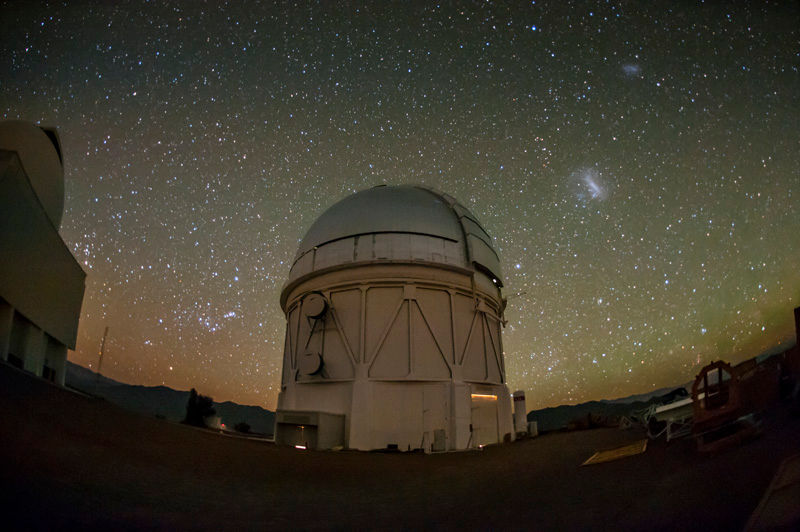
Researchers mapped more than one-eighth of the sky using a telescope and high-resolution cameras at the Cerro Tololo Inter-American Observatory in the Chilean Andes. Photo/Reidar Hahn/Fermilab
Images captured in Chile demonstrate how light from distant galaxies is distorted by gravitational forces. And this effect is intensified in regions featuring clusters of galaxies.
“If light travels in a straight line, we see a clear image. But if light is deflected by gravity, the image looks warped,” she said.
Muir is contributing to the project as part of the analysis team where she led the development of statistical techniques for checking the consistency of different parts of the data. They validated theoretical predictions that are compared measurements and the process of using those comparisons to learn about the physics of dark energy.
She has a background in applied mathematics, earning a master’s degree from Cambridge University before she received a doctoral degree in physics. Muir contributed to the data analysis using UC’s Advanced Research Computing Center.
“I wanted to get into theory, but as a doctoral student I realized the things I found most compelling were at the interface of theory and experiment,” Muir said. “We use statistics to test our understanding of the universe.”
She also had an opportunity to visit Chile where she took part in two shifts as an observer on the project in 2017 and 2018.
Physicists are still grappling with concepts outlined by Albert Einstein in his theory of general relativity.
“The simplest model for dark energy is the cosmological constant. Is dark energy constant with time or is it enhanced or diluted as the universe expands?” Muir said.
“I’m excited to be part of these big collaborative efforts to use data to say something about that,” she said.
“In physics we want to understand what things are made of and what mathematical laws govern how they behave,” she said. “And we still can’t explain 95% of the universe.”
Featured image at top: Researchers are studying the way galaxies cluster to learn more about a force called dark energy that explains why the universe is expanding at an accelerating rate. Illustration/Jessica Muir
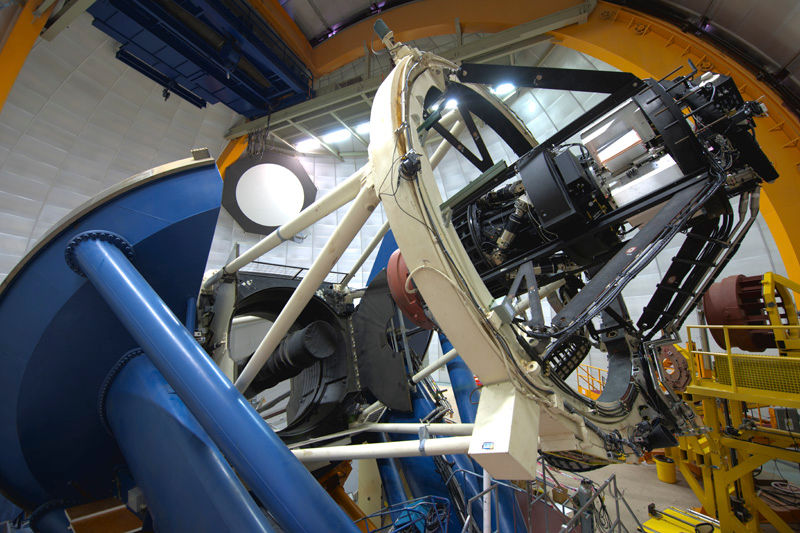
Fermilab built a 570-megapixel camera for its four-meter telescope the Cerro Tololo Inter-American Observatory in the Chilean Andes. Photo/Reidar Hahn/Fermilab
The next groundbreaking discovery
UC is a powerhouse of discovery and impact as a Carnegie 1 research institution. From pioneering medical research to transformative engineering and social innovation, our faculty and students drive progress that reaches across the world.
Related Stories
UC-built detector at CERN looks for enticing evidence to explain dark matter
August 4, 2026
A physicist from the University of Cincinnati and his research partners from around the world conducted an experiment at CERN’s Large Hadron Collider in Switzerland to look for evidence that might help explain one of science’s most baffling questions: dark matter.
UC researchers examine ethics of evolving AI
September 28, 2026

Spectrum News highlighted research by the University of Cincinnati to examine questions about harm, trust and fairness surrounding artificial intelligence.
Unlike many parents, children are fearless around AI
September 23, 2026
Researchers at the University of Cincinnati found that children ages 5-10 are enthusiastic about playing with new AI toys but also tend to believe what the AI tells them. Their embrace of AI contrasts with concerns expressed by some of their parents.