
How do bats tell insects from leaves? Ask a robot
Researchers use robotics to explain big-eared bat’s echolocating superpower

Why do researchers think big-eared bats can find hidden insects without having to scrutinize every leaf in a forest?
Their robot can do it.
Led by the University of Cincinnati, engineers programmed an autonomous robot to find a dragonfly hiding on leaves using only electronics that mimic a bat’s echolocation. The robot uses a nimble, jointed arm fitted with stereo microphones that, like a bat, can detect the reflective echoes of pulses it bounces off surfaces as it rolls across a track.
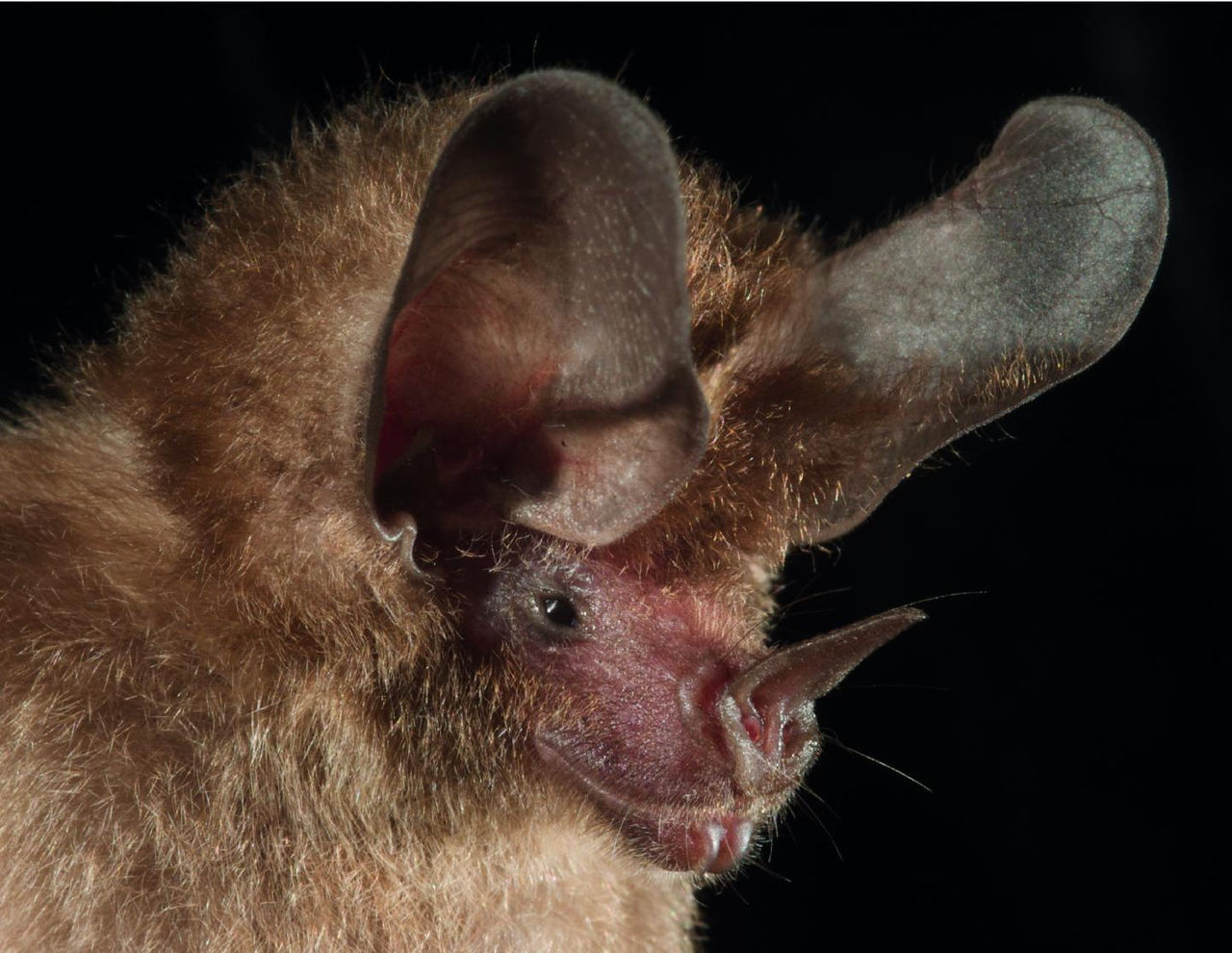
A common big-eared bat. Photo/Elizabeth Clare/EurekAlert
Insects, even 3D-printed ones used in the experiment, create a different echoic signature than flat leaves, also 3D printed for the demonstration.
The robot was able to home in on the plastic dragonflies hiding on a single leaf among many other “empty” leaves by reacting to the echoes of its pulses and making fine adjustments in its sensors’ orientation — all without having to make time-consuming and laborious auditory scans of every leaf.
Biologist Dieter Vanderelst, associate professor in UC’s College of Engineering and Applied Science, said after many iterations, they created a simple experimental design.
“The robot doesn’t have to know what a leaf is or what an insect is. It just has to identify the signal in its left or right ear and steer to make the signal louder,” he said. “And when it pauses, the robot has indicated it found something.”
Supported with grants from the National Science Foundation, the study was published today in the Journal of Experimental Biology.
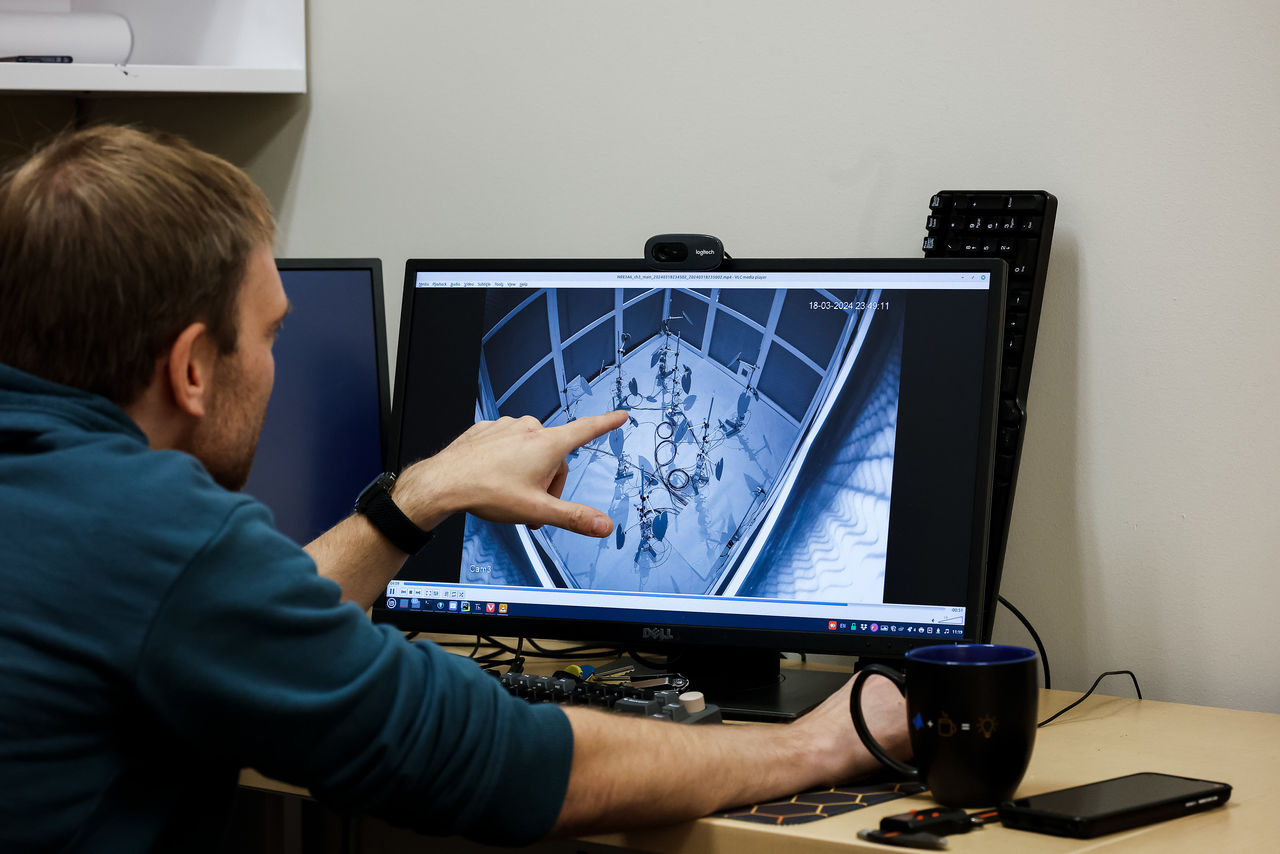
Associate Professor Dieter Vanderelst studies the hunting behavior of a common big-eared bat from video taken in a flight cage in Panama. Photo/Connor Boyle/UC Marketing + Brand
Most bats use echolocation to find food by emitting high-frequency chirps to catch mosquitoes, moths and other flying insects in midair.
But big-eared bats have the ability, extremely rare among bats, to find insects hiding on leaves. Vanderelst said the bats take advantage of the specular reflection effect, in which noise bounces off a surface at the same angle that the sound strikes it.
Vanderelst and his research partners previously demonstrated how the bats can find hiding prey on leaves with sniper-like accuracy in total darkness.

For a bat, dragonflies are like children’s squishy squeeze snacks.
Dieter Vanderelst, UC biologist
Vanderelst witnessed this behavior firsthand at the Smithsonian Tropical Research Institute in Panama where he and his research partners erected a 15-foot-square flight cage and used a suite of night-vision cameras to capture the hunting techniques of wild big-eared bats.
Researchers captured the bats in the late afternoon from known roosts where they spend the daylight hours and released them into a flight cage.
“At first they panic and flutter around, but then they settle down and feed,” Vanderelst said.
The foliage in the flight cage represents a novel landscape that the bats have to navigate to find food, Vanderelst said. And the video demonstrates how the bats take precious little time identifying a target, in this case dragonflies.
“For a bat, dragonflies are like children’s squishy squeeze snacks. They bite the dragonfly’s body and squeeze out the insides,” he said, adding, “It’s not very pretty.”
In the morning after capturing hours of video footage, researchers released the bats back to their daytime roosts.

An autonomous robot mounted with stereo microphones used rudimentary echolocation to find plastic dragonflies without having to scan every leaf, demonstrating how big-eared bats, too, can quickly home in on hiding prey. Photo/Connor Boyle/UC Marketing + Brand
Silent but deadly
Big-eared bats use echolocation sparingly, he said.
“They’re super quiet. You don’t pick up a lot of their calls on microphones,” he said. “They’re called whispering bats because they’re so quiet compared to other bats.”
This probably provides a hunting advantage since some moths and other insects have evolved to hear the frequencies of echolocating bats to help evade them.
“This study nicely shows how you can use robots as physical simulation tools to study the mechanisms behind the behavior of bats,” said co-author Herbert Peremans, an engineering professor at the University of Antwerp.
“It might get us a small step closer to understanding how bats use their sophisticated echolocation system to ‘see’ their world through sound,” added study co-author Inga Geipel, a behavioral ecologist also at the University of Antwerp.
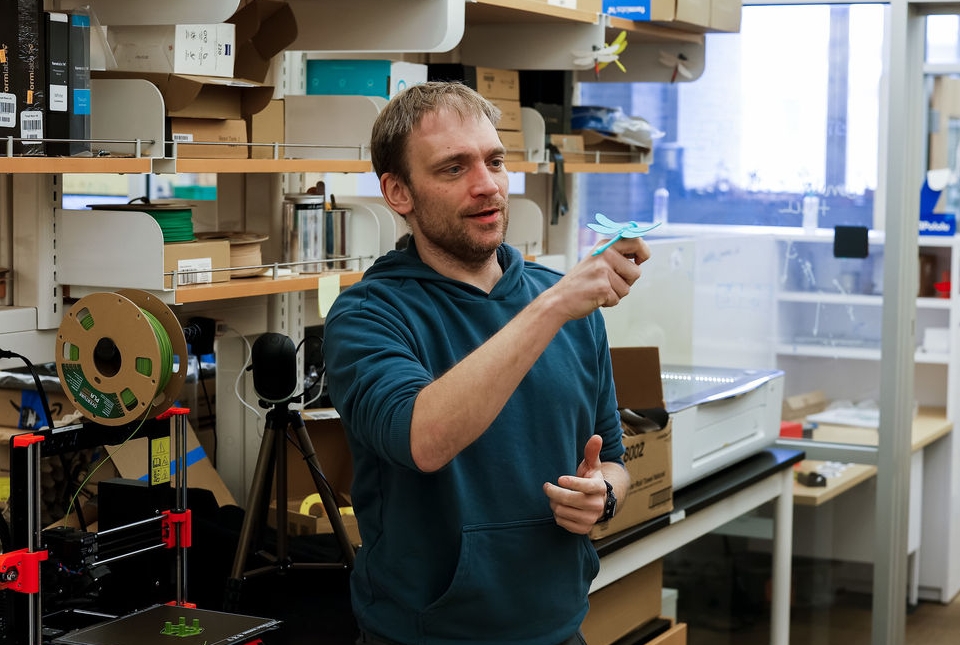
Associate Professor Dieter Vanderelst shows off one of the 3D-printed dragonflies used in the experiment. Vanderelst holds joint appointments in biology, psychology in the College of Arts and Sciences and in mechanical engineering in the College of Engineering and Applied Science. Photo/Connor Boyle/UC Marketing + Brand
Animal-inspired engineering
Peremans has partnered with Vanderelst and other researchers on many studies of bats in his career. They never fail to amaze him, he said.
Previously, Vanderelst and Peremans discovered that huge colonies of bats can share airspace safely without collisions using their echolocating calls in the raucous, crowded confines of a cave opening. They likened this to cooperative signal processing, allowing sometimes millions of bats to come and go in tight spaces without deadly collisions.
“Oh, I have always been a great believer in the remarkable abilities of bats to use echolocation to survive under challenging conditions,” Peremans said.
And their unusual superpowers could hold the key to unlocking new abilities for autonomous systems, he said.
“I believe there is still a lot more to find out about bat sonar,” he said. “In particular, how the combination of signal processing, environmental constraints and bat behavior allows the bat to efficiently deal with the difficult perceptual challenges it is confronted with will remain a treasure trove for engineers for many years to come.”
Featured image at top: UC Associate Professor Dieter Vanderelst used robotics to explore how common big-eared bats find insects hiding in thick foliage. Illustration/Margaret Weiner/UC

UC Associate Professor Dieter Vanderelst is studying how bats use sound to navigate their dark world. Photo/Connor Boyle/UC Marketing + Brand
The next groundbreaking discovery
UC is a powerhouse of discovery and impact as a Carnegie 1 research institution. From pioneering medical research to transformative engineering and social innovation, our faculty and students drive progress that reaches across the world.
Related Stories
How do you study the world’s smallest materials?
June 22, 2026
In a paper published in the journal Nature Materials, University of Cincinnati Assistant Professor Hanxun Jin highlighted advances in ultrasensitive technology to measure and manipulate some of the tiniest nanomaterials used in manufacturing, aerospace, medicine and more.
UC’s research surges with $346M in awards
February 12, 2026
The University of Cincinnati reached $346 million in sponsored research awards in fiscal year 2025, up 6.6% increase over the previous year. Additionally, funding for clinical trials at UC climbed, with $88 million in industry-sponsored awards and $33 million in federally sponsored awards.
Powerful AI can help diagnose substance use disorder
February 5, 2026
A new study by the University of Cincinnati uses a novel artificial intelligence to predict substance use disorder-defining behaviors with up to 83% accuracy.