
Study tests non-opioid treatments for severe post-stroke headaches
UC serves as test site for national trial involving patients recovering from subarachnoid hemorrhage

The University of Cincinnati is a site for a clinical trial testing a new approach to manage severe headaches that occur following subarachnoid hemorrhage (SAH), a type of stroke that accounts for approximately 10% of all strokes and affects 30,000 Americans each year.
Charles Prestigiacomo, MD, is site principal investigator for the BLOCK-SAH trial, sponsored by the University of Florida.
SAH is caused by a brain aneurysm, a tiny point of breakage in a blood vessel similar to a blister on a tire that can appear, grow and rupture. The aneurysm’s rupture leads to bleeding around the brain tissue, and the current standard of care is to prevent the aneurysm from bleeding again by coiling or clipping it.
“Nearly all SAH patients experience headaches of varying intensity, and in about 90%, headaches are severe (scores greater than or equal to 7 on the zero-to-10 numeric rating scale),” said Prestigiacomo, a UC Gardner Neuroscience Institute neurosurgeon and professor and director of cerebrovascular and endovascular surgery in the Department of Neurosurgery in UC’s College of Medicine. “Some will report this as being the ‘worst headache of my life.’”
These persistent headaches are the fourth leading cause of SAH patients returning to the emergency room within one to three months after discharge, so pain control is critical to improving patient outcomes. Currently, the headaches are commonly treated with opioid-based medications.
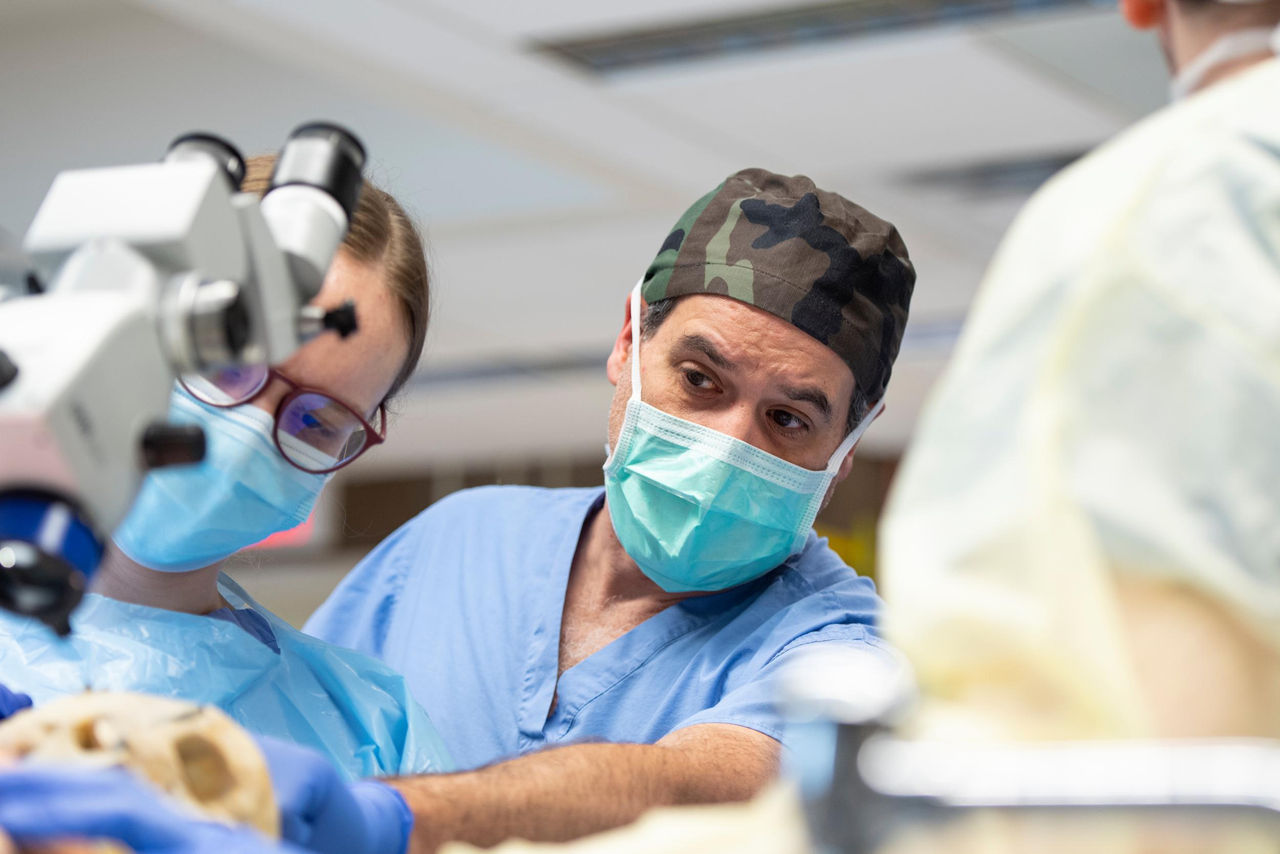
Charles Prestigiacomo, MD, center, works with students during an anatomy of the head and neck course. He is the site principal investigator for the BLOCK-SAH trial. Photo/Colleen Kelley/UC Marketing + Brand.
“Because we all know the dangers of opioid use over time, along with some of its side effects, there has been a desire to minimize — if not move away from — its frequent use,” Prestigiacomo said. “The intent of the study is therefore to reduce or even eliminate the need for opioid usage for the headache pain after the stroke.”
Researchers are testing the drugs ropivacaine (a numbing agent) and dexamethasone (a steroid that reduces inflammation) as a substitute for opioid treatment while patients are still in the hospital following SAH. The drugs will be injected into the pterygopalatine fossa, a space between several bones that make up the base of the skull just over the cheekbone in the face.
The treatment is aimed at targeting a significant nerve center known as the sphenopalatine ganglion and maxillary nerve that controls sensation along the scalp and linings of the brain.
“Several prior studies have shown that by numbing this collection of nerve cells, headaches and their effects are reduced and at times eliminated,” Prestigiacomo said.
Patients will be randomized to one of three treatment arms within the trial, and every patient enrolled will receive the active trial drugs one to two times in a four-day window. When receiving the placebo, patients will receive a saline injection.
If this approach is found to be safe and effective, there will potentially be less opioid use for treatment of these post-stroke headaches.
Charles Prestigiacomo, MD
The primary objective of the trial is to determine how effective the study medications are compared to placebo at reducing opioid use by patients within 24 hours of injection.
Secondary objectives include determining whether the treatment lowers pain intensity scores, assessing the safety and patient tolerability of the technique, and determining whether treatment leads to improvements in various imaging studies of the blood vessels.
Approximately 10 to 12 patients are expected to be enrolled at UC, with approximately 195 patients expected to be enrolled at sites nationwide.
“If this approach is found to be safe and effective, there will potentially be less opioid use for treatment of these post-stroke headaches and pain relief with improvement in pain severity,” Prestigiacomo said.
The next groundbreaking discovery
UC is a powerhouse of discovery and impact as a Carnegie 1 research institution. From pioneering medical research to transformative engineering and social innovation, our faculty and students drive progress that reaches across the world.
For more information on the trial, please contact Alexandra Ramirez at ramiream@ucmail.uc.edu or 513-558-1012.
Featured photo at top of a woman with a headache. Photo/FG Trade/iStock.
Related Stories
UC achieves first-in-world remission of aggressive pituitary tumor with novel immunotherapy
May 13, 2026

Researchers at the University of Cincinnati Gardner Neuroscience Institute’s Brain Tumor Center have been confirmed as the first in the world to achieve complete remission of a rare pituitary cancer using a novel immunotherapy treatment. The findings were published in Surgical Neurology International and recently featured in The Cancer Letter.
UC team first in world to achieve complete remission of aggressive pituitary tumor through immunotherapy
May 4, 2026
Researchers at the University of Cincinnati Gardner Neuroscience Institute’s Brain Tumor Center were the first in the world to achieve complete remission of a rare pituitary cancer using a novel immunotherapy treatment. The case of the complete remission, which had been previously published in the Neurosurgery Journal, was verified as the first in the world with a novel immunotherapy regimen detailed in a new publication in the journal Surgical Neurology International.
New Imaging Research & Development Center opens on UC’s medical campus
May 28, 2026
The University of Cincinnati’s new Imaging Research & Development Center on its Cincinnati medical campus brings UC, UC Health, Cincinnati Children’s, GE HealthCare and JobsOhio together to advance MRI research and accelerate imaging innovation.