
Boosting safety in proton therapy for kids
UC 1819 backed ‘Range Assure’ lowers risks

A new health technology startup emerging from the 1819 Innovation Hub at the University of Cincinnati is tackling one of the most persistent challenges in proton radiotherapy: range uncertainty.
Range Assure was co-founded by four UC professors: Jimmy Stringer, PhD, founder/CTO, inventor, medical physics researcher; Henry Spitz, PhD, professor, scientific advisor, radiation measurement expert; UC alumni Peter Sandwall, PhD co-founder/CEO, medical physicist, entrepreneur, global health imaging leader; and UC professor emeritus, Michael Lamba, PhD, medical physicist, radiation oncology.
TEM-plate for success

Jimmy Stringer, PhD, CTO, Range Assure founder, inventor, proton radiotherapy researcher. Photo/Range Assure
The co-founders participated in and recently graduated from the UC Venture Lab accelerator program housed within the 1819 Innovation Hub.
Building on the expertise gained through this program, the team has focused its efforts on a next-generation evolution of existing calibration phantoms used in proton radiotherapy. In medical imaging and radiation therapy, a phantom is a physical model of a patient's internal organs made of tissue-equivalent material, or TEMs.
“We typically use polyurethane with additives to build TEMs that mimic the radiometric characteristics of human tissue. We verify the TEMs design by measuring its radiometric performance against published human radiometry data," says Stringer. "This allows us to validate the efficacy of our design of our TEMs and apply data to patient treatments.”
This emphasis on precise modeling is crucial, as new technologies and safety systems cannot be tested directly on humans until they are proven safe. Consequently, researchers rely on physical models to simulate real-world conditions and to help predict and improve outcomes.
A crash-test dummy is a human stand-in used to measure automobile safety. Biomedical engineers use materials that replicate a human driver. They measure bone stiffness, muscle density and proportions to evaluate joint movement, positioning and impact during crash testing.
Similarly, a phantom model mimics human anatomy during radiation treatment. It allows safe planning, such as choosing proton beam entry angles and paths to the organ.
Sharpening proton accuracy
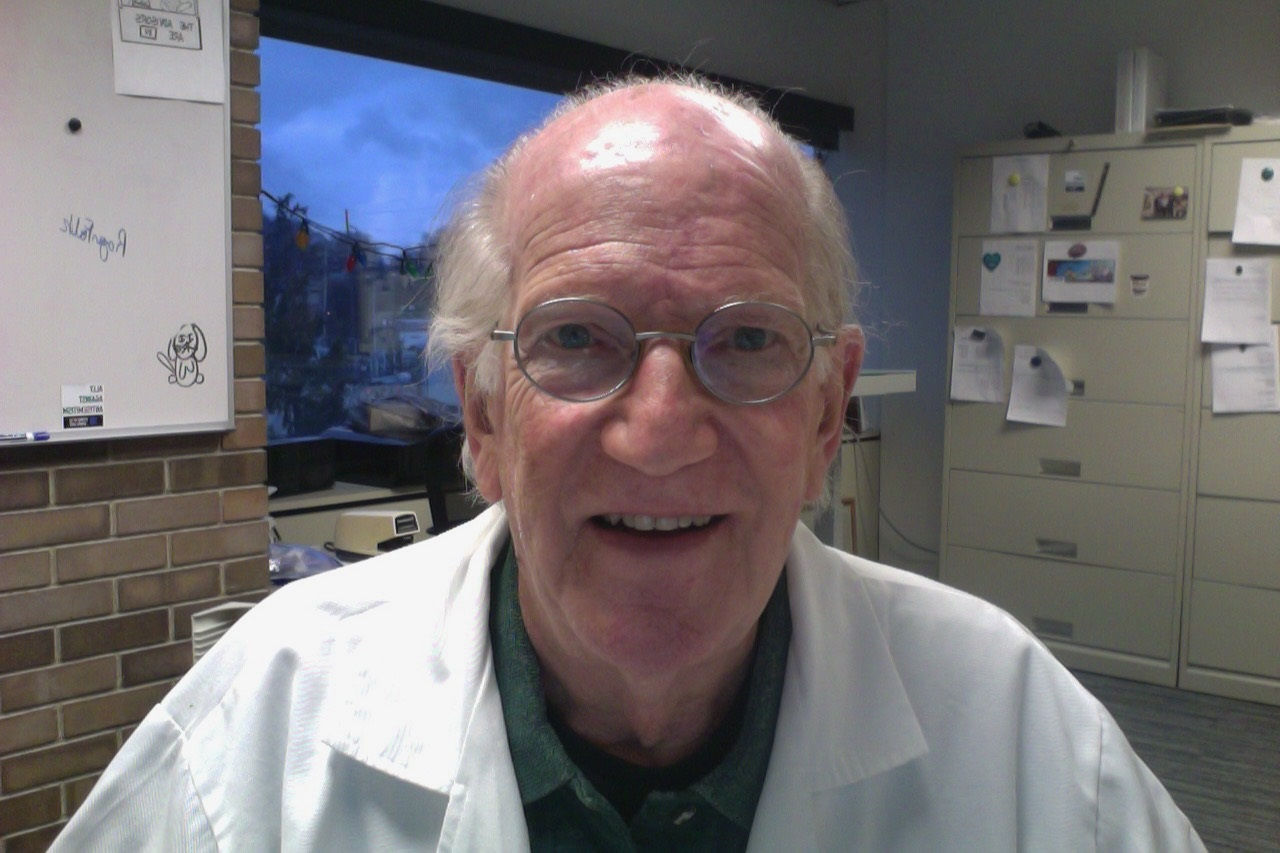
Henry Spitz, PhD also serves as scientific advisor. Photo/Range Assure
“Instead of using a smooth, one-size-fits-all model, our phantom is designed to match the actual structure of the human body,” said Spitz. “It enables us to duplicate patient radiation measurements more precisely, reducing the chance of error.”
Range Assure’s anthropomorphic calibration phantom makes it more human-like than current models.

(Photo 1) CT imaging of the pelvis is reflected in Range Assure's human-like phantom model, which replicates the patient's anatomy. Photo/Range Assure
In addition to helping convert CT scan data into more precise proton radiotherapy plans, this phantom's stopping-power ratio (SPR) enhances both accuracy and safety. Compared to older, less realistic models, Range Assure’s is widely valued for its ability to target tumors with ultraprecision and certainty, depositing most of its energy at a specific depth known as the Bragg peak.
However, uncertainty in predicting the exact peak location often forces clinicians to expand treatment margins, unintentionally exposing more normal tissue to radiation.
Children are much more radiosensitive, so reducing exposure to healthy tissue can have lifelong benefits.
Jimmy Stringer, PhD, Founder, Range Assure
Measurements matter

UC professor emeritus, Michael Lamba, PhD, medical physicist, radiation oncology. Photo/Range Assure
Lamba, co-founder of Range Assure, explained, "Proton range uncertainty increases the amount of healthy tissue treated during therapy. This limits the benefits that proton therapy provides. To address this issue, our phantom, a test device that simulates human tissue and realistic anatomy, is designed to reduce that uncertainty."
Traditional calibration phantoms are typically smooth, oval-shaped, and made of uniform materials, failing to reflect the complexity of the human body. By contrast, Range Assure’s solution is designed to mimic the human male pelvis, closely mirroring how radiation interacts within real bodies and supporting more confident treatment planning.
Built to mimic the human body
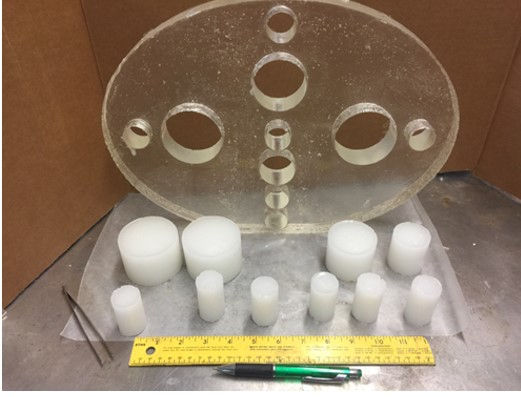
Range Assure shapes its phantom models using multiple methods, including CT imaging (Photo 1). Inside the clear disc, the white cylindrical material, or TEMs, is accurately arranged to mimic the tissue composition and anatomical dimensions of organs in the pelvis. Photo/Range Assure
This lifelike matching of organ makeup, shape, and layout lets you see how Range Assure’s phantom empowers clinicians to predict with greater confidence where proton radiation will stop in the body.
Imagine holding a material that feels human-like. That's the goal the founders pursued when they developed an optimization algorithm to determine the precise ratios of plastics and additive materials needed to replicate different tissue types.
To make all this possible, the team tackled the demanding task of building a vast library of radiation interactions for every material. This technical feat now forms the core of the company’s patented innovations.
Meaningful impact for pediatric patients
Photo/floridaproton.org
If the material properties are incorrect, this can alter the CT unit's calibration, affecting dose delivery to the patient.
What sets Range Assure apart is not just the materials used, but how they are arranged.
This novel discovery has important clinical implications. “This is especially impactful in pediatric radiation therapy,” Stringer noted. “Children are much more radiosensitive, so reducing exposure to healthy tissue can have lifelong benefits.”
With this approach, the potential benefit to patients is significant. While radiation therapy is effective at destroying cancer cells, it also damages non-cancerous tissue. By reducing range uncertainty, the Range Assure phantom allows clinicians to tighten treatment margins and spare healthy cells.
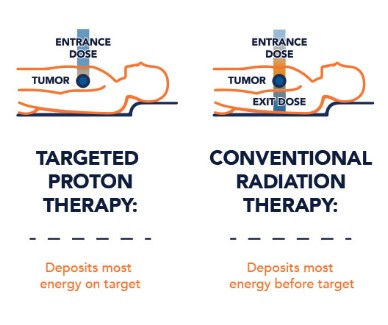
Traditional radiation therapy (photon/X-ray therapy) uses high-energy X-rays that pass through the body, depositing radiation along their entire path before, through, and after the tumor. Proton beam therapy uses charged protons, which have a unique physical property called the Bragg Peak that releases most of their energy at a specific depth, stopping just beyond the tumor.
Range Assure’s primary customers are hospitals and radiation oncology clinics that offer advanced cancer treatment. The team is currently reaching out to Cincinnati Children’s Hospital as a potential initial clinical collaborator.
From research to real-world application

Geoffrey Pinski, Vice President of UC Technology Transfer. Photo/Greg Glevicky
The UC Office of Technology Transfer partnered with Range Assure to secure a U.S. patent. With a functional prototype, the technology demonstrated promise in preclinical tests. The team is now advancing toward clinical trials, sharpening protocols and actively engaging early adopters to drive clinical implementation.
Reflecting on the project’s progress, Geoffrey Pinski, vice president of technology transfer, said, “This is exactly how university research is meant to work. When discoveries move from the lab to patented technologies and into the market, they create real-world impact, strengthening industry, advancing patient care and ultimately improving outcomes for the communities we serve.”
Subsequent iterations are expected to be customized for specific anatomical sites and tailored to patient age, size, bone density, and other relevant factors, thereby facilitating personalized, precise radiation therapy.
Powered by the UC 1819 Innovation Hub

UC 1819 Innovation Hub. Photo/Greg Glevicky
Range Assure cofounders credit the Venture Lab accelerator with helping them transition from research to commercialization. As part of the inaugural cohort, they benefited from mentorship, peer learning, and support from the technology transfer team.
“One of the biggest takeaways was understanding how to value the company and deciding whether to license the technology or manufacture the phantoms ourselves,” says Stringer. “Those conversations were eye-opening and critical for our next phase.”
As a result of these important insights and continued support, Range Assure has received grant funding from both the Nuclear Regulatory Commission and the 1819 Innovation Hub. This funding enables the startup to expand its team and infrastructure as it prepares for broader market adoption of its technology, positioning the company for continued growth.
Range Assure connects with early adopters; the founders believe their technology could become the global standard for proton therapy calibration.
Looking ahead

Peter Sandwall, PhD, CEO, Range Assure. Photo/Range Assure
Sandwall emphasizes the phantom’s technology, agility and customizability. Range Assure is open to collaboration and committed to ongoing development, signaling confidence in the technology's future advancement.
With a strong scientific foundation, institutional support from UC and a clear clinical need, Range Assure represents a promising step toward making cancer treatment safer, more precise and more patient-centered. “We invite healthcare partners, researchers and stakeholders to join us in advancing this vital technology,” said Sandwall.
Located in the Cincinnati Innovation District, the 1819 Innovation Hub serves as a corporate meeting place and startup incubator, reinforcing its position as a regional center of innovation.
Featured photo of a radiation therapist preparing patent for proton therapy treatment. Photo/Cincinnati Children’s Medical Center
Innovation Lives Here
The University of Cincinnati is leading public urban universities into a new era of innovation and impact. Our faculty, staff and students are saving lives, changing outcomes and bending the future in our city's direction. Next Lives Here.
Related Stories
UC 1819-backed startup Sense Neuro fueled by $17 million
September 29, 2025
Neurocritical care startup Sense Neuro Diagnostics has become one of Cincinnati’s startup success stories due to collaboration between UC’s Venture Lab, Alloy Growth Lab and other regional entities.
Fences down, human-robot collaboration up for Sensory Robotics
June 18, 2026
Sensory Robotics gained a critical UL certification, enabling the Cincinnati-based business to install its innovative SR-1 robots on working factory floors.
Seven common startup challenges and how to solve them
April 3, 2025
Launching a new business isn’t an easy endeavor, but it’ll be simpler for entrepreneurs who consider common startup challenges and plan out ways to solve them.