
Empowering nurses to lead healthcare innovation

For Melissa Cheeks, DNP, RN, innovation begins where nursing has always lived: at the bedside, on the front lines where challenges take shape.
After nursing school, she worked in the surgical intensive care unit at The Christ Hospital, caring for critically ill patients and their families. While she loved patient care, she knew she wanted to influence change on a broader scale.
“In the ICU, you’re impacting one or two patients and their families at a time,” Cheeks says. “I wanted to impact nursing on a broad scale, and I knew that to do that I had to be positioned within a large organization.”
That clarity led her to Johnson & Johnson’s Ethicon Endo-Surgery division, where she transitioned from bedside nursing into industry, initially while still working weekends in the hospital. “I wasn’t sure I was ready to leave patients, so I did both.”
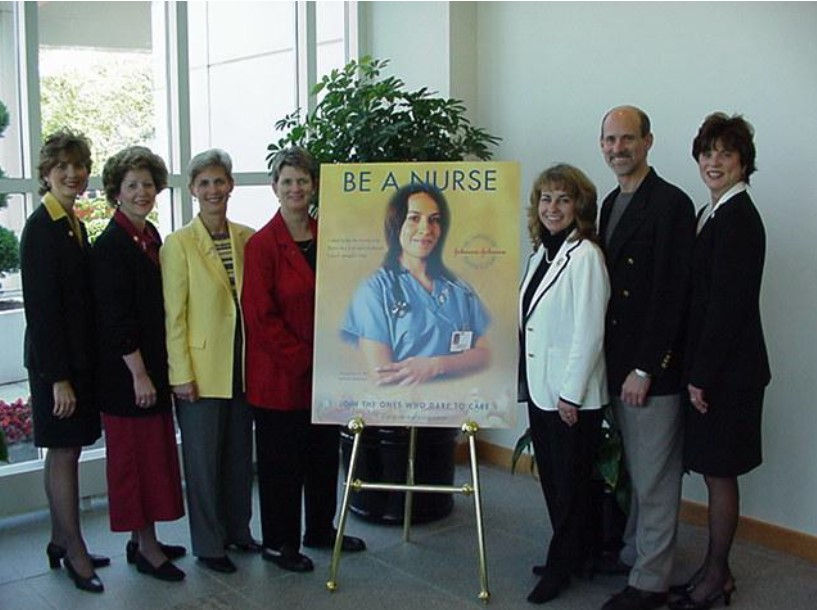
Leaders from AACN, AORN, and ANA gathered at the inaugural Ethicon Endo-Surgery Nursing Forum, organized by Cheeks (extreme left) and UC alumna Karen Kilgore (extreme right).
At the time, the only nursing role available at the company was in a clinical call center supporting operating rooms in real time. Within months, her clinical insight stood out, and she was pulled onto a cross-functional innovation team as the clinician responsible for “protecting the voice of the clinical customer.”
“That was my first real taste of innovation,” Cheeks recalls. “Working on something that didn’t exist yet and making sure it actually worked in the real clinical environment and addressed an unmet clinical need.”
Her ability to translate clinical reality into business decisions quickly became invaluable. That perspective, as well as the trust she built as a clinician, helped Cheeks convert the first million-dollar direct distribution competitive account for Johnson & Johnson.
Bridging innovation and academia
Over more than a decade at Johnson & Johnson, Cheeks worked across professional education, clinical sales and marketing. She helped launch the company’s first education program designed specifically for C-suite executives, anticipating the shift toward value-based care.
Later, she led surgical simulation strategy across seven operating companies and helped develop the first minimally invasive colorectal surgical simulator. Throughout it all, nursing remained her anchor. “If I make life better for nurses and doctors, that makes life better for patients.”
After corporate restructuring prompted a potential relocation, Cheeks transitioned into consulting, advising startups and global healthcare organizations alike.
“The start-ups had great ideas, but they didn’t know how to navigate healthcare systems, business strategy, or innovation at scale. My experience at a large multinational healthcare company provided insight and value for my clients.”
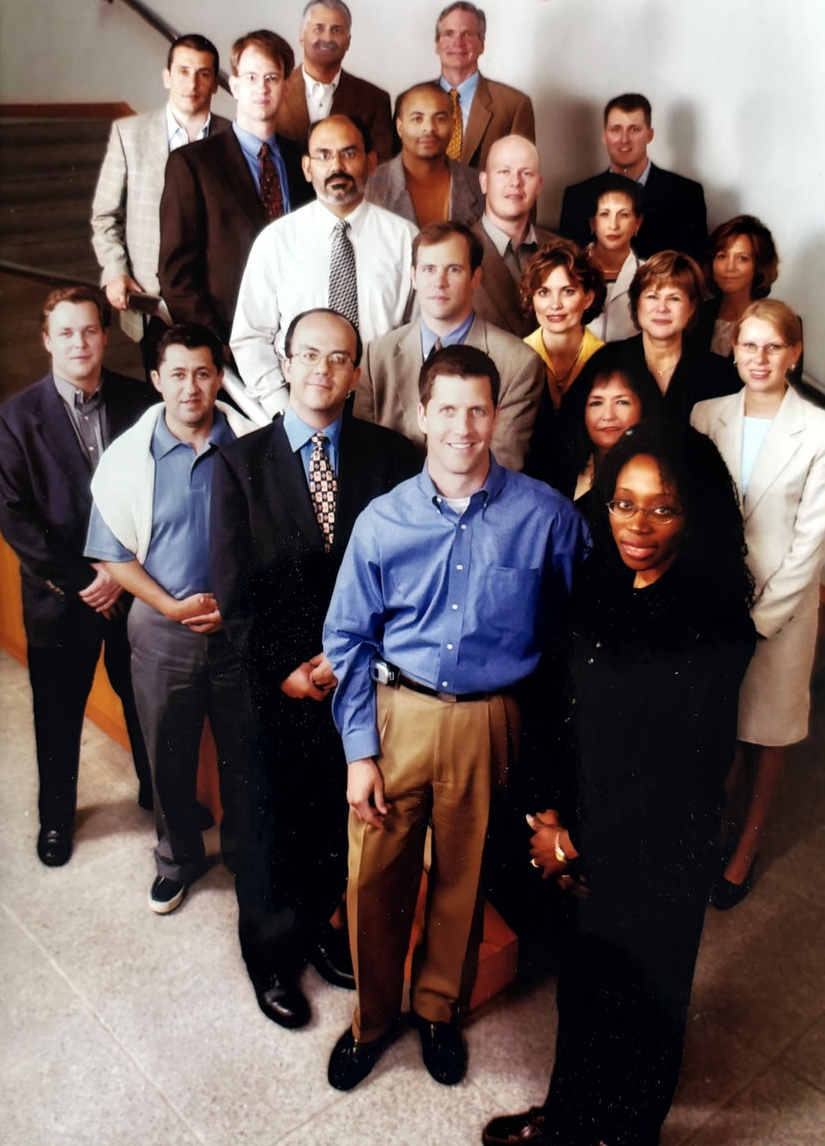
Cheeks (in yellow), then American Society for Metabolic and Bariatric Surgery President Dr. Alan Wittgrove and bariatric surgery fellows from across the country in 2003.
As Cheeks began planning for the next phase of her career, the realization that nursing students weren’t being prepared to innovate led her back to academia. She earned a master’s degree in nursing with a focus on healthcare administration and a Doctor of Nursing Practice in executive leadership from Duke University, then returned to UC determined to help build something new.
Since becoming the College of Nursing’s Joan and Mark Hurray Professor of Innovation & Director of Nursing Innovation, Cheeks has ensured innovation at the college remains connected to real-world demands by assembling an advisory board that bridges academia, industry, startups and healthcare leadership.
She has created events that build awareness and momentum around nursing innovation, including a visiting professor lecture series at the 1819 Innovation Hub. From there, Cheeks began forming partnerships the same way she did in industry—by knocking on doors, sharing the College of Nursing’s innovation strategy and inviting collaboration.
Those efforts culminated in a slate of webinars and CNO round tables featuring nationally recognized leaders such as innovation author and speaker Rebecca Love, RN, MSN, FIEL, and Oriana Beaudet, DNP, RN, FAAN, vice president of innovation at the American Nurses Association Enterprise.
Making nurse-led innovation accessible
In Spring 2026, Cheeks is taking a deliberate step to make nurse-led innovation more accessible and feasible by leading the launch of and directing UC’s Nurse-led Innovation Certificate program.
“The certificate gives nurses structure on how to evaluate an idea, how to move it forward, who to involve.”
The program—offered in partnership with UC Lindner College of Business—is designed to be practical, flexible and deeply connected to real-world healthcare challenges. “This isn’t just about creating products,” she says. “It’s about care model innovation, workflow redesign, advocacy and systems thinking.”
Cheeks, who also teaches at the college’s Systems Leadership programs, envisions health systems sponsoring nurses to participate. Innovation, she believes, doesn’t pull nurses away from patient care—it amplifies it.
“Nurses see problems every day and just need the tools and permission to fix them,” she says. “But we can’t do this in isolation, we need the right mindset and partnerships.”
Featured image: Melissa Cheeks in front of UC College of Nursing's Procter Hall. Photo: Connor Boyle/UC Marketing + Brand.
Related Stories
UC College of Nursing climbs into the top 20 Best Online Master’s in Nursing Programs
January 27, 2026
The University of Cincinnati College of Nursing continues to be recognized among the nation’s top schools for online graduate nursing education. In the 2026 U.S. News & World Report rankings, UC Nursing is ranked No. 19 Best Online Master’s in Nursing Program, placing the college among the top programs nationwide and No. 3 in Ohio.
UC launches Bearcats Affordability Grant
January 7, 2026
The University of Cincinnati is making college more attainable for students across Ohio with the creation of the Bearcats Affordability Grant. The new grant will provide a pathway to tuition-free college for students of families who make less than $75,000 per year. Beginning in fall 2026, the Bearcats Affordability Grant will cover the remaining cost of tuition for Ohio residents who are Pell eligible.
University of Cincinnati's online programs earn 16 US News rankings
January 27, 2026
The University of Cincinnati's online programs have earned 16 recognitions from U.S. News & World Report.