
Yahoo! News promotes UC botanist's solution for honeysuckle
Getting rid of invasive bush is no easy task, naturalists say

Yahoo! News shared an herbicide-free technique of eliminating invasive honeysuckle that was developed by a University of Cincinnati botanist.
UC College of Arts and Sciences Professor Denis Conover has been helping parks battle nonnative invasive species across the United States by studying which methods work best for long-term eradication.
Amur honeysuckle can be especially persistent because it's labor-intensive to remove. This hardy flowering shrub is outcompeting many native plants because it produces so many seeds and has a prolonged growing season late into the fall.
“Not very many caterpillars eat honeysuckle leaves. It’s a big pest. It can become so dense that not even tree seedlings can regenerate underneath it,” he said.
“So you might have some native trees poking up above the canopy. But once those trees die, that’s it. They’re not regenerating. Eventually, you could have an entire monoculture of Amur honeysuckle where once there was a complex ecosystem of native deciduous forest.”
Conover said cutting the plant's woody shoots down to the stump provides no guarantee of eliminating it because honeysuckle typically produces fresh shoots from its cut base.
Traditionally, the solution has been to apply herbicides to the exposed stumps to kill the plant. But these chemicals can kill desirable plants and insects as well and end up in waterways where they can also harm aquatic life.
Conover developed a simple solution. He covers the cut stumps with black plastic garbage bags that he pins to the ground with landscaping stakes, depriving the stump of the sunlight it needs to regenerate.
The system is simple, low-cost and effective, he said. And once the honeysuckle is dead, the plastic can be removed and reused.
Conover recommends planting native bushes or trees in its place to help prevent honeysuckle from taking hold again.
Featured image at top: UC Professor Denis Conover holds up an acorn to plant in place of honeysuckle he removed from a patch of forest. He is perfecting chemical-free ways to eliminate Amur honeysuckle. Photo/Andrew Higley/UC
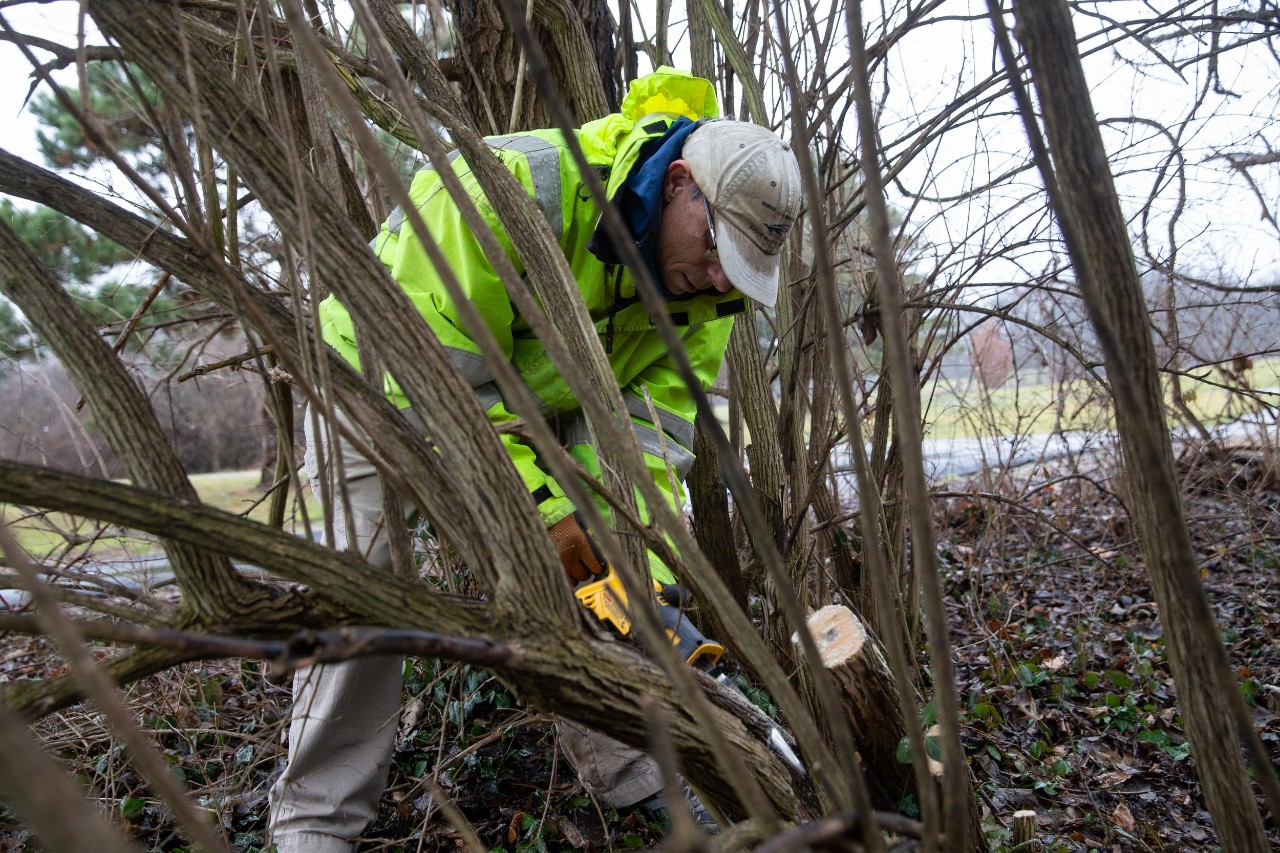
UC Professor Denis Conover saws down a honeysuckle bush. He has been experimenting with herbicide-free methods for removing the pesky invasive species. Photo/Andrew Higley/UC
Related Stories
Wired: Is psychedelic therapy bubble about to burst?
September 9, 2022
UC postdoctoral researcher Nese Devenot talks to Wired magazine about challenges facing psychedelic therapies.
Is your garden in need of drought relief?
September 26, 2024

UC Professor Theresa Culley takes listener questions about gardening and the drought on WVXU's Cincinnati Edition.
UC experts’ Maya research featured in Cincinnati Museum Center exhibit
July 28, 2020
The Cincinnati Museum Center officially opened Maya: The Exhibition last week, and with it a hands-on companion exhibit developed by an interdisciplinary team of Maya experts from the University of Cincinnati College of Arts and Sciences. Originally slated for a March 14 opening, the exhibits were shuttered until late this month after the state lockdown resulting from the novel coronavirus pandemic. In its U.S. premiere, the exhibit features more than 300 original objects—from massive, carved-stone slabs to elaborate jade jewelry to tools and everyday items—that explore Maya culture. From 1000 BC to 1500 AD, Maya civilization spanned the jungles of Mexico, Guatemala and Belize, noted for its innovations in science, agriculture, astronomy and mathematics.