
Meet the startup ventures elevating Cincinnati’s scene
Startup founders filled 1819 for Venture Lab Demo Day

A full crowd filled the University of Cincinnati’s 1819 Innovation Hub as entrepreneurs took their marks to pitch their technologies.

Attendees during Venture Lab Demo Day. Photo/Gregory Glevicky
Savvy investors leaned forward, business-minded students took notes and community members buzzed with anticipation in mid-April during the Venture Lab's spring 2026 Demo Day. The event capped the Venture Lab Accelerator program, where eight intense weeks of building, testing and refining ideas culminated in high-stakes first impressions for entrepreneurs.
Ideas presented ranged from car accident prevention tools to robots designed to make factory floors safer. The clock ticked as teams were limited to just six minutes in the spotlight. Each cohort had one shot to win over the room and walk away with potential funding, connections and feedback to move their ventures to the next phase.
Discover six innovative startups from Venture Lab Demo Day powering Cincinnati’s rise as one of the Midwest’s entrepreneurial hotbeds.
Team members: Isaiah Clifford and Samarth Edlabadkar
Approximately 6.18 million car accidents were reported across the U.S. in 2024, causing 2.42 million injuries and leading to 39,254 deaths. These statistics, as recorded by the National Highway Traffic Safety Administration, reveal an unsettling truth: The road remains a risky place.
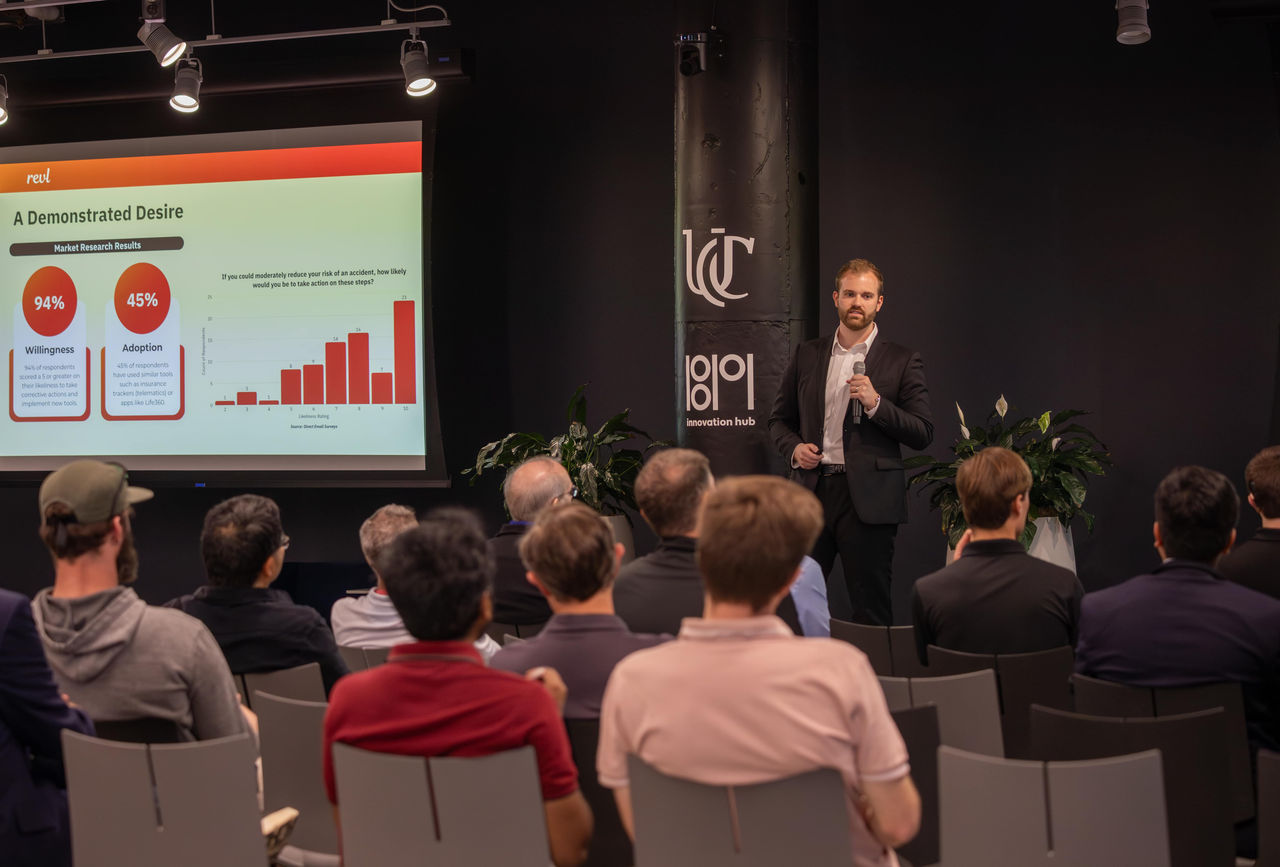
Clifford presenting at Demo Day. Photo/Mary Dwyer
Revl, a Cincinnati startup co-founded by UC alumnus Isaiah Clifford and Bearcat undergraduate Samarth Edlabadkar, wants to help change that. The company’s mission is to “help drivers get home safe by reducing the frequency and severity of traffic accidents with technologies that connect transportation and mobility.”
Tools such as Life360 and Samsara aim to improve safety behind the wheel, but Clifford says Revl offers a more comprehensive mix of low-distraction, predictive technologies:
- Risk mapping: Discover where on your route car accidents are most likely to occur.
- Real-time risk assessment: Get tailored insights on car crash risks based on your driving behaviors.
- Safer routes: Find alternative ways to get where you’re going on lower-risk roads.
- Predictive intervention: Employ real-time preventive measures to travel with less risk.
- Live dashboard metrics: Learn how you can drive more safely while you’re still on the road.
Rather than just flagging hazards that already exist, Revl is built to spot patterns early and warn drivers before danger turns serious.
Team members: Tessa Manuszak and Evan Moore
Most companies juggle multiple software products that don’t always work well together, leading to what is known as “integration technical debt.” Businesses often patch those gaps with shortcuts and workarounds, but those fixes usually create new problems later.

Open Prem CEO Tessa Manuszak presenting. Photo/Mary Dwyer
Technical debt accounts for between 21 and 40% of the average organization’s IT spending, according to Deloitte’s 2026 Global Technology Leadership Study. Open Prem wants to help cut that burden down.
Its open-source technology helps teams connect applications into a more unified software environment. The result is less technical debt, more operational clarity and a smoother path to efficiency.
Open Prem has an ambitious vision: “A world where software is freely accessible to machines and humans addressing unique challenges, creating a new era of software that will accelerate the advancements of all humanity.”
By bringing company tech stacks together, Open Prem aims to give organizations a stronger foundation for growth. The 1819 coworking partner and Venture Lab graduate is also building the tools to make that vision possible.
Team members: Richard Harknett and Kathryn Harknett
The average data breach cost U.S. companies over $10 million in 2024, according to a report by the Ponemon Institute. That was a 9% increase from the prior year, making the case for stronger cybersecurity habits even harder to ignore.
Yet many organizations still rely on training that feels more like a box to check than a lesson that sticks. That mindset leaves the door open to costly mistakes when a single click or careless reply could hand sensitive data directly to malicious actors.
Persistent Cyber Improvement (PCI) believes there's a better way: turn cybersecurity training into a game that pushes employees to identify possible threats before they happen. The gamified model uses competition and fun to build the kind of vigilance businesses desperately need.

Harknett presenting at Demo Day. Photo/Mary Dwyer
Confidence in PCI’s game is well placed as it prepares for a nationwide digital rollout. The effort is backed by co-founder and CEO Richard Harknett, a University of Cincinnati professor with more than three decades of cybersecurity experience. He served as the first scholar-in-residence at U.S. Cyber Command, co-directs the Ohio Cyber Range Institute and chairs UC’s Center for Cyber Strategy and Policy.
Harknett’s model of “persistent engagement,” reflected in PCI’s game, serves as a key cybersecurity doctrine for the U.S. government and military along with others around the world. He believes private businesses should adopt the same mindset through proven techniques built into PCI’s role-playing game.
Today, cybersecurity matters more than ever for businesses. As Harknett says, “They do not quit; neither can you.”
Team members: Emilio Sese, Jaran Chao and Jaydee Lorenzo
Organized events can be incredible experiences, unless you’re the one making them happen behind the scenes. In that case, they’re all too often stressful, costly and chaotic.
Kloob takes some of that pressure off by offering a unified tech stack that brings event planning resources into a single app. With Kloob, planners can delegate tasks, communicate with other organizers and track engagement analytics all in one place.
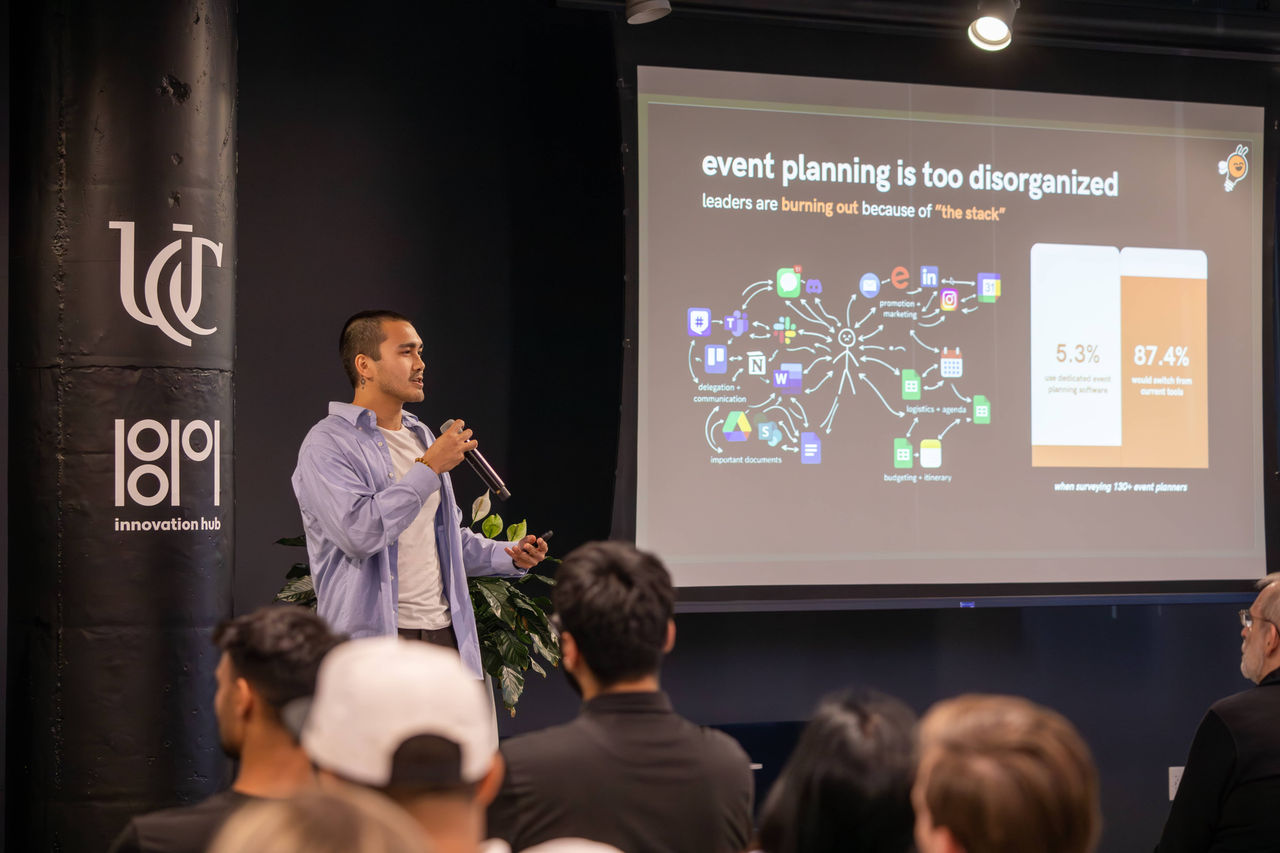
Sese presenting at Demo Day. Photo/Mary Dwyer
CEO and Bearcat graduate Emilio Sese brings more than a decade of event planning experience to the startup. He served as founding president of UC’s Society of Asian Scientists and Engineers, president of the Pinoy American Student Organization and community chair for the UC Health Sciences Club. More recently, he coordinated more than 350 helpers as volunteering committee lead for Asianati, which hosts Cincinnati’s Asian Food Fest and the Night Market during BLINK.
Sese understands exactly what works, and what does not, for today’s event planners. Kloob turns that experience into a single platform that simplifies the process and gives planners room to focus on the event itself.
Team members: Broder Schmidt and Maobing Tu
Biofuels, energy sourced from plants and animals, accounted for over 55% of all consumption of renewables in the U.S. in 2025, according to the Energy Information Administration. They produce less carbon dioxide than fossil fuels and are relatively easy to source since they come from wood, agricultural crops and waste materials. Ethanol is the most common biofuel.

Athanex CEO Broder Schmidt presenting. Photo/Mary Dwyer
The challenge is that much of biofuels’ potential energy is lost during extraction due to toxic inhibitors that eat away at the sugars needed to produce energy. That “inhibitor tax” lowers yields from biomass and cuts into producers’ margins.
Enter Athanex. The startup adds protein scavengers to biomass before extraction, neutralizing harmful toxic inhibitors and helping companies capture more of the energy already inside the material. Less energy is lost during ethanol production, meaning greater value for producers.
Ethanol is cleaner than fossil fuels and easy to source. Athanex helps remove one of the biggest obstacles standing in the way of a more efficient and economical biofuels industry.
Team members: Chris Edwards, Tristan Fogt and Mark Gagas
Robots are no longer just the future. In manufacturing facilities around the world, they’re already here. But human-robot collaboration is not always seamless or safe without advanced technology, which Sensory Robotics offers.
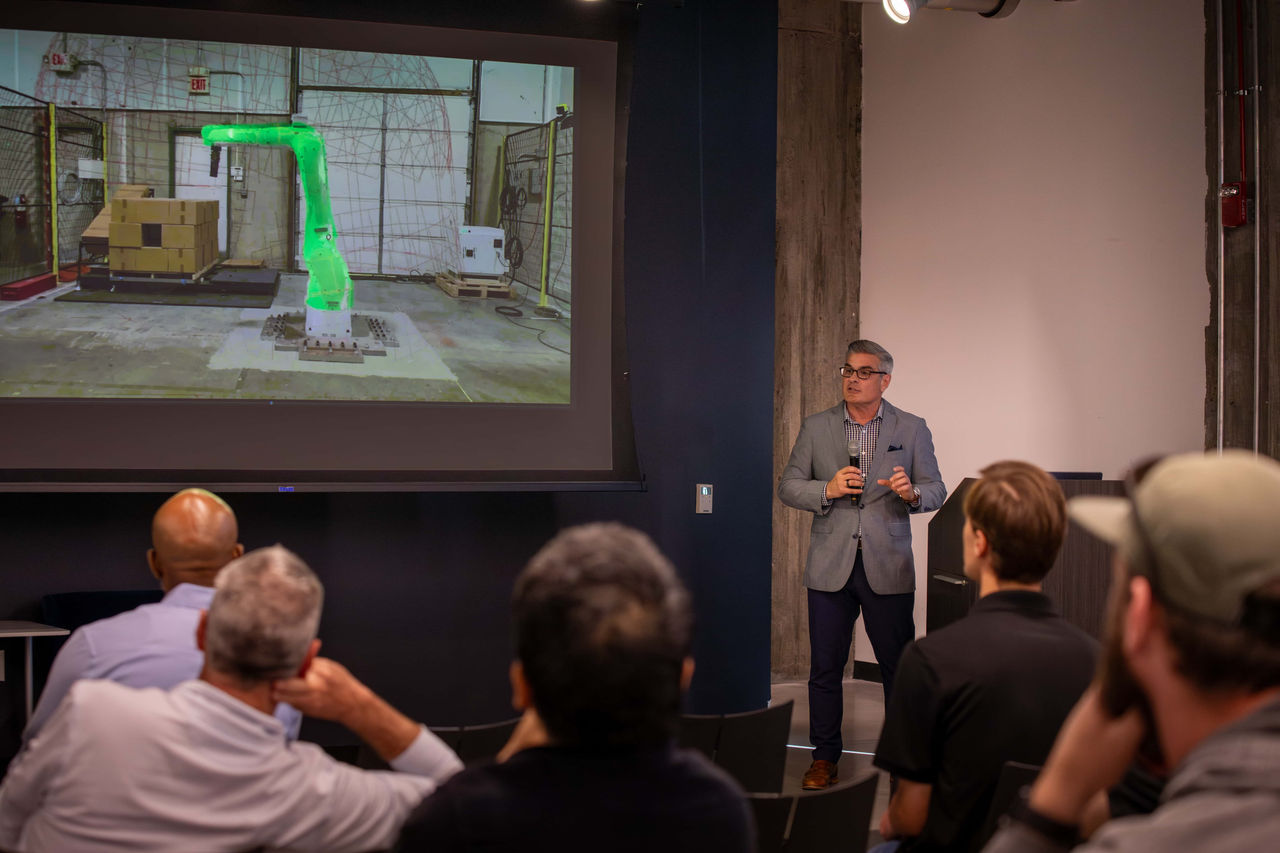
Sensory Robotics chief operating officer Mark Gagas presenting. Photo/Mary Dwyer
The company, based at UC’s 1819 Innovation Hub, is working to create “a new safety standard for human-robot collaboration.” That vision shows up in its first product, the SR-1, which removes the need for the fencing traditionally used to protect workers from robots on factory floors.
The SR-1 automatically pauses robot activity when a person enters its proximity, reducing injury risks while keeping production moving. Sensory Robotics says current forms of robot safeguarding require 7 1/2 minutes of downtime, while the SR-1 reduces that to 2 1/2 minutes.
Traditional fencing around robots also takes up valuable floor space. According to Sensory Robotics, the SR-1 can free up that 30% of factory floor area for more productive uses instead.
With its innovative technology, Sensory Robotics is shaping the future of manufacturing while improving workers’ safety and productivity today.
Where startups take off
The 1819 Venture Lab is Cincinnati’s leading startup accelerator, giving teams entrepreneurial guidance and valuable connections that help them grow. It also provides access to the largest pool of nondilutive funding in the region.
Dr. Kesha Williams, a Venture Lab graduate and the founder and CEO of feminine care products startup Cool Comforts, gave testimony about the program's value during the event. She would know – her company's VPod recently gained a "golden ticket" from Walmart, giving it access to shelves across the U.S.
Demo Day did more than showcase what these teams gained during the latest Venture Lab cycle; it reinforced Cincinnati’s place as one of the Midwest’s top entrepreneurial hubs. From 1819, located at the center of the Cincinnati Innovation District, these founders showed that the Queen City is where big ideas get a real shot at taking off.
Featured image at top: Venture Lab spring 2026 cohort and program graduate Kesha Williams at Demo Day. Photo/Stephen Kenney
Innovation Lives Here
The University of Cincinnati is leading public urban universities into a new era of innovation and impact. Our faculty, staff and students are saving lives, changing outcomes and bending the future in our city's direction. Next Lives Here.
Related Stories
Cincinnati’s healthtech startups soar with state funding
March 6, 2026
Four Cincinnati-based healthtech startup ventures earned significant grants from the state of Ohio, fueled by expert guidance and resources at UC’s 1819 Innovation Hub.
Highlights from UC Startup Weekend
February 4, 2026
Entrepreneurial students raced the clock and each other during UC Startup Weekend, a high-energy three-day hackathon where teams competed for up to $5,000 in prizes.
Students crack investors’ playbook through venture capital competition
April 2, 2026
The world’s largest venture capital competition came to the University of Cincinnati in late February, letting students be VCs for a day and giving startups a chance to sharpen fundraising skills.