
Solving real-world problems with AI
Co-op experiences help sharpen UC computer science graduate’s focus

A downtown Cincinnati, Ohio brawl that went viral last summer sparked a lot of conversations on ways to prevent similar disturbances.
For Arvish Pandey, then a computer science major at the University of Cincinnati, the answer seemed to lie in the use of artificial intelligence to better assess risk and prevent harm to the public.
It became the subject of a research project dubbed “HORIZN” that Pandey and fellow computer science student Mikhail Nikolaenko presented at UC’s College of Engineering and Applied Science ’26 Expo in April. They developed an AI-powered city response platform to improve community safety through early detection and timely alerts.
“I began to think more seriously about how AI in infrastructure could help people understand risk in real time and help emergency responders and [telephone] operators work more efficiently,” explains Pandey, who graduated with his bachelor’s degree in May and is now finishing his master’s degree in business administration from UC’s Carl H. Lindner College of Business.
The system they created uses multi-stage models to identify patterns associated with potential public safety threats and also monitors weather conditions to provide alerts for natural hazards. HORIZN would use open source intelligence — that’s information publicly available — along with video-based feeds which use cameras for traffic, public safety and emergency management.
“With the Cincinnati brawl scenario, we noticed there were specific problems that our project could address,” explains Pandey. “Several minutes into the brawl, and nobody called for help. There was a police patrol car, according to news sources, that was six minutes away. A huge crowd gathered near a music festival, and we were wondering how we can fix these issues with AI?”
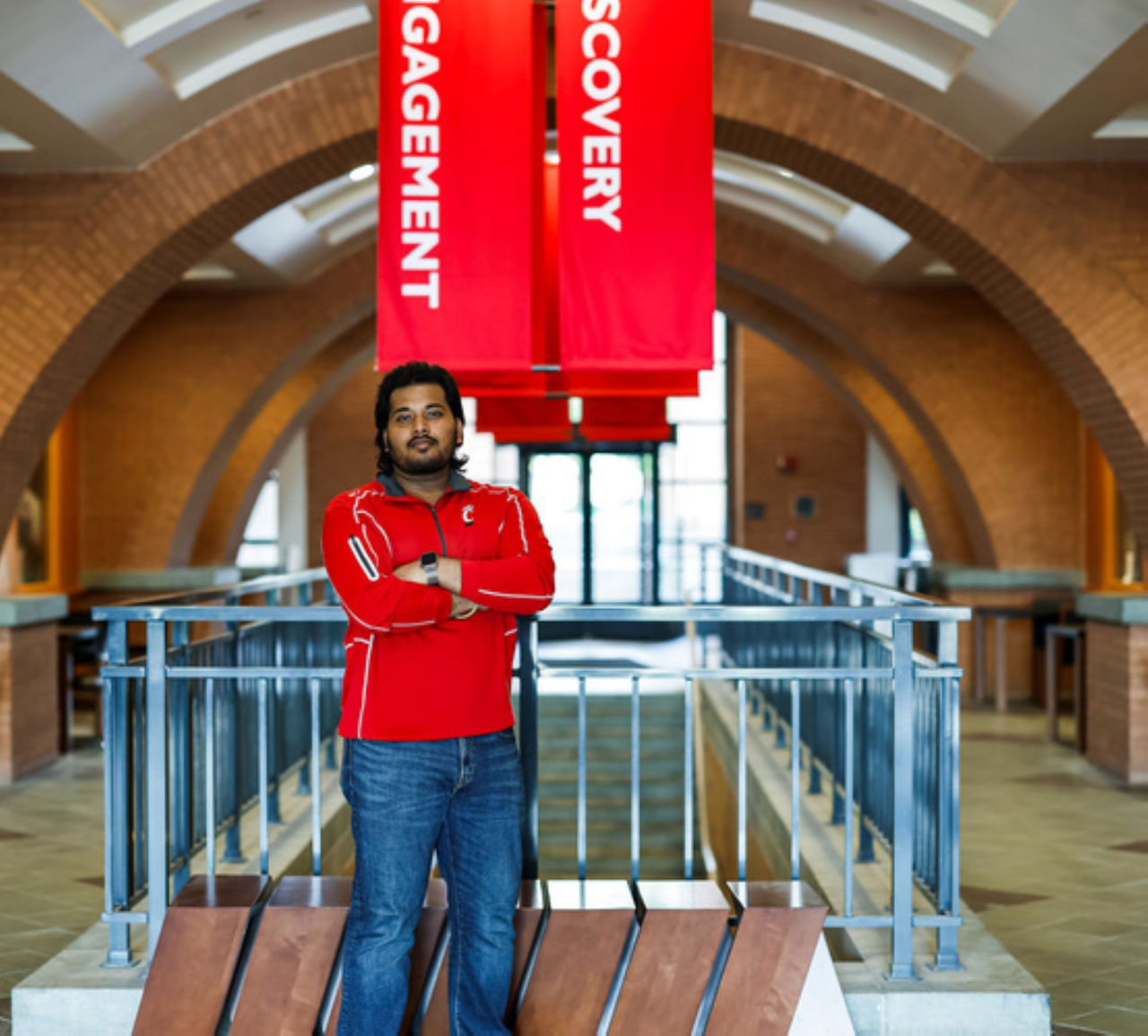
Arvish Pandey in UC's Mantei Center. Photo/Connor Boyle/UC Marketing + Brand.
How HORIZN uses AI for public safety and emergency management
HORIZN was designed to detect anomalies and analyze hot spots: a large crowd gathers, vandalism has occurred and the system could flag unusual patterns and help surface possible response cues. The system could also be useful in responding to other emergencies such as severe storms or floods. It could access datasets from the National Oceanic and Atmospheric Administration.
“We could use our model to figure out if a specific area of the city is going to be flooded or if there’s going to be severe lightning storms involved,” says Pandey. “This would generate action cues and help expedite the response process.”
Pandey focused on creating AI-based extreme weather analysis and public safety components using massive real-world datasets, while Nikolaenko developed video-based crime detection components. “The project stands out because it combines technical depth, collaboration and real-world relevance into one system with a clear purpose,” adds Pandey.
Jun Bai, assistant professor in the UC Department of Computer Science, says their project HORIZN is unique because of its integrated approach.
“Many AI systems focus on only one area, such as crime analytics, surveillance or weather warning systems,” explains Bai, who served as an adviser for the project. “HORIZN brings these together into a single platform for broader situational awareness. That combination makes it more practical and impactful for real-world public safety use.”

Arvish Pandey during a study abroad trip to Italy during his junior year at UC. Photo provided.
[Arvish's] experiences at Motz Engineering, Headstarter and SHP have clearly helped him develop strong professional skills in addition to his technical foundation.
Jun Bai assistant professor in the UC Department of Computer Science
Co-op experiences built a strong foundation in AI and software development
Bai describes Pandey as one of UC’s outstanding students.
“From what I have seen through my oversight of his project, he is bright, hardworking and very proactive,” adds Bai. “He does not just complete assigned tasks; he really tries to understand the bigger picture and think about how his work can create practical value.”
A native of Lucknow, India, Pandey is a UC Global Scholar, International Outreach Scholar and Global Citizen Scholar. He is a member of the National Society of Leadership and Success, the UC Piloting Club and the UC chapter of the Institute of Electrical and Electronics Engineers. Pandey did a study abroad trip to Italy that focused on innovation at companies during his junior year.
After completing his MBA, Pandey hopes to work at the intersection of AI, data and business operations, helping organizations use emerging technology to solve practical problems and make better decisions.

Dr. Jun Bai and Arvish Pandey.
Pandey says he started thinking about solutions for the Cincinnati incident during one of his co-op experiences which sharpened his skills with AI-based systems.
He did a total of three rotations at two companies: Motz Engineering, a Cincinnati-based consulting firm offering mechanical, electrical, plumbing, security and IT design services and SHP Architecture and Design, also based in Cincinnati. Pandey’s experience-based learning opportunities also included a full-ride AI residency at Headstarter, a New York City-based AI engineering platform and community designed to help emerging engineers.
“His experiences at Motz Engineering, Headstarter and SHP have clearly helped him develop strong professional skills in addition to his technical foundation,” says Bai, referring to Pandey. “He communicates effectively and shows a level of maturity and preparedness that gives me a lot of confidence in his ability to succeed in industry. I think he is very well prepared for his first job and has the potential to grow quickly in whatever role he takes on.”
UC co-op by the numbers
- $94 million-plus in collective self-reported earnings.
- 8,300-plus students from disciplines across the university participate.
- $11,220 average co-op salary per student per semester.
- 1,700-plus employer partners participate in co-op.
- Top 5 program in the nation (U.S. News & World Report).
Discovering a passion for creative problem-solving in computer science
Pandey says he started looking at colleges during COVID-19 and weighed the idea of attending bigger schools but the concept of co-op fused with computer science was a strong attraction.
“I was doing computer science and UC was, ‘You want to do this, we have the best possible way you can do it. You learn and you just go execute.’ And I am an execution guy, I really want to know and learn everything I can.”
His first co-op was at SHP in Cincinnati and Pandey described the experience as “amazing” but also an eye-opener about his tastes. He learned a lot but also discovered what he didn’t want to do in computer science.
He was a programmer responsible for debugging, modularizing code, looking at old codes and trying to make them faster, better and more efficient. “I didn’t feel as much in control of things just because of the nature of the job,” adds Pandey. “That’s where I realized I like computer science but it has multiple outlets. I like the concept where I can have more creative control of things.”
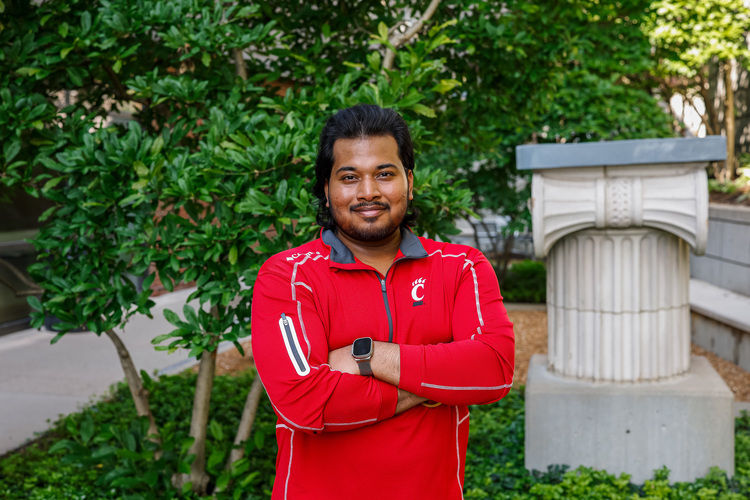
Arvish Pandey in a courtyard at Lindner College of Business. Photo/Connor Boyle/UC Marketing + Brand.
“I think I enjoy when things are hectic. When things are not working out and the project manager says, ‘Why did you do it this way?’ I feel like I do my best when I’m in that scenario. Even though I might complain, I’m not a quitter.”
Pandey’s second and third co-op rotations were at Motz Engineering in Cincinnati. He led application development and executive level briefings and tackled automated workflows and modernized software and processes used to manage customer interactions.
He was assigned more responsibility and was tasked with managing projects.
“My supervisor was extremely generous,” explains Pandey. “He helped me get into executive meetings and in meetings with the company president and the owner and present my vision about the entire project.”
Pandey’s fourth professional experience was at Headstarter in New York. He did a three-month fellowship at the company followed by 10 months of residency at its AI Accelerator. He was extremely productive and built 14 full-stack AI projects — designing the interface visible for the public along with back-end processes such as the server, logic and databases.
“What set Headstarter apart was not the tech, but the culture,” says Pandey. “A community with thousands of aspiring engineers became a pressure-cooker of ideas and camaraderie. Everyone was building toward something bold.”
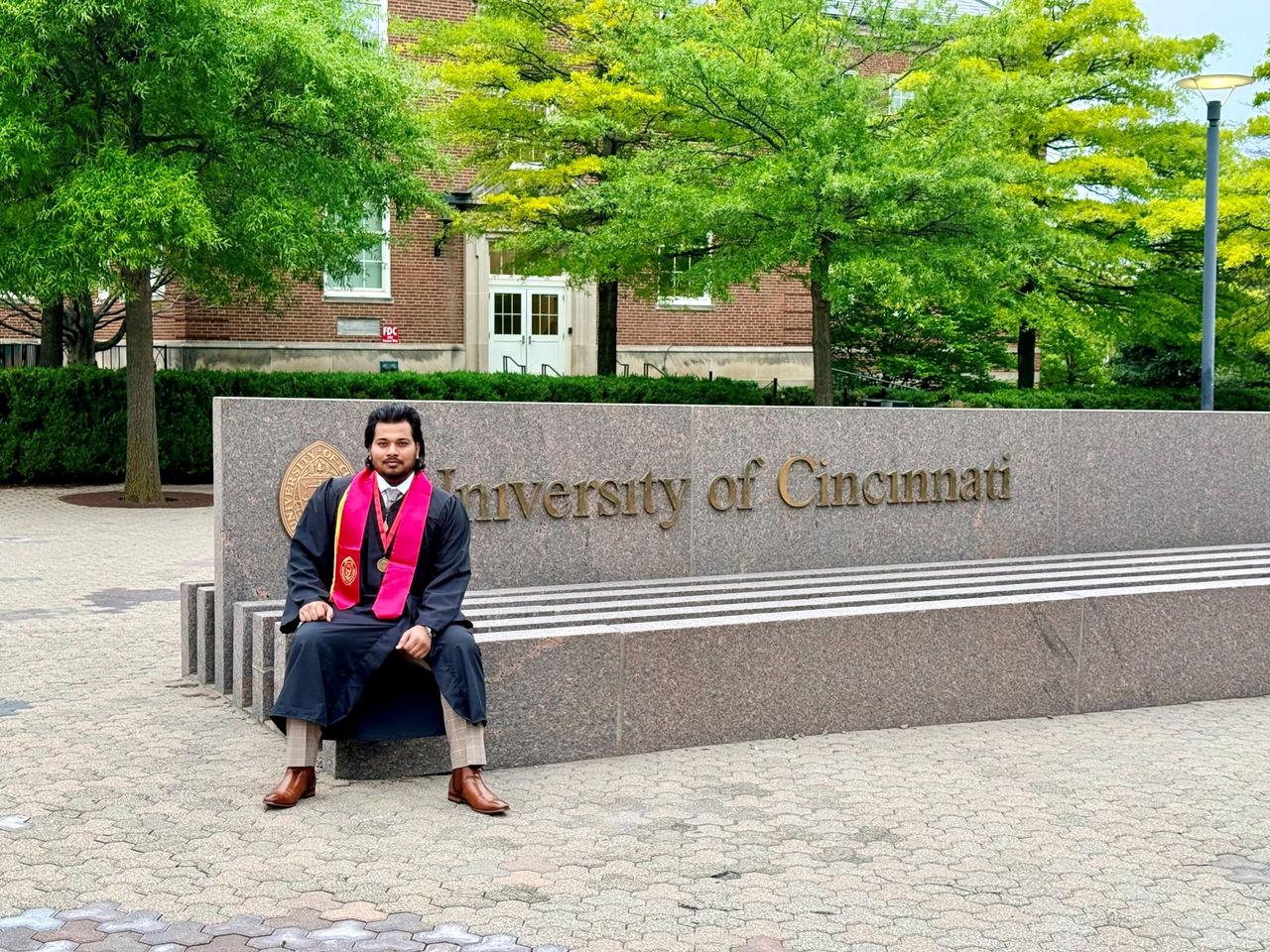
Arvish Pandey graduated with his bachelor's in computer science in May at the University of Cincinnati. He will complete his MBA in August. Photo provided.
Your career is next
Through one of the nation’s most robust co-op programs, UC students don’t just learn about their future — they live it, alternating classroom study with real, career-shaping experience in industries around the world.
Students: Earn while you learn at UC.
Employers: Find your next hire.
Tags
- Artificial Intelligence
- Alumni Association
- International
- Experience-based Learning
- University Honors Program
- Student Experience
- Lindner College of Business
- College of Engineering and Applied Science
- College of Cooperative Education and Professional Studies
- Science & Tech
- Computer Science
- Next Lives Here
Related Stories
How the University of Cincinnati co-op program is shaping the future of work at SXSW
March 17, 2026
The University of Cincinnati served as a 2026 Workplace Track sponsor at the annual South by Southwest (SXSW) Innovation Conference March 12-18 in Austin, Texas, showcasing how co-op is redesigning the future of work.
UC student aims to make AI more explainable, trustworthy
July 11, 2024
Artificial intelligence systems have quickly advanced and can answer just about any question, but how they come to their decisions often isn't understood, even by the people who create the AI. Lynn Pickering, a University of Cincinnati alumna who is working on her PhD at UC, wants to make sure AI is used safely and responsibly. She wants people to be able to review how AI models come to their answers and ensure humans have opportunities to make final decisions, not the machines.
Back to School 2026: UC remains a destination campus
August 24, 2026
The University of Cincinnati welcomes its largest first-year class and a record share of first-generation students for fall 2026, reinforced by affordability initiatives, co-op opportunities and new academic offerings across all campuses.