Parakeet males, females equally likely to fight
Sex doesn't matter in fights over pecking order

In a study of monk parakeets, researchers with the University of Cincinnati and Duke University found that sex has little to no impact on who initiates fights, who is targeted or who rises in the dominance hierarchy.
The work, led by undergraduate researcher Yuchen Chen with co-authors Sara Lipshutz (Duke) and UC Associate Professor Elizabeth Hobson, was published in the journal Integrative & Comparative Biology.
The study started from overlapping interests within the research team in how the sex of individuals can shape many characteristics and behaviors of species combined with the importance of aggression and hierarchies within groups. Females and males parakeets look identical.
“Because we can’t tell a female monk parakeet from a male based on their appearance, I started wondering about the effect of sex on their behavior, particularly aggression and dominance,” Chen said.

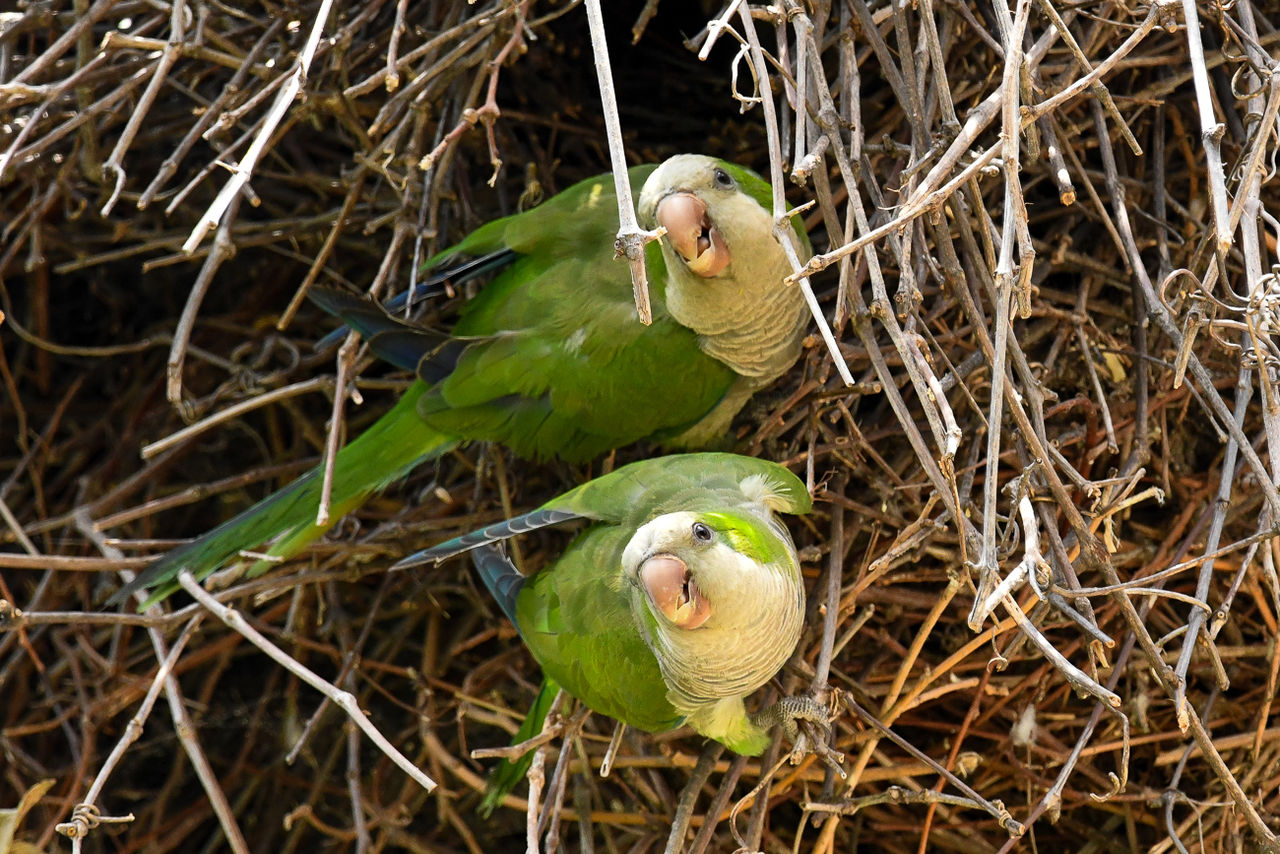
Monk parakeets quarrel to improve social standing. A new study by the University of Cincinnati and Duke University found that males and females fight in equal measure. Photo/Deza Frega
“In a lot of animals, you see differences in aggression and how hierarchies form between females and males. But our new results show that we don’t observe any major differences between female and male aggression or rank in our parakeet groups,” UC's Hobson said.
In her lab in UC’s Department of Biological Sciences, Hobson studies animal sociality and cognition. She has been working with monk parakeets for 20 years. One thing monk parakeets love to do is squabble.
They spend much of the day exerting dominance over others in behaviors such as taking over another’s perch.
“In the parakeet groups, the birds fight a lot, which gives us a lot of data to analyze, but these fights are usually minor squabbles, and it’s extremely rare for them to injure each other,” Hobson said.
Low-stakes squabbles can build a social hierarchy that prevents more intense, dangerous fights.
Sara Lipshutz, Duke University
These frequent squabbles could be a way the parakeets resolve social differences.
“Many previous studies have studied aggression and dominance in a sex-specific manner or only in one single sex. Since we observed all of the parakeets interact, we decided to examine both aggression between individuals of the same sex and across individuals of the opposite sex,” Chen said.
“Group living involves frequent interactions among individuals. Low-stakes squabbles can build a social hierarchy that prevents more intense, dangerous fights,” Lipshutz said.
Besides engaging in fights, monk parakeets are keen observers when others fight. Watching closely who wins and loses helps them know where they stand in the hierarchy and what fresh opportunities exist to improve their standing, researchers said.

UC Associate Professor Elizabeth Hobson studies dominance hierarchies, among other topics, in her biology lab. Photo/Andrew Higley
Understanding more about how sex affects social interactions and aggression helps us better understand why females and males may interact differently sometimes, or more similarly in other circumstances.
“For some species, sex differences in certain behaviors can be small or even absent, despite what we might expect from existing assumptions or biases. A well-designed experiment with robust statistical analysis is necessary to test whether sex differences actually exist,” Lipshutz said.
“I had a suspicion from watching them for so many years that the sex of the birds wasn’t really affecting aggression. We tend to get a 50-50 split in sex for who becomes the top-ranked bird in our groups. But it’s important to formally test these suspicions, which is what we did in this study,” Hobson said.
“I think the main takeaway is to not make strong assumptions about animal behavior without collecting data and testing for patterns. It’s important to be careful about the kinds of pre-existing notions because they can lead to unsupported biases and wrong conclusions,” she said.
If you ask the parakeets? They just love a good fight, regardless of their opponents.
Featured image at top: Male and female monk parakeets are equally prone to fight for dominance, researchers say. Photo/Sydney Austin
UC Biology's study of monk parakeets: Frequently Asked Questions
What are monk parakeets?
Monk parakeets are intelligent and social birds from South America that were introduced to the United States through the pet trade and now live wild in some states.
Why do researchers study monk parakeets?
Monk parakeets live in large, noisy colonies and constantly interact, making them an ideal species for researchers to study social structure, aggression and dominance hierarchies.
What is a dominance hierarchy?
Dominance hierarchies are the social structures that determine which animals get prioritized access to the best or preferred resources. This ranking system is sometimes called a pecking order.
What did researchers learn about monk parakeets?
Researchers found that sex does not play a role in the pecking order for monk parakeets and that males and females are equally likely to be the instigator or target of a fight among birds in their dominance hierarchy.
The next groundbreaking discovery
UC is a powerhouse of discovery and impact as a Carnegie 1 research institution. From pioneering medical research to transformative engineering and social innovation, our faculty and students drive progress that reaches across the world.
Related Stories
Biology student tackles big invasives problem
March 18, 2025
UC biology student Griffin Paul is studying the best ways to remove invasive Amur honeysuckle without using chemical herbicides.
PHOTOS: UC greenhouse offers colorful respite from winter
March 11, 2026
Atop a roof at the University of Cincinnati, six high-tech glass houses that grow plants for biology in the College of Arts and Sciences. Greenhouse Manager Audrey Trauth is here most days tending the plant collection, which is organized into biomes to accommodate the desert, temperate and tropical plants.
Blind cavefish have extraordinary taste buds
August 15, 2024
UC biologist Josh Gross studies blind cavefish, a species of fish that dwell in cave ponds in Mexico. In a study, supported by the National Science Foundation, Gross looked at the timeline for when the cavefish develop additional taste buds on the head and chin, finding the taste bud expansion starts at five months and continues into adulthood.