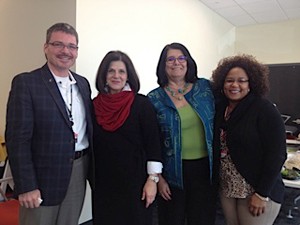
IT@UC Leadership Academy Builds Skills, Community

From sharing cheese coneys to scaling rock walls, IT@UC Leadership Academy participants build on common interests and grow their trust in each other every month. The goal of the nine-month program, according to its director Diana Noelcke, is to create a connected team of employees who can work successfully, and happily, across disciplinary and organizational boundaries.
IT@UC touches nearly every faculty, staff and student at UC. IT workers set up computers, phones, networks and moreand then they troubleshoot. And troubleshoot some more.
I have pulled cable, repaired computer equipment and implemented wireless on campus, said Diana Noelcke, UCs assistant vice president for Enterprise Shared Services. Her impressive range of experience over 27 years at UC helped Noelcke realize the importance of training IT leaders to deal with a wide range of circumstances and personalities.
The monthly sessions started last year with a class of 23 top-level managers. This years IT@UC Leadership Academy includes 20 second-level managers who were selected after a competitive application process. Those who applied but did not make it into the class this year are guaranteed a spot next year, Noelcke said.
Topics focus on developing strong self-awareness as well as organizational and leadership development skills in a collaborative setting. Key areas include:
- customer service
- servant leadership
- team building
- peer to leader
- diversity and inclusion
- strength finding
- emotional intelligence
- performance-based budgeting
- communication
Noelcke encourages IT employees to innovate, which she says depends on their abilities to communicate their ideas and hear the ideas of others. I have a passion for developing new leaders in our organization, she said. This is what they need to hear.
In January, Provost Beverly Davenport visited the Leadership Academy to discuss the importance of civil, mindful communication. Much of peoples life satisfaction stems from their satisfaction at work, she explained to the group. Research shows that satisfaction depends, in large part, on relationships with bosses and co-workers.
Truly listening, then hearing and acting upon what colleagues say can make a dramatic difference in job performance and job, and life, satisfaction. Were all so distracted with technology and constant demands on our time, it can be difficult to slow down, listen and think, said Davenport, who has authored three books about organizational communication.
Leadership Academy members took notes and shared their own communication challenges as part of the session.
This program is a great opportunity for established and developing leaders to learn and grow together, Davenport said. Its a pleasure to talk with them and hear their stories. It makes me appreciate the wealth of talent we have in our ranks.
Noelcke said hearing directly from the Provost encourages participants to see themselves in the context of the entire university. The opportunity to meet with the Provost or to hear her speak is invaluable, she said.
Related Stories
DAAP appoints Joseph Heathcott as new associate dean for research
August 27, 2026
DAAP appoints new associate dean for research Joseph Heathcott, who will bring a nationally recognized voice in urban development, design and research to the University of Cincinnati starting this fall 2026.
Imaging reveals how a tumor-fighting drug triggers cellular breakdown
August 24, 2026

Optics trade publication SPIE highlighted research led by the University of Cincinnati's Jiajie Diao, PhD, published in Biophotonics Discovery that demonstrated how super-resolution microscopy can track how a drug alters several important structures within cancer cells.
Hoffman Honors Scholars program kicks off third year
August 24, 2026
This year marks the third cohort of the Hoffman Honors Scholars (HHS), which offers exceptional students in the College of Arts & Sciences, the College-Conservatory of Music and the Lindner College of Business a substantial scholarship to the University of Cincinnati, along with exclusive opportunities for leadership, service and global engagement.