UC Research Partnership Explores How to Best Harness Solar-Power

A University of Cincinnati research partnership is reporting advances on how to one day make solar cells stronger, lighter, more flexible and less expensive when compared with the current silicon or germanium technology on the market.
Yan Jin, a UC doctoral student in the materials science and engineering program,
Department of Biomedical, Chemical, and Environmental Engineering
, will report results on March 2, at the
American Physical Society Meeting
in San Antonio, Texas.
Jin will present on how a blend of conjugated polymers resulted in structural and electronic changes that increased efficiency three-fold, by incorporating pristine graphene into the active layer of the carbon-based materials. The technique resulted in better charge transport, short-circuit current and a more than 200-percent improvement in the efficiency of the devices. We investigated the morphological changes underlying this effect by using small-angle neutron scattering (SANS) studies of the deuterated-P3HT/F8BT with and without graphene, says Jin.
The partnership with the Oak Ridge National Laboratory, U.S. Department of Energy, is exploring how to improve the performance of carbon-based synthetic polymers, with the ultimate goal of making them commercially competitive.
Unlike the silicon-or germanium-powered solar cells on the market, polymer substances are less expensive and more malleable. It would be the sort of cell that you could roll up like a sheet, put it in your backpack and take it with you, explains Vikram Kuppa, Jins advisor and a UC assistant professor of chemical engineering and materials science.
One of the main challenges involving polymer-semiconductors is that they have significantly lower charge transport coefficients than traditional, inorganic semiconductors, which are used in the current solar technology. Although polymer cells are thinner and lighter than inorganic devices, these films also capture a smaller portion of the incoming light wavelengths and are much less efficient in converting light energy to electricity.

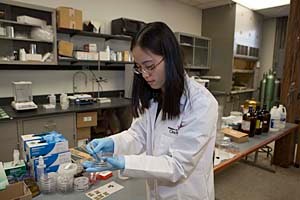
UC doctoral student researcher Yan Jin is photographed with her advisor, Assistant Professor Vikram Kuppa.
Our approach is significant because we have now shown peak improvement of over 200 percent on a few different systems, essentially a three-fold increase in the efficiency of the cell by addressing the fundamental problem of poor charge transport, says Kuppa.
Jin led the research conducted at Oak Ridge National Laboratory and at UCs Organic and Hybrid Photovoltaics Laboratory in the UC College of Engineering and Applied Science (CEAS). Were finding that these enhancements resulted from improvements in both charge mobility and morphology, says Jin. The morphology is related to the physical structure of the blend in the polymer films and has a strong impact on the performance and the efficiency of the organic photovoltaic (OPV) cells.
Yans future research is continuing on the examination of morphology and its connection to solar cell performance. Part of that research will be conducted on state-of-the-art, Ultra Small Angle X-ray Scattering (USAXS) equipment coming to the College of Engineering and Applied Science at UC, the result of a Major Instrumentation Award to Kuppa from the National Science Foundation. Kuppa says the $400,000 piece of equipment is only the second of its kind in a university in the U.S. and the first such instrumentation with multiple-sources and broad-measurement range.
Co-researchers on the project include Kuppa; Gregory Smith, Structure and Dynamics of Soft Matter group leader, Biology and Soft Matter Division, Oak Ridge National Laboratory, U. S. Department of Energy; James Browning, senior research staff scientist, Chemical and Engineering Materials Division, Neutron Scattering Sciences Directorate, Oak Ridge National Laboratory; Jong Kahk Keum, staff scientist, Instrument and Source Division, Oak Ridge National Laboratory; and Kunlun Hong, staff scientist, Center for Nanophase Materials Science, Oak Ridge National Laboratory.
The American Physical Society is a nonprofit membership organization working to advance and diffuse the knowledge of physics through its research journals, scientific meetings, education, outreach, advocacy and international activities. APS represents over 51,000 members, including physicists in academia, national laboratories and industry in the United States and throughout the world. The March meeting is expected to be attended by nearly 10,000 physicists, scientists and students.
UCs
College of Engineering and Applied Science
is a leader in engineering education, research and innovation, and is the world founder of cooperative education.
Related Stories
Campus buzz returns as UC students experience their first week
August 27, 2026
Near-perfect weather, record first-year enrollment, Thrifty Move-In and a packed Involvement Fair mark the University of Cincinnati’s first week back as thousands of Bearcats move into campus housing.
UC, NKU renew longstanding partnership supporting Army ROTC cadets
August 26, 2026
The University of Cincinnati Army ROTC and Northern Kentucky University (NKU) have renewed a longstanding partnership that supports students preparing to become Army officers and leaders in their communities. The universities formalized the renewed agreement during a signing event Aug. 11 at NKU.
One in four NFL players had CTE at death
August 25, 2026

Forbes cites research on concussions and football helmets by the University of Cincinnati in a report that found one in four NFL players had brain damage at death.