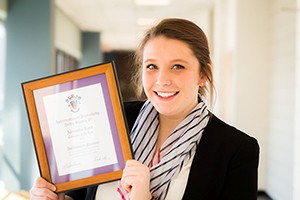
Lindner Undergraduate Wins Delta Sigma Pi Collegian of the Year Award

Alexandra Land, BBA 15, is one of five winners nationwide to receive Delta Sigma Pis Collegian of the Year Award. As the Collegian of the Year, Land will represent the 52 collegiate chapters of the professional business fraternity in the Northeastern region.
Land is a senior majoring in Marketing and International Business at the UC Lindner College of Business. As a Collegian of the Year, Land will serve on the Northeastern Provincial Executive Board and focus on committee initiatives such as professional development and community service.
Land was selected for this honor based on her service on the Executive Committee of the UC Chapter of Alpha Theta, her involvement in national conferences and committees and her agenda proposal on diversity.
My proposal focused on expanding the fraternity's support for diversity initiatives, she says.
Land, who was drawn to the fraternity for its commitment to civic betterment, is working to establish a grant in support of diversity training and helping veterans and fraternity members with disabilities.
I am hoping to build Connection Communities for those specialty groups to provide fellow fraternity members with additional resources to help them achieve their passions, she says.
Lindner College of Business student Brendan OBrien, BBA 15, who served as past president of UCs Alpha Theta chapter, was awarded the same Collegian of the Year honor in 2014.
It is a huge honor and a very rare occurrence for two members of the same chapter win back-to-back, Land says. Its a testament to the chapter's excellence in professionalism, service and leadership.
Related Stories
London fashion in focus
August 31, 2026
Since 2016, the University of Cincinnati's College of Design, Architecture, Art, and Planning (DAAP) has offered a study abroad trip called “United Kingdom: The Style Studies.” This year, 15 students embarked across the Atlantic right before the fall semester to see all the retail expertise London has to offer.
Campus buzz returns as UC students experience their first week
August 27, 2026
Near-perfect weather, record first-year enrollment, Thrifty Move-In and a packed Involvement Fair mark the University of Cincinnati’s first week back as thousands of Bearcats move into campus housing.
UC Real Estate Center appoints new executive director
August 27, 2026
The UC Real Estate Center has announced Sean McGrory as its new executive director. McGrory succeeds Carl Goertemoeller, who retired.