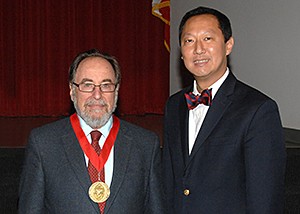
Award for Excellence Presented to Nobel Winning Scientist

Nobel Prize Winner David Baltimore, one of the worlds most influential biologists, was presented the University of Cincinnati Presidents Award for Excellence by President Santa J. Ono on May 6.
President Emeritus of the California Institute of Technology and the Robert Andrews Millikan Professor of Biology since 2006, Baltimore visited UC to present a lecture as a part of Research Week, a collaboration of UCs Academic Health Center, UC Health, Cincinnati Childrens Hospital Medical Center, the Cincinnati Department of Veterans Affairs Medical Center, and the Cincinnati Education and Research for Veterans Foundation.
Baltimore shared the Nobel Prize in 1975 with another researcher who simultaneously but separately had made the break-though finding that RNA viruses could make copies of themselves. Prior to that, the conventional wisdom in molecular biology was that genetic information was transmitted only from DNA to RNA.
Baltimore also devised the Baltimore classification system, a system that classes viruses into seven groups according to their genome type and method of replication. His work had enormous implications for fields beyond virology including oncology, molecular and cell biology, and biotechnology.
His work also provided keys to understanding the life cycle of retroviruses such as HIV, and as a result Baltimore has contributed widely to the understanding of cancer, AIDS and the molecular basis of the immune response.
In the mid-1970s, he played an important role in creating a consensus on national science policy regarding recombinant DNA research. He served as founding director of the Whitehead Institute for Biomedical Research at MIT from 1982 until 1990. An early advocate of federal AIDS research, Baltimore co-chaired the 1986 National Academy of Sciences committee on a National Strategy for AIDS and was appointed in 1996 to head the National Institutes of Health AIDS Vaccine Research Committee.
His present research focuses on control of inflammatory and immune responses, on the roles of microRNAs in the immune system and on the use of gene therapy methods to treat HIV and cancer in a program called Engineering Immunity. He also serves as director of the Joint Center for Translational Medicine, an activity that joins Caltech and UCLA in a program to translate basic science discoveries into clinical realities and where an active clinical program is under way.
Related Stories
These teeny spiders are social media stars
August 28, 2026

The New York Times turned to a University of Cincinnati professor to explain the appeal of jumping spiders on social media.
Niah Fowler
BEARCATS FOR LIFE
My time at UC has been defined by growth, community, and opportunity. From UCBA to campus involvement, professional experience, and pursuing a career in STEM, each experience has helped shape who I am today and prepared me for the future.
An internal divide among unions on AI impacts the Wisconsin gubernatorial race
August 28, 2026

Anne Lofaso, a professor in the Donald P. Klekamp College of Law at UC, spoke with Wisconsin Public Radio, about the schism among unions over AI and whether it is a plus, a negative, or somewhere in between when looking at job creation.