Psychology Researchers Report a Major Discovery of Harmony Amid Chaos

A discovery into the workings of the human nervous system is expected to have a transformative impact on how scientists understand the role of perceptual-motor delays in human and animal behavior, as well as understandings of the dynamics of behavioral anticipation. The NIH-funded research project conducted by Auriel Washburn, a University of Cincinnati doctoral student in psychology, is
in The Journal of Experimental Psychology: Human Perception and Performance, a journal of the American Psychological Association.
The researchers say the study demonstrates that inherent delays in the nervous system may play a constructive role in enabling individuals to anticipate the movement of others.
Human behavior, explain the researchers, can be highly unpredictable in how humans react or move. Its not always a clear, stable pattern. The study aimed to explore how one person is able to coordinate with the movements of another person when the movements are unpredictable and chaotic. For example, such chaotic movement can occur between athletes coordinating with each other on a team, or between people working in tandem on chores like loading a dishwasher, or navigating a room packed with people.
In addition to the fact that we know we have these intrinsic delays in our nervous system, our experiment sort of built on and exaggerated those delays, and demonstrated how they can increase ones ability to anticipate the chaotic movements of another co-actor, says Washburn.
The study focused on an arm movement task involving a total of 22 people divided into 11 pairs. A leader and follower controlled dots on a screen, using hand-held motion tracking sensors. The leader was taught to produce chaotic and unpredictable movements, and the follower was asked to reproduce and synchronize with the leaders movements. After introducing a small feedback delay between when the follower would physically move and when their dot moved on the screen, the researchers found that, contrary to traditional thinking that a feedback delay would be a hindrance to coordination, the delay actually allowed the follower to better anticipate the unpredictable and chaotic movements of the leader.
The results of this study are profound, because it could potentially change the way we understand how the nervous system works and how perpetual-motor delays play a role in human behavior, says Washburns co-researcher and advisor, Michael J. Richardson, an associate professor of psychology.

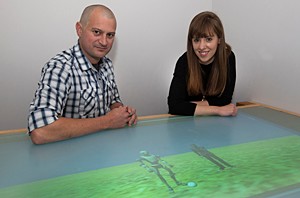
Michael J. Richardson, associate professor of psychology, and psychology doctoral student Auriel Washburn are photographed in UC's Center for Cognition, Action and Perception.
The researchers say the discovery could also impact future research into areas such as the development of robotics, with the addition of small feedback delays enabling those systems to better anticipate unpredictable human behavior. These findings could aid in the development of any artificial system that works with a human, says Richardson.
The research was conducted in the UC
Center for Cognition, Action and Perception
. Funding for the study was supported by a
. The five-year grant supports the development of computerized models to examine how social interaction and movement influence each other.
Co-authors on the paper are Rachel W. Kallen, a UC assistant professor of psychology; Charles A. Coey, a UC doctoral student in psychology; Kevin Shockley, a UC professor of psychology; and Richardson, the primary investigator on the NIH grant.
Related Stories
An expert pieced together this Roman document like a puzzle
September 1, 2026

National media highlighted a new project by UC Classics Assistant Professor Matthijs Wibier to piece together and translate an ancient Roman text from fragments buried in the desert for more than 1,600 years.
Her book drive is changing literacy in Cincinnati
August 31, 2026

WCPO highlights a nonprofit dedicated to childhood literacy that has offers co-op positions to UC students.
These teeny spiders are social media stars
August 28, 2026

The New York Times turned to a University of Cincinnati professor to explain the appeal of jumping spiders on social media.