UC Research Reveals Connections Between Social Science, High Fashion

While theyre often linked with studying remote civilizations, the role of the contemporary anthropologist is changing.
Stephanie Sadre-Orafai, a University of Cincinnati assistant professor of anthropology, will apply one example as she examines how anthropology is linked with the high fashion industry in New York.
The presentation is part of a panel at the
114th annual meeting of the American Anthropological Association. Billed as the worlds largest gathering of anthropologists, the meeting takes place Nov. 18-22, in Denver, Colorado.
Sadre-Orafai explains that casting agents often have some form of anthropological training. Although many of these casting agents apply this expertise toward scouting diverse talent for commercials, magazine layouts and other media in the New York fashion industry, Sadre-Orafai says they can be limited by conservative views in the industry. As a result, some turn to creative outlets on the side, creating documentaries and blogs.
The role of the anthropologist is evolving and the kind of people we work with is evolving, too, says Sadre-Orafai. As anthropologists studying professionals, if were only focusing on what people do on the job, we may be unwittingly narrowing our focus. We need to grant multiplicity to our research subjects when were measuring the work they do.

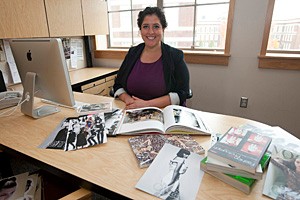
Image of anthropology researcher Stephanie Sadre-Orafai
Sadre-Orafais presentation features several vignettes based on years of fieldwork and face-to-face interviews with casting professionals in the New York fashion industry. The presentation is part of a session titled,
Para-Ethnographies of Branding and Design.
The theme of the annual meeting of the American Anthropological Association is Familiar, Strange. Sadre-Orafais paper reveals that Just as ethnographers use techniques of intimacy and estrangement in their fieldwork, balancing insider and outsider perspectives to make the strange familiar (translating others experiences so that they are intelligible beyond a local context), and the familiar strange (gaining enough critical distance to see underlying patterns and connections), so too, do street scouts and casting directors.
Funding for the research was supported by the
Wenner-Gren Foundation of Anthropological Research
, UCs University Research Council and the
Charles Phelps Taft Research Center
at the University of Cincinnati.
UCs
in the
McMicken College of Arts and Sciences
focuses research around bio-evolutionary approaches to health, ecosystem dynamics and forms of social inequality. Researchers conduct field research around the world ranging from the forests of Nicaragua to Fashion Week in New York.
Founded in 1902, the American Anthropological Association calls itself the worlds largest professional organization of anthropologists, with an average annual membership of more than 10,000. The Arlington, Va.-based association represents all specialties within anthropology cultural anthropology, biological (or physical) anthropology, archaeology, linguistics and applied anthropology.
Related Stories
Her book drive is changing literacy in Cincinnati
August 31, 2026

WCPO highlights a nonprofit dedicated to childhood literacy that has offers co-op positions to UC students.
These teeny spiders are social media stars
August 28, 2026

The New York Times turned to a University of Cincinnati professor to explain the appeal of jumping spiders on social media.
UC, NKU renew longstanding partnership supporting Army ROTC cadets
August 26, 2026
The University of Cincinnati Army ROTC and Northern Kentucky University (NKU) have renewed a longstanding partnership that supports students preparing to become Army officers and leaders in their communities. The universities formalized the renewed agreement during a signing event Aug. 11 at NKU.