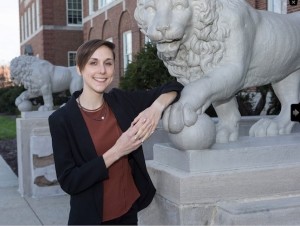
UC Neurobiology Graduate Investigates Health Care Gap from Social Justice Perspective

Juliana Madzia is a 2017 graduate of the University of Cincinnati College of Arts & Sciences
. Earlier this year, she became UCs first Rhodes Scholarship finalist, and she was awarded the UCs Presidential Leadership Medal of Excellence.
Madzias also a cross-country All-American, ranking #10 on UCs all-time Top 10 in the outdoor 10,000-meter run she has been nominated this years NCAA Woman of the Year Award.
As if all that werent impressive enough, several years of her undergraduate research at UC and abroad resulted in her co-discovery that Black South African and African-American LGBTQ women face similar barriers to HIV prevention and treatment.
And that knowledge has already shaped her burgeoning medical career.
How Womens, Gender and Sexuality Studies (WGSS) informed a future doctors outlook on population health.
Madzia is passionate about womens studies and about social justice. She took several WGSS courses during her UC undergraduate career.
In "Black Feminism and Reproductive Justice," she learned about the history of racial and gender discrimination in medicine, and how those injustices continue to influence health disparities today.
WGSS courses pushed me to think in ways that I didnt often get to think in my science classes to come up with my own ideas, to think critically, and write creatively, said Madzia.
She was also active in GlobeMed, the universitys student-led global health and social justice organization. As its co-president, she worked with
in the Thai-Burmese borderlands.
While in Southeast Asia, Madzia worked with SAW physicians and social workers to develop community health education programs for Burmese migrant communities along the Thai-Burma border.
Madzia noted that her WGSS courses helped prepare her for her work in Thailand. The most important skill she learned was how to engage responsibly and act in solidarity with communities outside of her own.
This influenced how I interacted with every person I met, how I perceived my role as an assistant teacher, and how I went about having conversations with the staff members of Social Action for Women when thinking about the future goals of our partnership, she said.
In her sophomore year, on another study-abroad opportunity in South Africa, Madzia was intrigued to learn that Black, LGBTQ, South African women suffered disproportionately from higher rates of HIV infection.
Madzia made it her mission to find out why. She also wanted to learn whether queer-identifying Black women in the United States faced similar prevention and treatment disparities.
I began to look at my own community, in Cincinnati, to see where I might be able to use what I was learning to begin to have an impact, Madzia remembered. I felt that doing research to understand the roots of race-based health disparities in Cincinnati neighborhoods was the best place to start.
Working with The Cincinnati Project to improve lives back home
When she returned home, Madzia pursued the topic with assistance from
UC Sociology professor Carolette Norwood
, who was conducting her own research project on health disparities and exposures to violence within lower-income African-American communities in Cincinnati.

Juliana Madzia
The work was supported by a college-funded initiative called
The Cincinnati Project
, an organization created to help bring together faculty, students, and local non-profits who work for equality in Cincinnati.
Madzia and Norwood began their research by conducting 2½-hour interviews with study participants. They asked their subjects questions about sexual history, perceptions of race and gender, their community and social support, and their experiences with the medical system.
After combing through the interviews, they discovered that, in both South Africa and the US, black LGBTQ women who are HIV positive are prevented from seeing physicians for diagnosis, from returning for follow-up appointments and from continuing their treatment regimens.
They also found that both populations were more likely to experience violence based on their sexual orientation, contributing to lower life expectancies and poorer overall health outcomes.
In both countries, Madzia feels, institutional racism may be closely connected (if not the single root cause) of disparities in healthcare especially for Black and LGBTQ women.
A lot of times we overlook the fact that underdeveloped countries around the world are more similar to us than we imagine, Madzia said. Violence takes many forms structural, interpersonal, and community and is a significant daily stressor that affects both mental and physical health.
Madzia believes that policymakers should address these issues by enacting legislation that would enhance economic opportunities and reduce incarceration rates in Black communities.
She also believes that there needs to be a policy solution to curb the increasing costs of housing because, she said, gentrification as a significant source of financial and emotional stress.
Policymakers, as well as everyday citizens, must recognize that institutional racism is still highly prevalent in Cincinnati, in everything from the way that neighborhoods are designed and divided, to the locations that grocery stores open, Madzia asserted.
She said that she realized the most effective activists were those who were working within their own communities to enact positive change in a context that they understood firsthand.
Studying the problem, she explained, took me down a totally different path that wasnt necessarily neuroscience-related, but I wouldnt have known what I was really passionate about without pursuing that research in the first place.
Approaching urban population health from a social justice perspective.
Madzia was granted early acceptance to UCs dual
MD-PhD Medical Scientist Training Program (MSTP)
. Shell simultaneously pursue her medical and sociology doctorates, with an eye toward one day working to improve care for underserved urban populations.
Reflecting on her undergraduate years, Madzia noted that shes grateful to have been a part of the Neurobiology program, which gave her the flexibility to take various courses. She advised students who are interested in studying neurobiology to take advantage of as many diverse learning opportunities as possible.
Now, as she embarks on her next journey as a UC MD/PhD student, she plans to focus her research on womens reproductive health.
Through my clinical work and research, I hope to address reproductive health disparities experienced by the LGBTQ community and people of color, she said.
Related Stories
An expert pieced together this Roman document like a puzzle
September 1, 2026

National media highlighted a new project by UC Classics Assistant Professor Matthijs Wibier to piece together and translate an ancient Roman text from fragments buried in the desert for more than 1,600 years.
Her book drive is changing literacy in Cincinnati
August 31, 2026

WCPO highlights a nonprofit dedicated to childhood literacy that has offers co-op positions to UC students.
These teeny spiders are social media stars
August 28, 2026

The New York Times turned to a University of Cincinnati professor to explain the appeal of jumping spiders on social media.