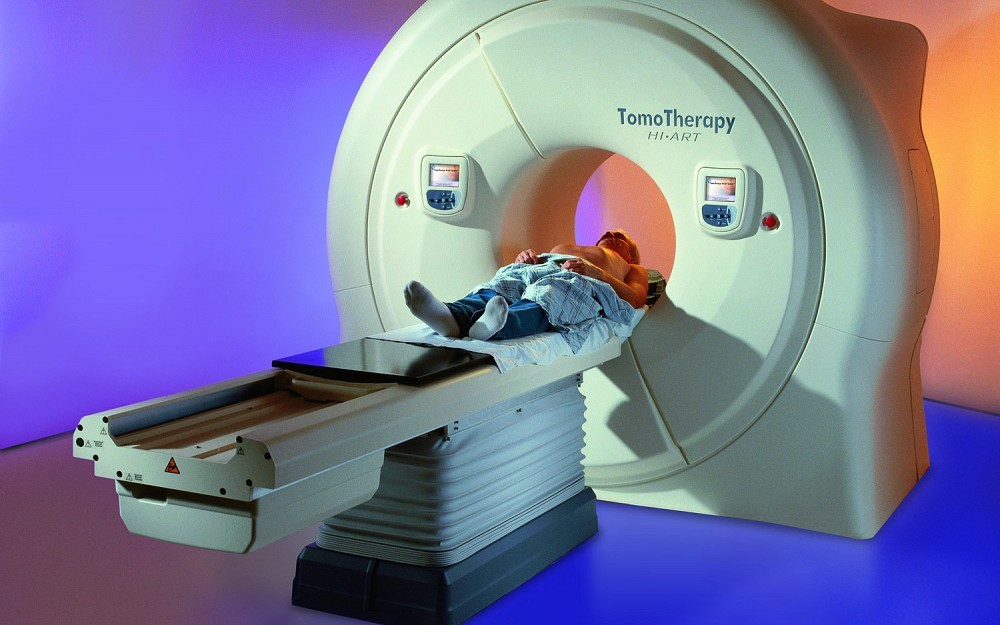
Local Physicians Install First 3-D Image-Guided Cancer Treatment System

University of Cincinnati radiation oncologists associated with the Precision Radiotherapy Center in West Chester have acquired an advanced, image-guided radiotherapy system that will allow them to precisely target virtually all tumorssmall or largethroughout the body.
The TomoTherapy Hi-Art System combines the three-dimensional (3D) imaging of
computerized tomography (CT) X-ray scans with highly targeted radiation beams in a large treatment field. By integrating these two elements in one system, physicians can adjust radiation dosages to match the size and shape of a tumor in real time and maximize treatment accuracy.
Radiotherapy uses high-energy beams to kill cancer cells and keep them from growing and dividing. The TomoTherapy system, based on what is called intensity modulated radiotherapy (IMRT), provides more precise identification, localization and treatment of cancerous tumors throughout the body.
Most current forms of radiotherapy rely on external body markers to direct one or more stationary radiation beams at a tumor. TomoTherapy produces real-time 3D images of the tumor and surrounding internal anatomy, and then delivers the radiation via a continuously adjusted, moving beam that rotates 360 degrees around the body.
Guided by the 3D images, radiation beams are modulated to wrap around the tumor. This allows the physician to spare the maximum amount of normal tissue surrounding the tumor and safely deliver high doses of radiation.
This new technology is the latest step in our commitment to bringing the highest level of cancer care to the Greater Cincinnati area, says John Breneman, MD, professor of radiation oncology at UC and co-director of Precision Radiotherapy.
The TomoTherapy system complements and extends our existing capabilities so that we can treat virtually any sized tumor in the any area of the body, explains Dr. Breneman, while minimizing damage to healthy tissue surrounding the tumor.
Tumors can change size and shapeeven shift their locationduring a course of radiation therapy, so knowing the exact shape and location of the tumor before every individual treatment can help us maximize treatment effectiveness, says Dr. Breneman.
During each treatment, the patient is moved through the TomoTherapy unit to get a 3D image to verify the size, shape and location of the tumor. The patient then goes back through the machine, where treatment is delivered via radiation beams emanating in a 360-degree, spiral pattern. The procedure takes about 15 minutes.
This system gives us very precise physical and geometric parameters for treating cancerous tumorswhether theyre the size of a marble or a softball, explains Dr. Breneman.
The new system will also allow Dr. Breneman and his team to integrate treatment planning, patient positioning and treatment delivery. Traditionally, these components have been separate, often requiring fragile patients to move between several treatment facilities.
Scheduled to open at Precision Radiotherapy in April, the TomoTherapy treatment center will be one of only about 40 in the United States to have this technology and the first within a 100-mile radius of Cincinnati. Dr. Breneman and his team expect to see about 20 patients per day.
Precision Radiotherapy, located at the University Pointe medical campus in West Chester, offers high-precision radiotherapy and radiosurgery. Founded in 2003, the center is a collaboration between the Mayfield Clinic and University Radiology Associates, two nationally recognized neuroscience programs affiliated with UC College of Medicine.
Related Stories
On-site training in Speech & Hearing Clinic sets UC’s programs apart
August 27, 2026
At the University of Cincinnati’s Speech & Hearing Clinic, Doctor of Audiology and Speech-Language Pathology graduate students gain real-world experience while providing free speech and hearing services to the community.
Designing with cancer patients' needs in focus
August 27, 2026
Kristina Shin is designing garments that prioritize the comfort, function and confidence of breast cancer patients, addressing a need often overlooked by traditional fashion.
UC, NKU renew longstanding partnership supporting Army ROTC cadets
August 26, 2026
The University of Cincinnati Army ROTC and Northern Kentucky University (NKU) have renewed a longstanding partnership that supports students preparing to become Army officers and leaders in their communities. The universities formalized the renewed agreement during a signing event Aug. 11 at NKU.