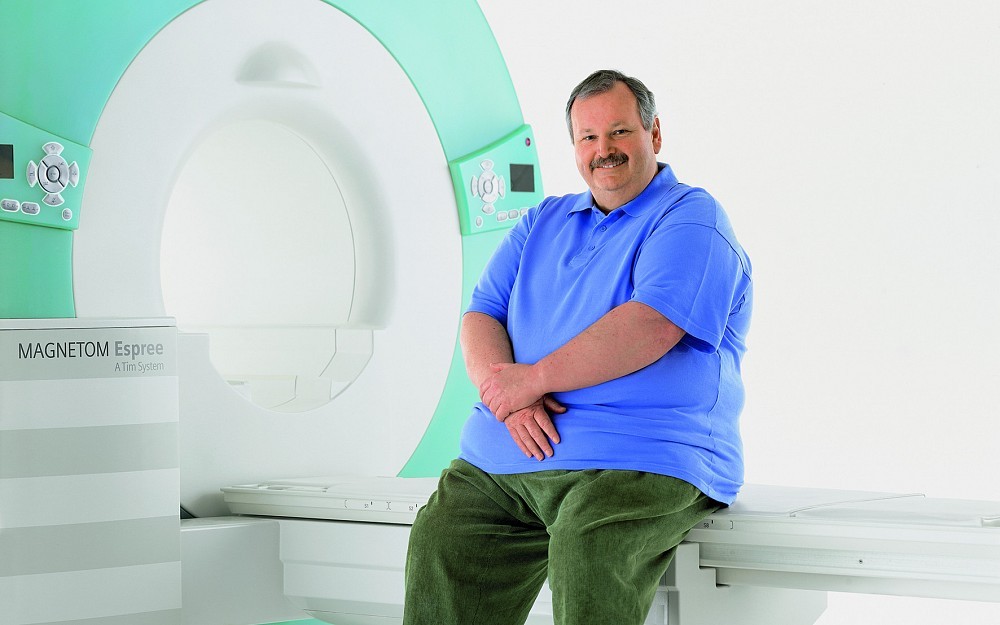
New Imaging Center Delivers Better Care to Athletes and Large Patients

CINCINNATIPhysicians at the University of Cincinnati (UC) are opening a state-of-the-art magnetic resonance imaging (MRI) center that gives virtually any patientincluding bulky athletes and the obesecomfortable access to quality body imaging.
Located in the
Were able to comfortably accommodate large athletes and obese and claustrophobic patients, explains Robert Wissman, MD, director of the
MRI is an imaging procedure that uses a magnetic field and radio-wave energy pulses to create pictures of organs and body structures. The test is used to detect, diagnose and plan treatment for a variety of disorders.
Most traditional high-field MRI scanners have a 350-pound weight limit. Patients who are too heavy or large to fit into a traditional scannerlike football defensive linemenare often examined on an open MRI system, which is typically lower in field strength. This system can accommodate patients who weigh up to 550 pounds.
In a city where some patients have to wait two weeks for an MRI scan, Dr. Wissman says, the
The
Unlike traditional MRI scannerswhich require patients to enter a narrow scanning tunnel and to hold their breaththe Esprees short magnet allows about 60 percent of scans to be done with the patients head outside the magnet.
Many patients experience anxiety in traditional scanners because they feel like theyre nose-to-nose with the magnet, explains Dr. Lukin. Although the Espree is a closed system, it feels very open, and most patients have a full foot of headroom.
The
A collaborative effort of UCs pathology, neurology, orthopaedics, radiology and rehabilitation practice groups, the
Tags
Related Stories
UC radiation oncologist speaks with Local 12 news about clinical trial for head and neck cancer treatment
August 10, 2026

Dr. Sara Medek, a UC radiation oncology professor, speaks with Local 12 news about a new clinical trial aimed at reducing radiation in certain areas while still treating cancer effectively but with fewer painful side effects.
Cancer Center director charts future based on collaboration, AI
August 10, 2026

David Gius, MD, PhD, was featured in a Cincinnati Business Courier article and The Cancer Letter’s “The Directors" podcast discussing his priorities and goals as he recently took the helm as director of the University of Cincinnati Cancer Center.
Bidirectional link between oral, kidney health calls for patient education, access
August 4, 2026

Despite growing awareness of the connection between oral health and chronic health conditions, patient awareness and access to dental care remain limited, according to University of Cincinnati experts who recently spoke with Healio | Nephrology News & Issues.