UC Unveils New Surgery Research and Teaching Center

CINCINNATIThe University of Cincinnati (UC) Center for Surgical Innovation (CSI), a $9.5 million, state-of-the art teaching and research facility, has officially opened.
Founded in June 2003, the CSI is an interdisciplinary collaboration between the departments of surgery and biomedical engineering at UC and leading government and industry partners. Its mission is to leverage regional assets and become a world leader in surgical thinking and innovationin research, medical practice and education.
One of only a handful of centers of its kind across the nation and the only one in the Midwest, the CSI focuses on addressing unmet medical needs, such as developing minimally invasive robotic surgery and telesurgery techniques that will improve the way physicians deliver and teach medicine.
No other place in the world has what weve assembled at UC, explains Jeffrey Matthews, MD, chairman of the department of surgery. Our goal is to become the leader in surgical innovationin the hospital, in the classroom and in the marketplaceand weve assembled the technology and the internal team and established key industry and governmental relationships critical to doing just that.
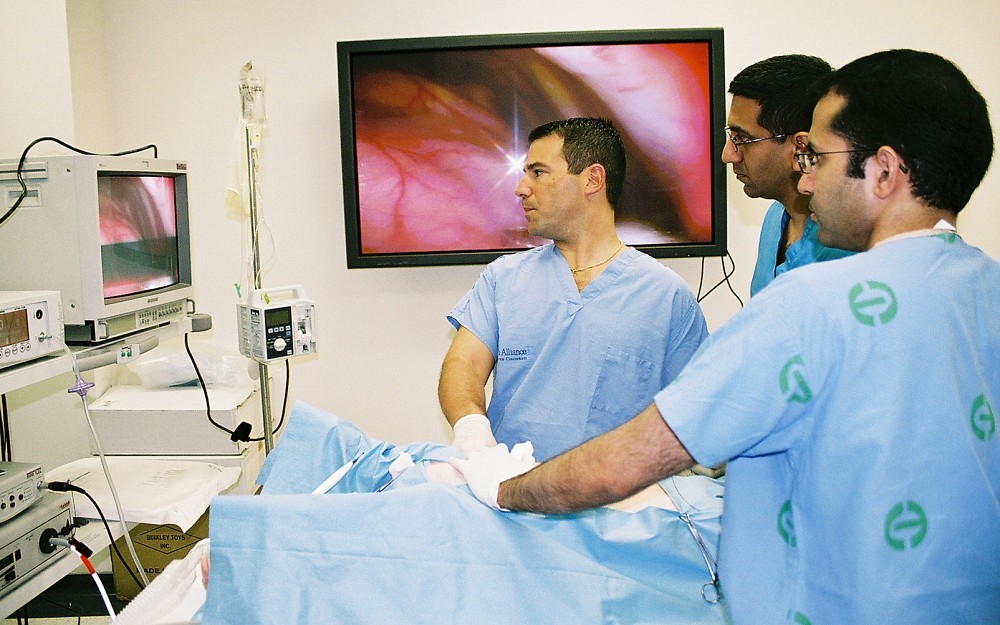
Housed in UCs Medical Sciences Building, the CSI is a 3,700-square-foot facility that includes an eight-bench teaching lab with advanced audiovisual and telecommunications capabilitiesincluding international videoconferencing and direct linkages to the operating rooms at University Hospital, UCs primary teaching facility. The center also has a sterile operating room outfitted with specialized medical equipment, including the da Vinci surgical robot.
Students and physicians gain real-time educational experiences in the lab and through distance-learning seminars delivered via Internet and streaming video. Prior to its official opening, for example, the CSI conducted a hands-on teaching symposium for more than 70 cardiothoracic surgery residents and physicians from across the United States.
Conceptually, however, the center represents something much larger.
The CSI is the impetus for bringing health-care providers together with medical industry and government leaders to push research from bench top to bedside, says Dr. Matthews. Were addressing tomorrows challenges today by taking medical discoveries and making them a reality that will improve patient care.
Some key surgical breakthroughs at UC include:
- The nations first telesurgery, from Ohio to California, which Timothy Broderick, MD, successfully completed using the da Vinci surgical robot in March 2005.
- The nations first test of a prototype communications platform for mobile robotic telesurgery, to occur later this month in conjunction with leading military, telecommunications and other surgical experts affiliated with the U.S. Armys Telemedicine and Advanced Technology Research Center (TATRC).
- The development of an effective, minimally invasive treatment for atrial fibrillation (irregular heart beat). The procedurecalled the mini-mazeeliminates the need for a large incision in the chest or use of the heart-lung machine. Through the its videoconferencing capabilities, CSI trains surgeons from as far away as China on the procedure.
A key aspect of the CSI is collaboration with medical industry and government institutions. Working with TATRC, the CSI helped establish the Advanced Center for Telemedicine and Surgical Innovation, a congressionally funded research effort focusing on telesurgery and remote surgical-care applications for the battlefield.
The CSI is also working with the Cleveland Clinic Foundation to create the Atrial Fibrillation Innovation Center Funded by the state of Ohio. This $22.8 million research facility focuses on minimally invasive and robotic procedures to treat atrial fibrillation, a condition that affects more than 2.5 million Americans.
Research partnershipswith medical industry leaders and government and military institutions position CSIand Cincinnatito play a key role in the future development of telesurgery and other long-distance medical procedures. These partners include Ethicon Endo-Surgery, Intuitive Surgical, Johnson & Johnson, the National Aeronautics and Space Administration and TATRC.
We want to help small medical businesses shepherd their ideas into the medical marketplace, explains Charles Doarn, associate professor of surgery and biomedical engineering. Companies develop the preliminary device, and then partner with us to fully develop, evaluate and validate its effectiveness in the lab.
Currently, CSI has more than $600,000 in grant funding and expects to secure an additional $3-4 million in the next year.
Solutions to complex medical problems arent developed in a vacuum, adds Doarn, so to make significant advances in medicine we have to encourage innovation and collaboration.
The best way to do that is to bring the brightest minds together to share ideas, he says. Thats what were doing every day at the CSI.
The CSI core facility was funded primarily by the department of surgery, with support from UCs biomedical engineering and emergency medicine departments, as well as the Health Alliance, Stryker Telecommunications, Ethicon Endo-Surgery, Trumpf, Cincinnati Bell, Intuitive Surgical and Cincinnati Childrens Hospital Medical Center.

One part of the Center for Surgical Innovation is the sterile operating room.
Tags
Related Stories
UC radiation oncologist speaks with Local 12 news about clinical trial for head and neck cancer treatment
August 10, 2026

Dr. Sara Medek, a UC radiation oncology professor, speaks with Local 12 news about a new clinical trial aimed at reducing radiation in certain areas while still treating cancer effectively but with fewer painful side effects.
Cancer Center director charts future based on collaboration, AI
August 10, 2026

David Gius, MD, PhD, was featured in a Cincinnati Business Courier article and The Cancer Letter’s “The Directors" podcast discussing his priorities and goals as he recently took the helm as director of the University of Cincinnati Cancer Center.
Bidirectional link between oral, kidney health calls for patient education, access
August 4, 2026

Despite growing awareness of the connection between oral health and chronic health conditions, patient awareness and access to dental care remain limited, according to University of Cincinnati experts who recently spoke with Healio | Nephrology News & Issues.