UC HEALTH LINE: Minimally Invasive Technique Shrinks Uterine Fibroids Without Surgery

Embolization is most appropriate for premenopausal women facing fibroid complications that affect their quality of life and who dont want to become pregnant again, says Darryl Zuckerman, MD, an associate professor and interventional radiologist at UC.
Uterine fibroids are benign (noncancerous) tumors that form in the muscular wall of the uterus, the female organ where fetuses grow and develop. Fibroids vary in sizefrom as small as a golf ball to as large as a cantaloupebut nearly all result in abnormally heavy menstrual bleeding and pelvic pain when left untreated.
Depending on their size and the severity of symptoms, the growths are traditionally treated by a gynecological surgeon, who removes the uterus (hysterectomy) or just the visible fibroids (myomectomy).
The new noninvasive uterine artery embolization technique, however, doesnt require open surgery and can be performed by a specially trained interventional radiologist.
The problem with conventional surgery is that some women experience additional health complications, explains Zuckerman. Uterine artery embolization, on the other hand, yields nearly the same success rates as hysterectomy, but with the benefit of a faster recovery and no major incisions into the body.
According to the Society of Interventional Radiology, up to 40 percent of American women over 35 have uterine fibroids that require some type of medical intervention. In addition, one-third of the 600,000 hysterectomies performed each year are due to fibroids.
Clinical research has shown that up to two-thirds of hysterectomies done in the
Whats important, he adds, is that the problem is accurately diagnosed and treated in a timely manner.
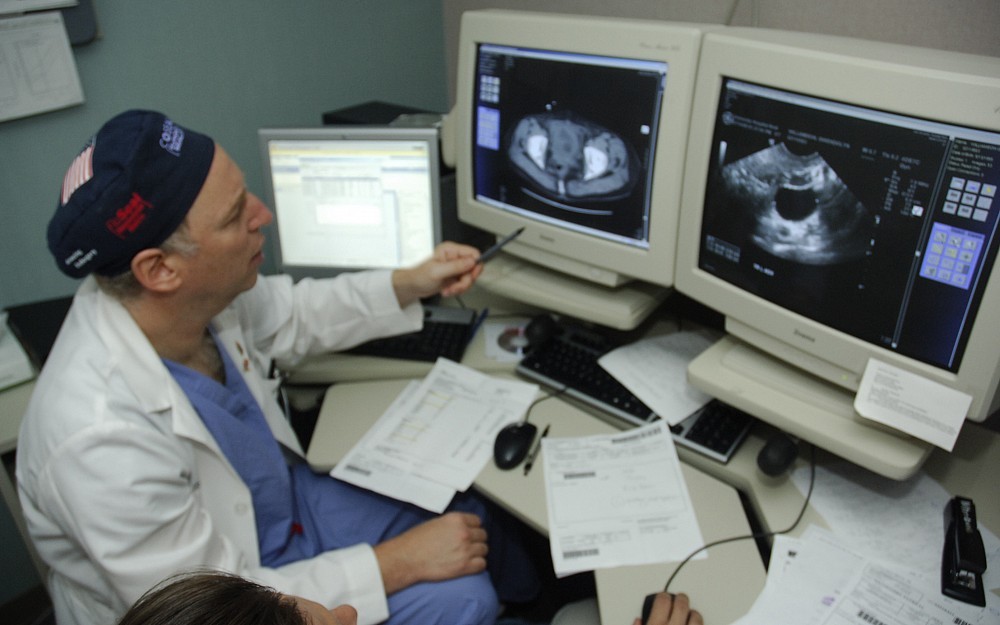
Fibroids are evaluated using ultrasound or magnetic resonance imaging (MRI) tests to determine the size, location and severity of the growth.
Prior to the uterine artery embolization procedure, the patient is moved into a hospital procedure room and given a mild anesthetic so she is drowsy but still conscious during treatment. The interventional radiologist then makes a tiny nick (2 mm) in the groin to gain access to the femoral artery. Using moving X-ray images (fluoroscopy) as a visual guide, the physician inserts a slender, flexible tube (catheter) and guides it into the uterine artery, which supplies blood to the fibroid.
Minuscule plastic particlesno larger than a grain of sandare then injected via the catheter into the uterine artery, where they block and cut off the fibroids blood supply, causing it to shrink and eventually die.
The procedure takes about an hour, and the patient usually goes home the next day. Many women can resume light activities within a few days and are back at work within a week.
About 90 percent of the women who choose this procedure experience a significantif not totalrelief from heavy bleeding, and about 85 percent have no more pain, says Zuckerman.
UCs interventional radiology team offers the uterine artery embolization procedure at
For more information on uterine fibroids, visit www.netwellness.org, a collaborative health-information Web site staffed by Ohio physicians, nurses and allied health professionals, or call (513) 584-0792 to schedule an appointment with Zuckerman.
Tags
Related Stories
Cancer Center plays key role in lab research, clinical trials for new pancreatic cancer drug
September 1, 2026

WLWT and WCPO highlighted the contributions of University of Cincinnati Cancer Center researchers that helped lead to the recent FDA approval of daraxonrasib, a new treatment for pancreatic cancer.
Cancer Center physician receives $150,000 New Investigator Research Grant to study treatment-resistant leukemia
September 1, 2026
The University of Cincinnati Cancer Center’s Sarah Skuli, MD, PhD, received a two‑year, $150,000 Leukemia Research Foundation New Investigator Grant to study TP53‑mutated leukemia, a treatment‑resistant subtype with very poor outcomes.
Heavy social media use linked to depression
August 31, 2026

U.S. News and World Report, Yahoo! News, MSN, USA Today and other national media highlight a new study by the University of Cincinnati and Northwestern University that found a correlation between heavy social media use and depression in adults.