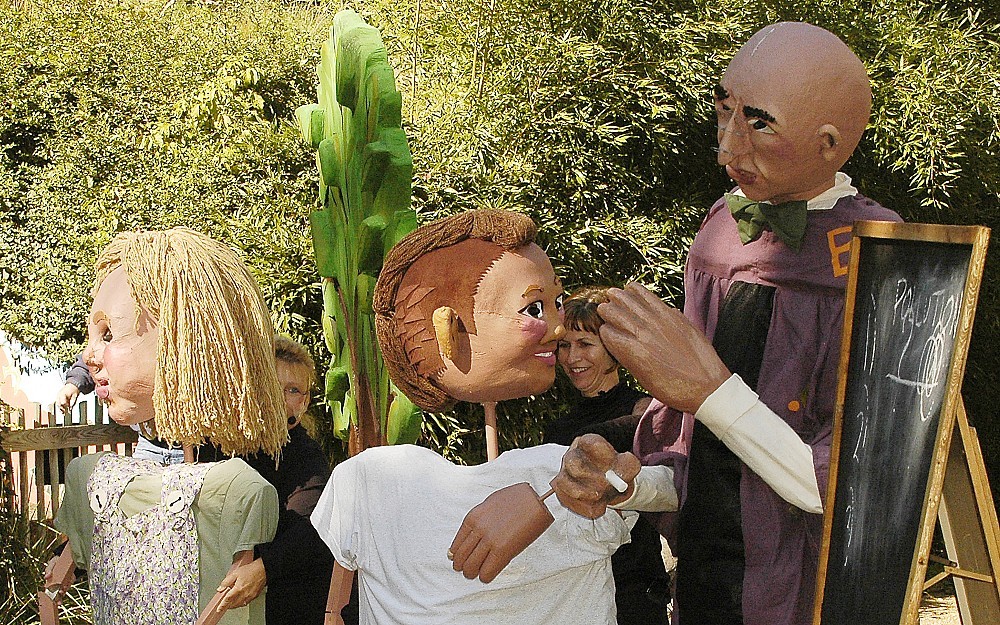
Researchers Use Puppets To Teach Toddlers

CINCINNATIUC environmental health researchers will use 15-foot-tall puppets to educate nearly 500 young children and their families about air pollution at the 5th Annual Cincinnati Childhood Allergy and Air Pollution Study (CCAAPS) family picnic.
The event takes place Saturday, Oct. 7, at the Cincinnati Zoo and Botanical Gardens Wings of Wonder Amphitheater from 11:00 a.m. to 1:00 p.m. The puppet show, which begins at 11:30 a.m., has been developed in conjunction with puppeteers from ImagineNation, who, in addition to performing the educational program titled Gloomy Doomy, Go Away! have custom designed puppets and settings for the event.
The families are participants in an epidemiologic study, funded by the National Institute of Environmental Health Sciences (NIEHS), that is examining the effects of diesel exhaust on childhood respiratory health and allergy development in an effort to better understand and develop ways to combat early childhood allergies.
Grace LeMasters, PhD, an epidemiologist and principal investigator for CCAAPS, will explain the UC research teams recent findings and offer practical advice on how to minimize childrens exposure to negative environmental factors. For example:
- Discourage idling of school buses to decrease childrens exposure to diesel exhaust, which has been related to wheezing
- Remove, with a dilution of bleach water, visible mold and water damage in the home, which is also associated with wheezing
Most recently the team found that infants born to parents with allergies are much more susceptible to develop allergies by ages 1 and 2 than previously thought.
All participants will receive free admission to the Cincinnati Zoo, lunch and prizes. The event is sponsored by NIEHS, the Ohio Environmental Protection Agency, AstraZeneca and Sepracor.
Tags
Related Stories
UC radiation oncologist speaks with Local 12 news about clinical trial for head and neck cancer treatment
August 10, 2026

Dr. Sara Medek, a UC radiation oncology professor, speaks with Local 12 news about a new clinical trial aimed at reducing radiation in certain areas while still treating cancer effectively but with fewer painful side effects.
Cancer Center director charts future based on collaboration, AI
August 10, 2026

David Gius, MD, PhD, was featured in a Cincinnati Business Courier article and The Cancer Letter’s “The Directors" podcast discussing his priorities and goals as he recently took the helm as director of the University of Cincinnati Cancer Center.
Bidirectional link between oral, kidney health calls for patient education, access
August 4, 2026

Despite growing awareness of the connection between oral health and chronic health conditions, patient awareness and access to dental care remain limited, according to University of Cincinnati experts who recently spoke with Healio | Nephrology News & Issues.