UC Given $1 Million to Develop Skin Cancer Prevention Treatment

CINCINNATIA research team led by University of Cincinnati (UC) scientists has received $1 million from the National Cancer Institute to develop a new topical treatment that would not only increase skin pigmentation to block harmful ultraviolet (UV) rays, but also repair damage that can lead to skin cancer.
The researchers will work with a chemically modified hormone called alpha-melanocyte stimulating hormone (alpha-MSH). Known to increase skin pigmentationthe tan that reduces dangerous UV ray penetrationalpha-MSH has also been found to repair precancerous damage that UV rays do to skin cell DNA, the genetic material within cells.
We hope to develop a new topical cream that will prevent skin cancer by both increasing skin pigmentation and at the same time repairing DNA damage caused by UV radiation, says study leader Zalfa Abdel-Malek, PhD, of UCs dermatology department.
We have already shown that alpha-MSH repairs DNA damage caused by excessive sun exposure, thus reversing the cancer-causing effects of UV radiation, says Abdel-Malek, who has studied this phenomenon in isolated human melanocytes, the cells that produce the tanning pigment melanin.
Abdel-Malek will work with Ana Luisa Kadekaro, PhD, a UC dermatology instructor, to determine the ability of alpha-MSH, and synthesized versions of it, to reduce DNA damage in melanocytes that have been exposed to UV radiation in the lab.
To make it easier for the hormone to penetrate the fatty lipid layer of the skin, team members James Knittel, PhD, of UCs College of Pharmacy, and Carrie Haskell-Luevano, PhD, of the University of Florida, have already reduced alpha-MSH from its original peptide chain of 13 amino acids to a chain of only four amino acids. They hope to make the chain even smaller, and consequently more effective at penetrating the skin to target the melanocytes.
Dorothy Supp, PhD, of UCs department of surgery, will study the synthesized peptides on artificial skin to determine whether, if applied as a topical cream, they can be absorbed through the skin and delivered to the melanocytes.
Gerald Kasting, PhD, also of UCs
According to the American Cancer Society, sun exposure is the main cause of skin cancer, of which 1 million new cases are diagnosed each year. Advanced melanoma, the deadliest form of skin cancer in the
Although melanoma currently accounts for only 8 percent of skin cancers, it causes almost all skin cancer deaths, and its incidence is rising at the rate of 4 percent a year. Melanoma is also the fifth and sixth most common cancer among men and women, respectively.
The impact of this grant is potentially tremendous, says Abdel-Malek. If this new prevention strategy works, it could ultimately reduce the ever-increasing incidence of skin cancer. It would especially benefit people with known high risk for skin cancer in general, especially those with fair skin, and might ultimately reduce the incidence of melanoma and prevent its recurrence in highly susceptible individuals.

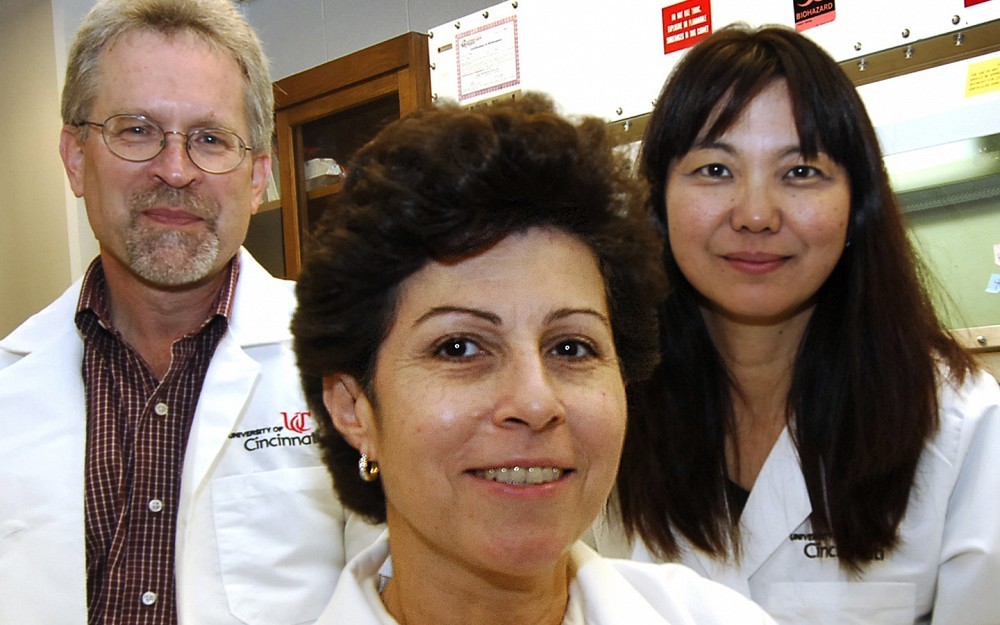
Researchers James Knittel, PhD, Zalfa Abdel-Malek, PhD, and Ana Luisa Kadekaro, PhD

Dermatology researchers Ana Luisa Kadekaro, PhD, and Zalfa Abdel-Malek, PhD, in the lab.
Tags
Related Stories
UC radiation oncologist speaks with Local 12 news about clinical trial for head and neck cancer treatment
August 10, 2026

Dr. Sara Medek, a UC radiation oncology professor, speaks with Local 12 news about a new clinical trial aimed at reducing radiation in certain areas while still treating cancer effectively but with fewer painful side effects.
Cancer Center director charts future based on collaboration, AI
August 10, 2026

David Gius, MD, PhD, was featured in a Cincinnati Business Courier article and The Cancer Letter’s “The Directors" podcast discussing his priorities and goals as he recently took the helm as director of the University of Cincinnati Cancer Center.
Bidirectional link between oral, kidney health calls for patient education, access
August 4, 2026

Despite growing awareness of the connection between oral health and chronic health conditions, patient awareness and access to dental care remain limited, according to University of Cincinnati experts who recently spoke with Healio | Nephrology News & Issues.