Jet Engines Help Solve the Mysteries of the Voice

Sound produced by vocal-fold vibration has been extensively researched, but the specifics of how airflow actually affects sound have not been shown using an animal modeluntil now.
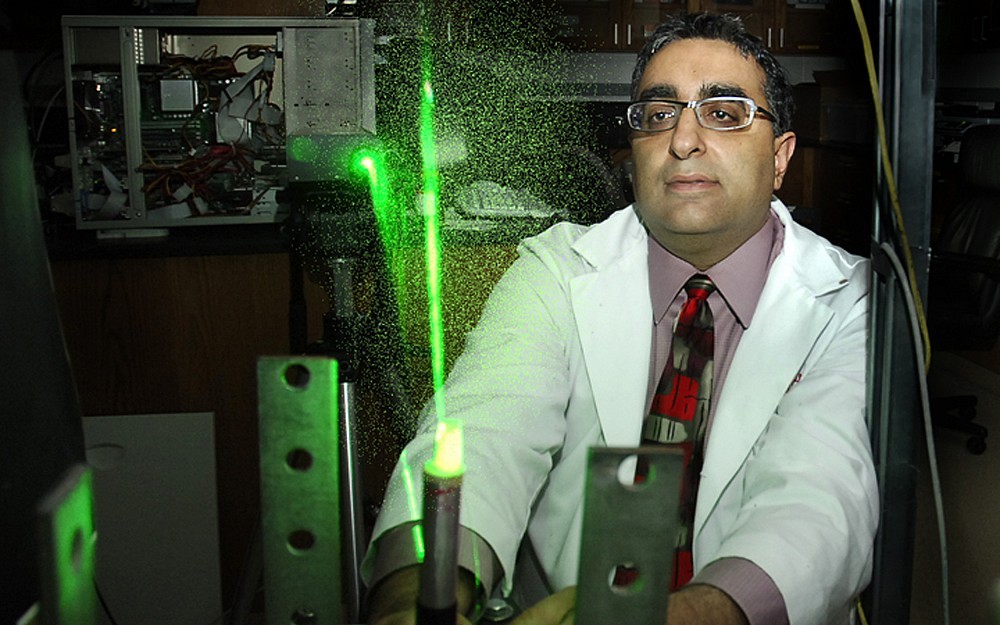
Vortices, or areas of rotational motion that look like smoke rings, produce sound in jet engines. New research from the University of Cincinnati (UC) uses methods developed from the study of jet noise to identify similar vortices in an animal model.
Sid Khosla, MD, lead author of the study, says vortices may help explain why individual voices are different and can have a different richness and quality to their sound.
If vortices didnt affect sound production, the voice would sound mechanical, says Khosla, assistant professor of otolaryngology. The vortices can produce sound by a number of mechanisms. This complexity produces a sound that makes my voice different from yours.
Khosla and his team report their findings in the March edition of the Annals of Otology, Rhinology and Laryngology.
Understanding how airflow patterns affect sound in a jet engine (aeroacoustics) helps us determine how we can reduce jet noise, says coauthor Ephraim Gutmark, PhD, a UC professor of aerospace engineering. We can apply the same physical understanding of aeroacoustics to study normal and abnormal voice.
According to Khosla, computational and theoretical models have been developed to demonstrate how vortices affect sound production, but the UC team is the first to demonstrate it using an animal model, which makes their findings more applicable to the human larynx.
Currently, when surgery is required to treat voice disorders, its primarily done on the vocal cords, says Khosla. Actually knowing there are additional sources that affect sound may open up a whole new way for us to treat voice disorders.
In addition to better surgery techniques, Khosla says, having a better understanding of how vortices affect voice production could help in the development of improved pharmacological approaches and clinical pathology services, as well as improved training of the voice.
Khosla and Gutmarks collaborators in the study are UCs Shanmugam Muruguppan, PhD, and Ronald Scherer, PhD, now at
The study was funded by a grant from the National Institute on Deafness and Other Communication Disorders (NIDCD).

Effie Gutmark (front), PhD, a UC professor of aerospace engineering, is applying his knowledge of jet engine noise in the study of normal and abnormal voice.
Tags
Related Stories
Cancer Center plays key role in lab research, clinical trials for new pancreatic cancer drug
September 1, 2026

WLWT and WCPO highlighted the contributions of University of Cincinnati Cancer Center researchers that helped lead to the recent FDA approval of daraxonrasib, a new treatment for pancreatic cancer.
Cancer Center physician receives $150,000 New Investigator Research Grant to study treatment-resistant leukemia
September 1, 2026
The University of Cincinnati Cancer Center’s Sarah Skuli, MD, PhD, received a two‑year, $150,000 Leukemia Research Foundation New Investigator Grant to study TP53‑mutated leukemia, a treatment‑resistant subtype with very poor outcomes.
Heavy social media use linked to depression
August 31, 2026

U.S. News and World Report, Yahoo! News, MSN, USA Today and other national media highlight a new study by the University of Cincinnati and Northwestern University that found a correlation between heavy social media use and depression in adults.