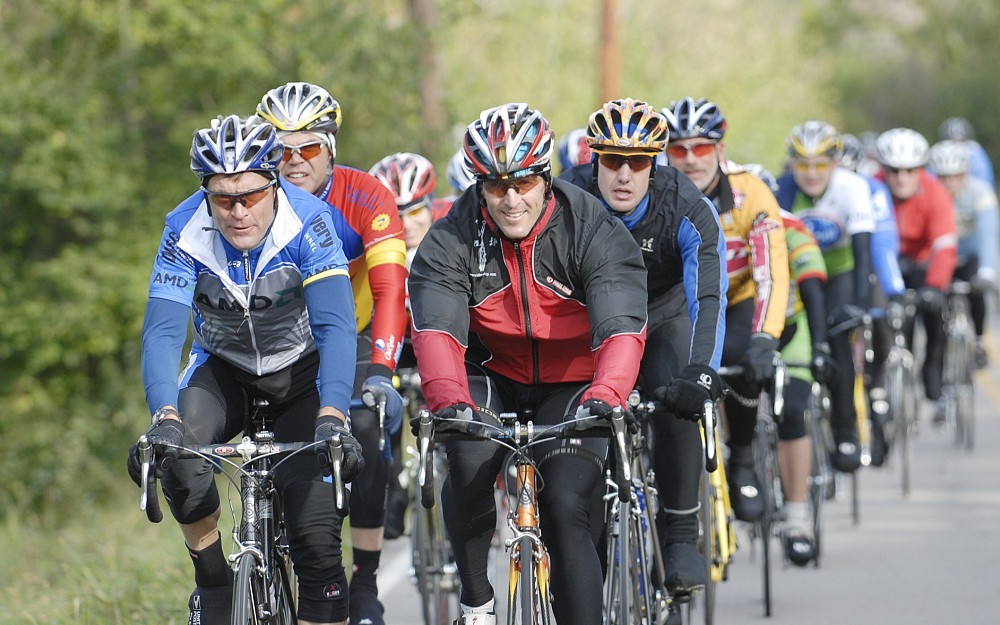
Sunflower Revolution Gala and Ride Funds Four Major Parkinson's Projects

The funding was provided by the Colorado-based Davis Phinney Foundation,whose October 2006 Sunflower Revolutiongala and bike ride in
A $50,000 grant went to Kim Seroogy, PhD, a UC neurology professor, and James Herman, PhD, professor of psychiatry, to continue their research into whether clinical depression accelerates the progression of Parkinsons.
Parkinsons disease is a degenerative neurological disorder involving the death of dopamine-producing neurons deep within the brain.
Depression is very common in Parkinsons, and is often said to contribute more to the lowered quality of life than the debilitating motor symptoms, said Seroogy, director of the Selma Schottenstein Harris Laboratory for Research in Parkinsons. This is detrimental in and of itself. But its also important to understand depressions effects on disease progression, and whether it exacerbates symptoms and the loss of dopamine cells in the brain.
Seroogy and Herman will study the phenomenon in rodents exposed to stress that mimics depression.
If their study shows that pre-existing and simultaneous depression increase nerve degeneration, the information can be used to test antidepressants and other drugs that protect the nervous system. The goal, of course, is to slow neurodegeneration and improve the quality of life for Parkinsons patients, Seroogy said.
The Sunflower Revolution also funded a clinical study of the effects of the surgical procedure called deep brain stimulation (DBS) on balance and gait, an animal study tracing development of Parkinsons disease years after a toxic exposure, and a clinical study to separately measure two aspects of bradykinesia, the slowing and constricting of movement and reflexes that are characteristic of Parkinsons.
DBS involves stimulating an area of the brain associated with movement. Fredy Revilla, MD, head of the Center for Parkinsons Disease and Movement Disorders at the Neuroscience Institute, received $45,000 to study how DBS affects balance and gait, in the hope of improving doctors ability to determine which patients will benefit most from and how to maximize the effectiveness of the procedure.
Timothy Collier, PhD, professor of neurology, received $40,000 from the foundation and has also been granted access to a unique collection of tissue, at a facility in St. Kitts,
Documentation of parkinsonism that results during a long lifespanand many, many years after an early toxic exposurewill provide the best evidence yet in support of one likely cause of Parkinsons, Collier said. If we can identify events that occur during the long interval between an initial silent exposure and the appearance of symptoms, we may be able to recommend medical or lifestyle changes that could halt the progression of degeneration and prevent the appearance of symptoms.
In the bradykinesia study, Alberto Espay, MD, an assistant professor of neurology, will apply his $45,000 Davis Phinney funding to separately studying slowness of movement and breadth of motion, to better understand how medications affect the two conditions. Its remarkable that bradykinesia, the defining feature of Parkinsons, remains so poorly understood, Espay said.
The 2006 Sunflower Revolution ride, which raised $300,000, earlier funded an effort to determine whether deep brain stimulation protects dopamine neurons in rodents affected by Parkinsons. Headed by Caryl Sortwell, PhD, associate professor of neurology, that study received $120,000.
The Davis Phinney Foundation supports research to understand, prevent and treat Parkinsons disease, which affects an estimated 1.5 million Americans. In 2006, the foundation named the Neuroscience Institute and
Were proud to support these important and original studies, said Davis Phinney, a world-renowned cyclist who was diagnosed with Parkinsons at age 40. They will further our mission to slow the progression of Parkinsons, while improving the lives of those who are battling against it.
This years Sunflower Revolution IV events are scheduled for Sept. 7 (gala), Sept. 8 (educational symposium and expo) and Sept. 9 (bike rides of 10, 40 and100 kilometers).
The Neuroscience Institute, a regional center of excellence at the University of Cincinnati and University Hospital, is dedicated to patient care, research, education and the development of new treatments for stroke, brain and spinal tumors, epilepsy, multiple sclerosis, trauma, and Parkinsons and Alzheimers disease.

Parkinson's disease experts Alberto Espay, MD, (left) and Kim Seroogy, PhD.

Fredy Revilla, MD, in the deparment of environmental health's biomechanics-ergonomics research laboratory.

Michael Behbehani, PhD, and Caryl Sortwell, PhD
Tags
Related Stories
UC radiation oncologist speaks with Local 12 news about clinical trial for head and neck cancer treatment
August 10, 2026

Dr. Sara Medek, a UC radiation oncology professor, speaks with Local 12 news about a new clinical trial aimed at reducing radiation in certain areas while still treating cancer effectively but with fewer painful side effects.
Cancer Center director charts future based on collaboration, AI
August 10, 2026

David Gius, MD, PhD, was featured in a Cincinnati Business Courier article and The Cancer Letter’s “The Directors" podcast discussing his priorities and goals as he recently took the helm as director of the University of Cincinnati Cancer Center.
Bidirectional link between oral, kidney health calls for patient education, access
August 4, 2026

Despite growing awareness of the connection between oral health and chronic health conditions, patient awareness and access to dental care remain limited, according to University of Cincinnati experts who recently spoke with Healio | Nephrology News & Issues.