New Knock-Out Gene Model Provides Molecular Clues to Breast Cancer

About a decade ago,
Unfortunately, because these mice lacked mammary glands as a consequence of genetic manipulation, using this model to study the relationship between the estrogen receptor and breast cancer proved ineffective, explains Sohaib Khan, PhD, professor of cell and cancer biology at UC.
Knocking out the estrogen receptor gene for the entire genome, as the NIH scientists did, doesnt just affect the function of the receptor in all estrogen-responsive organs. It also creates an imbalance in the bodys circulating sex hormone levels, which could affect other physiological functions, Khan adds. An alternative model was clearly needed to study the intricacies of estrogen receptors involvement in this disease.
Estrogen receptor is a cellular protein that binds with the hormone estrogen and facilitates action in different parts of the body, including the mammary gland. Research has shown that about 70 percent of breast cancer patients have estrogen receptor-positive breast cancer, meaning their tumors will have some beneficial response to anti-estrogen drugs like tamoxifen (ta-MOX-ee-fen, marketed as Nolvodex).
After two years of work, Khan says his team has developed a knock-out mouse model that will allow scientists to study the role of estrogen receptor in specific organs (for example, mammary glands) without affecting estrogen-signaling throughout the rest of its body.
Khan used what is called a conditional knock-out technique to develop a new mouse model that retains estrogen receptor in all tissues except mammary tissue, allowing scientists to study the receptors role in breast development and breast cancer.
Using this model, Khans team found that knocking out the gene only in mammary tissue resulted in abnormalities that compromised milk production in the nursing female. This suggests that estrogen expression is essential for normal duct development during puberty, pregnancy and lactation.
Khan and his coworkers report the creation of this model and its potential implications in an early online edition of the Proceedings of the National Academy of Sciences on Sept. 4, 2007, followed by the print issue Sept. 11, 2007. The study directly refutes previous research, which suggests that estrogen receptor in epithelial cells was not essential to normal mammary gland development.
Mammary tissue is made up of two cell typesstromal cells, which give the tissue structure, and epithelial cells, which make up the lining of the mammary gland and become cancerous in the majority of breast cancers.
Unlike other organs in the body, the mammary glands develop after birth in response to increases in circulating hormones. This triggers growth of a network of branched ducts throughout the breast tissue that do not change again until a woman becomes pregnant.
Even though the relationship between the estrogen receptor and breast cancer is well established, we still know very little about the receptors mechanism of action, explains Khan, corresponding author of the study. Unless we study those mechanisms more closely, improved strategies for breast cancer treatments will not be possible.
Premenopausal women with breast cancer are currently given five years of tamoxifen, a drug that blocks the estrogen receptor action in cancer cells, to prevent recurrence. Studies have shown that the drug reduces recurrence in 40 percent of the women who take it, but Khan says many women eventually develop resistance to the drug.
Using this unique mouse model, UC researchers are currently collaborating with scientists at Dana Farber Cancer Institute/Harvard Medical School to understand the relationship between estrogen-signaling and oncogene-mediated breast cancer development. Future findings from these studies could help scientists better understand the molecular origin of breast cancer and develop new drugs to more effectively treat it.
This study was funded by grants from the National Institutes of Health, U.S. Department of Defense and the UC pilot cancer grant program. Collaborators include Kay-Uwe Wagner, PhD, of the

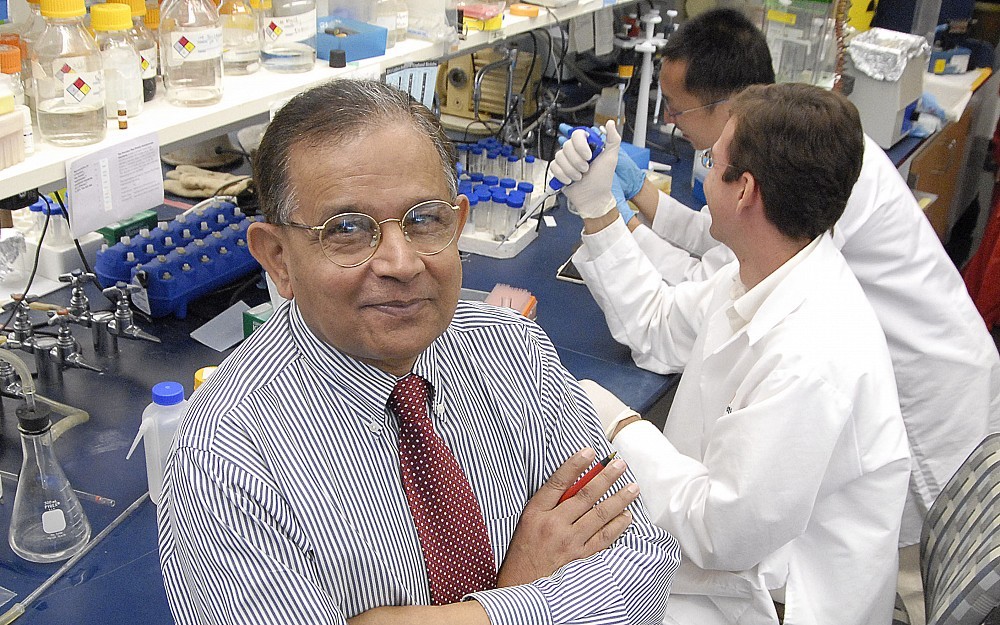
Yuxin Feng, David Manka, PhD, and Sohaib Khan, PhD, have developed a estrogen receptor gene knock-out mouse model.
Tags
Related Stories
UC radiation oncologist speaks with Local 12 news about clinical trial for head and neck cancer treatment
August 10, 2026

Dr. Sara Medek, a UC radiation oncology professor, speaks with Local 12 news about a new clinical trial aimed at reducing radiation in certain areas while still treating cancer effectively but with fewer painful side effects.
Cancer Center director charts future based on collaboration, AI
August 10, 2026

David Gius, MD, PhD, was featured in a Cincinnati Business Courier article and The Cancer Letter’s “The Directors" podcast discussing his priorities and goals as he recently took the helm as director of the University of Cincinnati Cancer Center.
Bidirectional link between oral, kidney health calls for patient education, access
August 4, 2026

Despite growing awareness of the connection between oral health and chronic health conditions, patient awareness and access to dental care remain limited, according to University of Cincinnati experts who recently spoke with Healio | Nephrology News & Issues.