Biomarker May Be an Early Predictor of Advanced Breast Cancer

Detailed Oct. 24, 2007, in an early online edition of the International Journal of Cancer, the discovery could one day influence therapy decisions and prevent patients from unnecessarily undergoing aggressive cancer treatments.
When diagnosing breast cancer, pathologists currently look for elevated levels of three standard molecules known to make tumors grow in the breast. These molecules
estrogen receptor (ER), progesterone receptor (PR) and HER2are used as biomarkers for diagnosis and individually detect only a fraction of breast cancers.
The problem with these biomarkers is that many of them are present at some level in the normal breast, says Georg Weber, MD, PhD, lead investigator of the new study and associate professor of pharmacy at the
Weber and his team have identified a molecule, osteopontin-c, that is absent from the normal breast and appears to more accurately predict breast cancer that will become metastatic and spread to distant organs from the original tumor site.
In normal levels, osteopontin is a protein used by the immune system to help cells move and migrate. There are three forms of osteopontina, b and cwhich are formed by splicing, or cutting and pasting, ribonucleic acid (RNA) molecules to make variations of the original gene. Osteopontin-a is the normal form that helps with immune functions. Little is known about osteopontin-b, but if present its levels are very low. Osteopontin-c is the molecule Weber and his team discovered is a good biomarker of breast cancer.
In a two-year evaluation of 178 breast tumors, normal and abnormal tissue samples, they found that osteopontin-c was present in 78 percent of cancers and in 36 percent of the surrounding tissues. It was not detected at all in normal tissues.
In 56 breast cancers, 20 were positive and 36 were negative for estrogen receptor, 19 were positive and 37 were negative for progesterone receptor, and 26 were positive for HER2 with 30 negative.
Osteopontin-c was present in a substantially higher number of breast cancers than the three biomarkers traditionally used to diagnose breast cancer, says Weber. We also found that the cancers containing osteopontin-c correlated with a higher tumor grade, meaning they were more likely to become aggressive cancer.
If we know that this molecule is not present in a patient with breast cancer, its more likely that we can treat them with conservative therapy rather than breast surgery, hormone therapy or chemotherapy because we know its less likely to metastasize, he adds. On the other hand, if we know that a patient has this molecule early in their diagnosis, we can treat it more aggressively because we know their cancer is likely to become invasive.
The study was funded by grants from U.S. Department of Defense Breast Cancer Program and the UC cancer research program. The tissue procurement was supported by a grant from the National Institute of Health.
Collaborators include UCs Mana Mirza and Elizabeth Shaughnessy, MD, John Hurley, Kristie Vanpatten and Gary Pestano of Ventana Medical Systems in

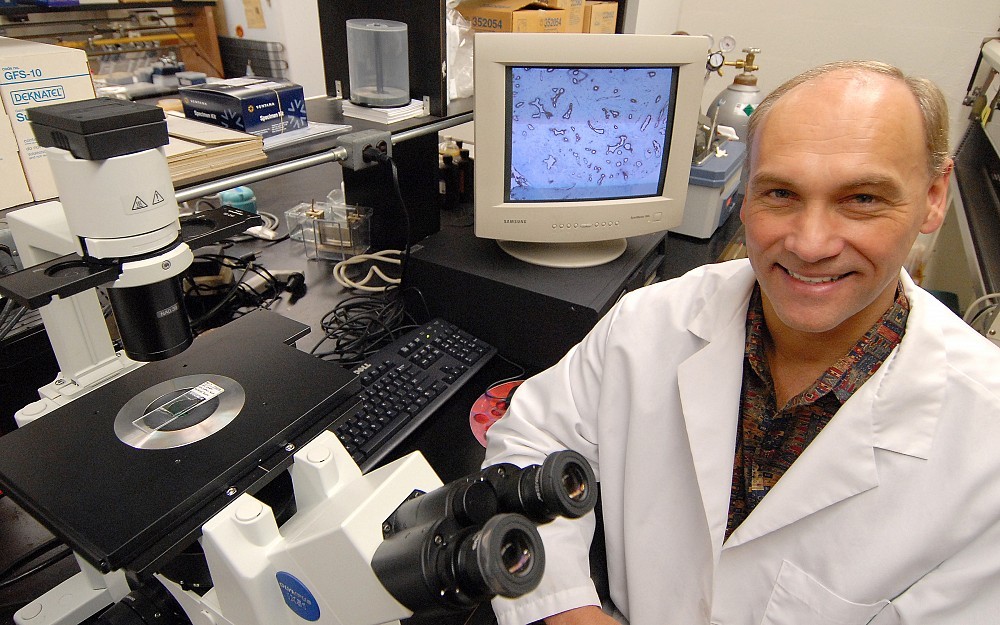
Georg Weber, MD, PhD, and his team have found a biomarker that may predict advanced breast cancer.
Tags
Related Stories
Cancer Center plays key role in lab research, clinical trials for new pancreatic cancer drug
September 1, 2026

WLWT and WCPO highlighted the contributions of University of Cincinnati Cancer Center researchers that helped lead to the recent FDA approval of daraxonrasib, a new treatment for pancreatic cancer.
Cancer Center physician receives $150,000 New Investigator Research Grant to study treatment-resistant leukemia
September 1, 2026
The University of Cincinnati Cancer Center’s Sarah Skuli, MD, PhD, received a two‑year, $150,000 Leukemia Research Foundation New Investigator Grant to study TP53‑mutated leukemia, a treatment‑resistant subtype with very poor outcomes.
Heavy social media use linked to depression
August 31, 2026

U.S. News and World Report, Yahoo! News, MSN, USA Today and other national media highlight a new study by the University of Cincinnati and Northwestern University that found a correlation between heavy social media use and depression in adults.