UC HEALTH LINE: Swallowing Disorder Can Cause Serious Health Issues

CINCINNATIStruggling to swallow food or coughing up food while eating is not only embarrassing but it can be a sign of a serious health problem.
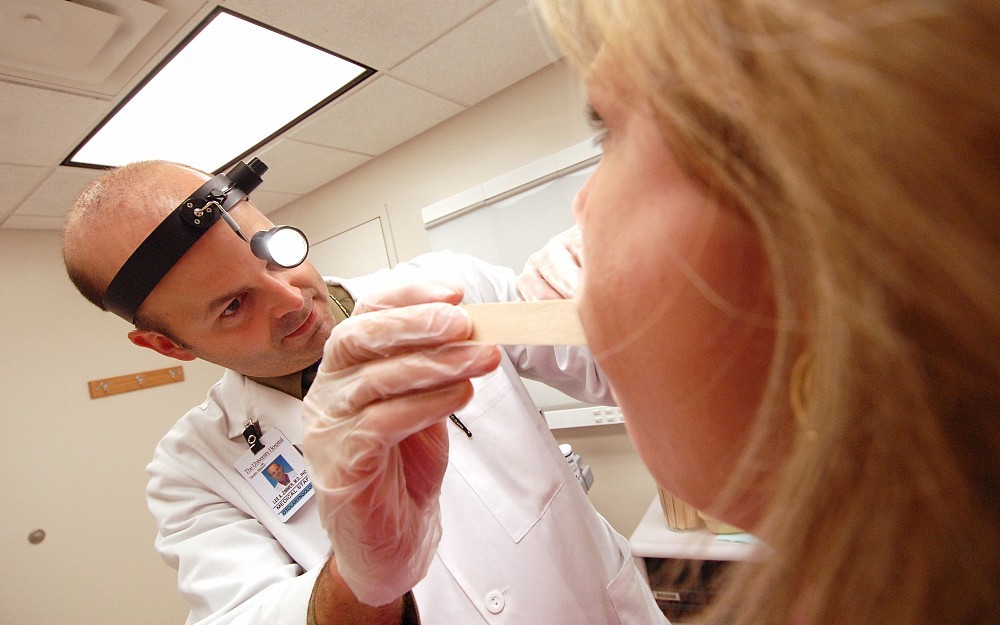
Bad breath, difficulty swallowing, a feeling of food sticking in the throat or unexplained weight loss are all signs of a swallowing disorder, says UC otolaryngologist Lee Zimmer, MD.
One disorder, called Zenkers diverticulum, is caused by a pouch that develops in the walls of the lower throat. It usually occurs in people over 50.
When we swallow, theres a muscular valve called the upper esophageal sphincter thats supposed to relax and allow food and liquids to pass. In some people, and we dont know the exact cause, that muscle doesnt relax properly, says Zimmer.
When that happens, the muscle at the top of the esophagusthe tube that connects the pharynx (throat) with the stomachbecomes herniated and a pouch develops.
Were not even sure how common this condition is because there are a lot of people who are undiagnosed, Zimmer says.
The condition is diagnosed through a barium esophagram. For this test, patients swallow a barium liquida white, chalky substancewhich allows X-ray images to be made of their esophagus.
Zenkers diverticulum is often categorized as small, medium or large in size. If a patient has a small Zenkers diverticula and food is not getting caught in the esophagus, he or she can simply be monitored for changes.
For patients who develop a medium or large-sized pouch, surgery is usually recommended.
Zimmer performs the surgery through an endoscopic approach, which has fewer complications than conventional open surgery.
In the endoscopic approach, a scope is placed through the mouth down into the proximal esophagus allowing surgeons to see the esophagus and the pouch.
They then use a special instrument that cuts and staples at the same time to divide the cricopharyngeus (a muscle in the throat that acts as a one-way valve) and the wall between the pouch and the esophagus. This eliminates the pouch by making it part of the upper esophagus.
For patients with a pouch smaller than 2 to 2 ½ centimeters, an endoscopic approach often cannot be done because the stapler is too large and doesnt fit into the pouch.
In many cases where the pouch is smaller, surgeons will perform open surgery which has a higher complication rate, says Zimmer.
For those patients we still offer an endoscopic approach by using a harmonic scalpel which uses high frequency vibrations to cut and seal the tissue instead of a stapling device.
Zimmer says there is a success rate of 90 percent for patients who undergo surgery for Zenkers.
Zenkers isnt a condition thats just socially embarrassingit can cause serious health issues. People can experience malnutrition, especially the older population we often see with this condition, and recurrent pneumonia as well as aspiration because food or liquid can enter the unprotected airway, says Zimmer.
For more information or to schedule an appointment, call (513) 475-8400.
More information on swallowing issues is available at
, a collaborative health-information Web site run by UC, Case Western Reserve University and Ohio State University and staffed by Ohio physicians, nurses and allied health professionals.

Lee Zimmer, MD, specializes in head and neck surgery.
Tags
Related Stories
UC radiation oncologist speaks with Local 12 news about clinical trial for head and neck cancer treatment
August 10, 2026

Dr. Sara Medek, a UC radiation oncology professor, speaks with Local 12 news about a new clinical trial aimed at reducing radiation in certain areas while still treating cancer effectively but with fewer painful side effects.
Cancer Center director charts future based on collaboration, AI
August 10, 2026

David Gius, MD, PhD, was featured in a Cincinnati Business Courier article and The Cancer Letter’s “The Directors" podcast discussing his priorities and goals as he recently took the helm as director of the University of Cincinnati Cancer Center.
Bidirectional link between oral, kidney health calls for patient education, access
August 4, 2026

Despite growing awareness of the connection between oral health and chronic health conditions, patient awareness and access to dental care remain limited, according to University of Cincinnati experts who recently spoke with Healio | Nephrology News & Issues.