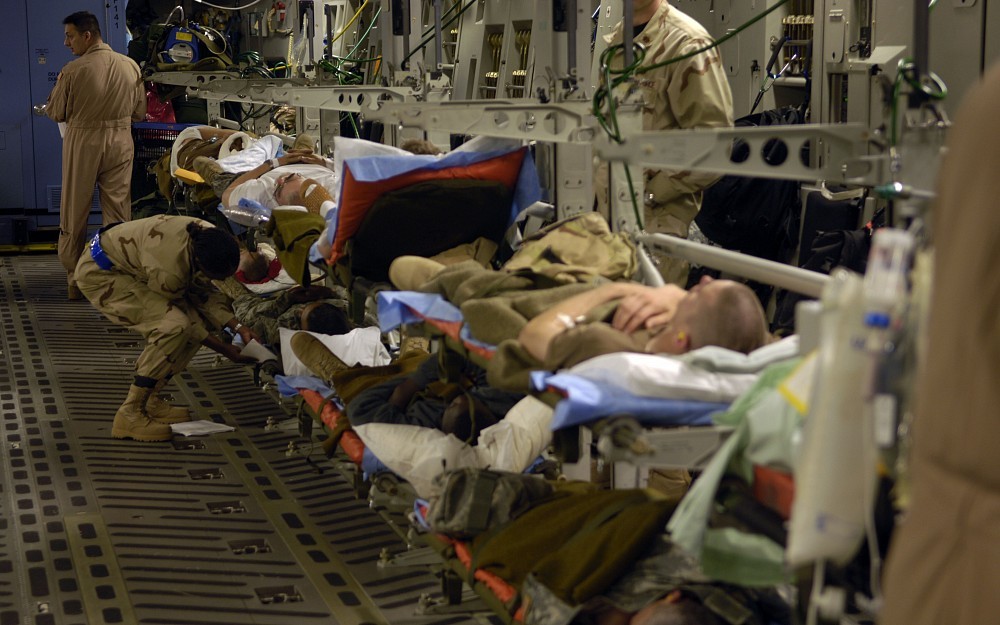
Air Force Grant Targets Medical Evacuation Procedures

There is a sense of urgency about getting these wounded soldiers to a cleaner, safer environment, explains Col. Warren Dorlac, MD, co-principal investigator on the UC study. Our overriding goal is to protect patients from anything that could potentially lead to a cascade of medical complications that will jeopardize survival. But the reality is that evacuation is happening at a time when they are most prone to a secondary hit.
According to
Avoiding this second hitsuch as a serious infection or pneumoniaimproves survival dramatically. Doing so is especially challenging, however, in the middle of a war zone where medical troops are being cared for in maze of canvas and plywood hospital tents.
Dorlac and his colleagues believe there may be a direct link between inflammatory changes in the body and the timing of strategic medical evacuation movements.
For this study, UC researchers will investigate how early evacuation of combat casualties affects the bodys inflammatory response, possibly predisposing already critically wounded people to death from related complications.
We need to understand the biological effects of the hypobaric environment so we can minimize the risk for additional injuries, says Dorlac, associate professor of surgery at UC and director of the
Currently, no data exists on the impact of the hypobaric environmentcharacterized by reduced oxygen levelsand altitude on patients recovering from traumatic injuries.
Determining the ideal time to fly could reduce infection, minimize hospital stays and result in fewer amputations and deaths for the soldiers defending our country, adds Dorlac.
Because of the nature of a combat zone, the average medical evaluation plane quickly ascends 8,000 feet within 10 minutes. The plane is very different than a hospital intensive care unit90 decibels of noise, lots of vibration and a pressurized environment that results in less oxygen to revive tissues and relieve stress on the bodys systems.
This, says Dorlac, is far from the ideal setting for a traumatic brain-injured or other severely injured patient.
When we send a patient up in an airplane, were essentially putting them into an environment we know cant be good for them in an effort to move them to safety, he adds. A dark, quiet intensive care unit with very little stimulation or distract is preferable. Even minor movements can cause a change in intracranial pressure.
For this two-phase study, the UC team will create three animal models representative of traumatic military combat injuries: controlled hemorrhage, hepatic ischemia reperfusion and scald/burn.
The controlled hemorrhage model, characterized by a low but sustainable level of blood pressure, is meant to reflect a soldier who has experienced a heavy-bleeding wound but doesnt reach a field hospital to receive fluids for several hours.
Hepatic ischemia reperfusion model represents a patient who needs serious abdominal surgery that requires re-establishing blood flow to a major organ.
The scald/burn model corresponds to a blast burn wound from weapon fire.
Each model has a different inflammatory response, all of them severe and relevant to injuries our soldiers are experiences during war, explains Alex Lentsch, PhD, co-principal investigator of the study and director of UCs surgical research unit.
By understanding how the inflammatory response evolves over the course of different injuries, flight times and altitudes, he adds, we will be able to better target care for patients who have been severely injured and need to be moved across country.
After taking baseline biological measurements, researchers will test whether moving to an altitude of 8,000 feet increases the bodys inflammatory response. This information is necessary to determine an ideal to time to fly that minimizes the risk for additional medical complications.
Cellular inflammation markers in the blood will be measured before and after flight to determine how different altitudes affect the bodys inflammatory response after injury.
When a person experiences trauma and loses a lot of blood, the body sends warning signals and stimulates certain cells that will try to fix or repair the problem, causing inflammation, explains Lentsch. But this storm of cellular response is unselective. This all eventually leads to multiple organ dysfunction.
The studys second phase will focus on a more complex brain injury model using concepts learned in the initial research. Researchers will continue to look at the effect of flight timing and altitude on the patients inflammatory response but also monitor blood oxygenation levels and intracranial pressure.
Three areas have been shown to increase brain tissue loss and increase mortality in head injured patients: lack of oxygen (hypoxia); low blood pressure (hypotension); and increased intracranial pressure, which can be brought on by a low oxygen environment characteristic of a medical evacuation plane.
There is nothing known beyond anecdotal evidence about inflammations affects on the survival of patients with traumatic injuries, so we have a great opportunity to learn more about this problem and make an impact on the real world.
Timothy Pritts, MD, PhD, and Lt. Col. Gina Dorlac, MD, are co-investigators in this study. Maj Stephen Barnes, MD, previously of CSTARS Cincinnati will also stay involved. Testing will take place both at UC and Brooks Air Force Base in
Tags
Related Stories
UC radiation oncologist speaks with Local 12 news about clinical trial for head and neck cancer treatment
August 10, 2026

Dr. Sara Medek, a UC radiation oncology professor, speaks with Local 12 news about a new clinical trial aimed at reducing radiation in certain areas while still treating cancer effectively but with fewer painful side effects.
Cancer Center director charts future based on collaboration, AI
August 10, 2026

David Gius, MD, PhD, was featured in a Cincinnati Business Courier article and The Cancer Letter’s “The Directors" podcast discussing his priorities and goals as he recently took the helm as director of the University of Cincinnati Cancer Center.
Bidirectional link between oral, kidney health calls for patient education, access
August 4, 2026

Despite growing awareness of the connection between oral health and chronic health conditions, patient awareness and access to dental care remain limited, according to University of Cincinnati experts who recently spoke with Healio | Nephrology News & Issues.