Researchers Receive Over $2 Million to Study Dialysis Access

But stenosis, or narrowing of the veins, often causes restricted access to the point in the body where blood is removed and then replaced during the dialysis process.
The UC nephrology division and the Cincinnati Dialysis Access Research Program (CAP) received two major grants to study why arteriovenous fistulas in hemodialysis patients are often unsuccessful.
Arteriovenous fistulas connect the artery and vein in dialysis patients and are essential for the removal and purification of blood during hemodialysis.
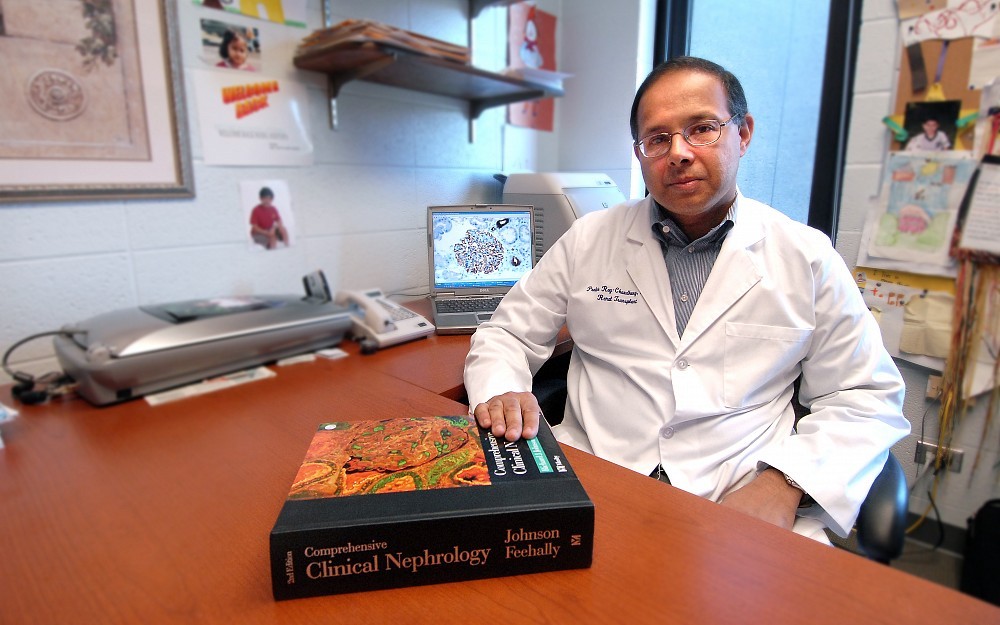
Prabir Roy-Chaudhury,
In addition, the team received a VA Merit Review grant$600,000look into the causes of fistula failure, such as blood flow abnormalities and cellular stress.
Unfortunately, a patients lifelineor dialysis accessis often compromised because of stenosis, Roy-Chaudhury says. As a result, hemodialysis vascular access dysfunction is currently the Achilles heel of hemodialysis, resulting in a significant morbidity, at a cost of over $1 billion annually.
Roy-Chaudhury, professor of medicine at UC and director of the CAP, says these grantswhich increase the funding of the CAP to almost $4 millionwill allow researchers to explore new pathways to prevent dialysis access dysfunction and improve the quality of life for dialysis patients.
The CAP is a translational, multi-disciplinary initiative that aims to improve dialysis access care through the application of new therapies.
Major collaborators include Rino Munda, MD, and colleagues from the department of transplant surgery, as well as physicians and researchers from the departments of nephrology, mechanical engineering, pathology, biomedical engineering, radiology, cardiology, pharmacy and community nephrologists.
This is a unique program in which we go from animal models to clinical trial research to clinical care, Roy-Chaudhury says.
Tags
Related Stories
UC study shows lack of awareness for lung cancer screenings across country
August 21, 2026
University of Cincinnati Cancer Center researchers have published a study in the American Journal of Surgery that found only 15% of eligible American adults have discussed lung cancer screening with their doctors.This research emphasizes the need to spread awareness and better educate the public about screening through low-dose computed tomography.
UC radiation oncologist speaks with Local 12 news about clinical trial for head and neck cancer treatment
August 10, 2026

Dr. Sara Medek, a UC radiation oncology professor, speaks with Local 12 news about a new clinical trial aimed at reducing radiation in certain areas while still treating cancer effectively but with fewer painful side effects.
Cancer Center director charts future based on collaboration, AI
August 10, 2026

David Gius, MD, PhD, was featured in a Cincinnati Business Courier article and The Cancer Letter’s “The Directors" podcast discussing his priorities and goals as he recently took the helm as director of the University of Cincinnati Cancer Center.