New Technology May Help Eliminate Deadly Type of Esophageal Cancer

Barretts esophagus is a condition in which the tissue lining the esophagusthe muscular tube that connects the mouth to the stomachis replaced by tissue that is similar to the lining of the intestine. Barretts is commonly found in people with chronic gastroesophageal reflux disease, often called GERD or acid reflux, and can lead to a deadly type of esophageal cancer.
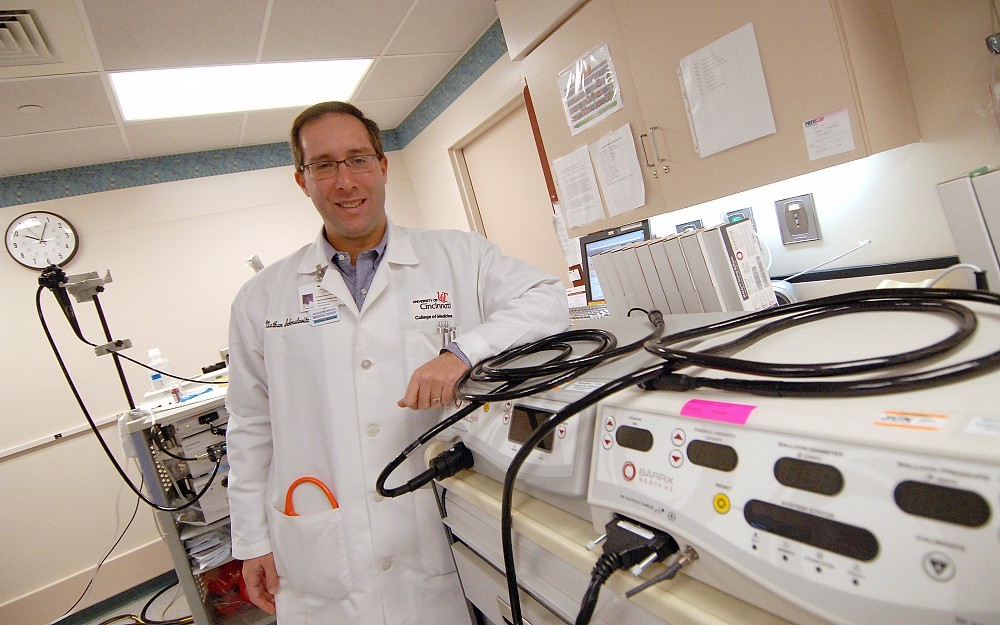
Nathan Schmulewitz, MD, assistant professor of digestive diseases at the University of Cincinnati (UC), is using a new technologycalled HALOwhich uses radiofrequency ablation to burn away this lining.
He says
Previously, the only way to cure Barretts was through surgerytaking out the portion of the esophagus that was affected and pulling the stomach into the chestor Photodynamic therapy, PDT, which also involves burning the esophageal lining, he says, noting that PDT causes a deeper burn, predisposing the patient to higher complication rates and possibly leading to severe skin burns. This new technology is a big deal. It is essentially curing the disease with a minimally-invasive procedure.
Radiofrequency ablationwhich has been used to destroy tumors in other organsuses an electrode to burn the circumferential lining of the esophagus away.
It is very safe and is done as an outpatient endoscopy procedure, Schmulewitz says. Our goal is to eradicate a known, precancerous condition.
Patients with Barretts esophagus who have shown precancerous changes on biopsy samples as well as those who have not yet demonstrated precancerous changes are candidates for the procedure.
Schmulewitz has no financial interests in Barrx, the company that manufactures the HALO ablation technology.

Doctors at University Hospital are using a new technology that could help eliminate the risk of cancer for patients with Barrett's esophagus.

Nathan Schmulewitz, MD, department of internal medicine, division of digestive diseases
Tags
Related Stories
Cancer Center plays key role in lab research, clinical trials for new pancreatic cancer drug
September 1, 2026

WLWT and WCPO highlighted the contributions of University of Cincinnati Cancer Center researchers that helped lead to the recent FDA approval of daraxonrasib, a new treatment for pancreatic cancer.
Cancer Center physician receives $150,000 New Investigator Research Grant to study treatment-resistant leukemia
September 1, 2026
The University of Cincinnati Cancer Center’s Sarah Skuli, MD, PhD, received a two‑year, $150,000 Leukemia Research Foundation New Investigator Grant to study TP53‑mutated leukemia, a treatment‑resistant subtype with very poor outcomes.
Heavy social media use linked to depression
August 31, 2026

U.S. News and World Report, Yahoo! News, MSN, USA Today and other national media highlight a new study by the University of Cincinnati and Northwestern University that found a correlation between heavy social media use and depression in adults.