UC HEALTH LINE: Penicillin Allergy Not Always Accurate

If you think that you are allergic to penicillin, ask yourself this: How do you know?
Unless youve had the allergy confirmed by a health care professional, you cant know for certain.
People often believe they are allergic to penicillin for many reasons: Maybe they were told by their parent as a child or had a reaction such as a rash that occurred when they had a virus or were taking other medications.
Now, for the first time, researchers at the University of Cincinnati (UC)
Prior allergy studies already place the inaccuracy of self-reporting a penicillin allergy at around 85 percent. What emergency medicine researchers found was that the number of people who reported a history of being allergic to penicillin but did not react when skin tested was slightly higher91 percent. The study also concluded that testing for penicillin allergy using skin tests in an emergency department setting was feasible and could allow for more appropriate antibiotic selection in certain cases.
Among the advantages: Penicillin, the first antibiotic discovered, is less expensive; its clinically effective in combating bacterial infections such as strep; and it lessens the use of broad-based antibiotics, which contribute to bacterial resistance, say study co-authors Joseph Moellman, MD, department of emergency medicine, and Jonathan Bernstein, MD, department of internal medicine, division of immunology, allergy section.
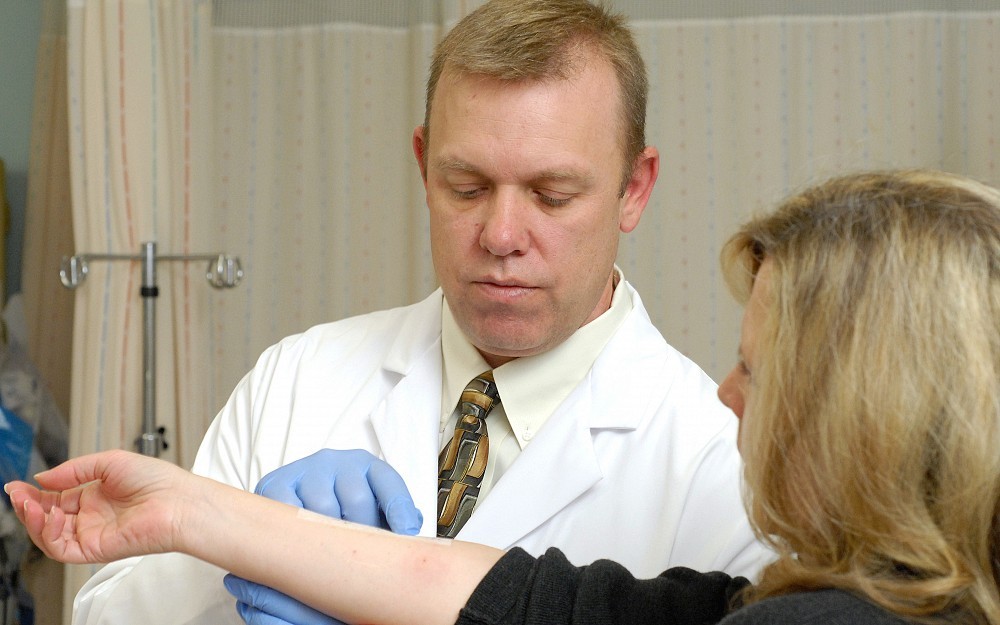
The study, an interdisciplinary effort, involved penicillin skin testing, which was administered to consenting patients who self-reported a penicillin allergy in the University Hospital emergency department. Out of 150 participants, 137 displayed false positives; meaning they did not react adversely to penicillin testing.
The implications, both Moellman and Bernstein say, are that a vast majority of the patient population in the emergency department could be feasibly tested and prescribed penicillin.
The study was funded by the

Joseph Moellman, MD, tests for penicillin allergy in the emergency department.
Related Stories
'Discovery, mentorship, momentum': UC College of Medicine's graduate programs celebrate year of success
September 22, 2026
From new mentorship honors to a growing research pipeline, see how the University of Cincinnati College of Medicine's graduate programs made this a standout year.
Tina Cheng, MD, receives American Academy of Pediatrics’ highest honor
September 22, 2026
UC Pediatrics chair Tina Cheng, MD, has received the American Academy of Pediatrics' highest honor for her decades of advancing child health.
President Pinto’s 2nd glow party brings first-year Bearcats together
September 20, 2026
UC President Neville Pinto and team hosted the second annual Bright Beginnings glow party for first-year students