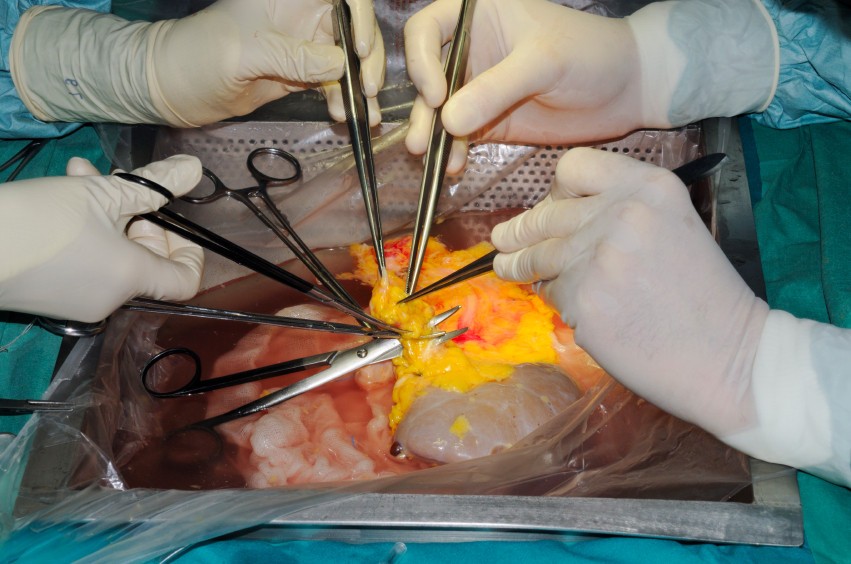
Altruistic, Paired Kidney Donors Can Spur More Transplants, Study Shows

This study is published in the March 12, 2009, edition of the New England Journal of Medicine.
Jonathan Kopke, research associate in the UC department of public health sciences, and his colleagues from around the country assembled a chain that began with one altruistic donor and has resulted in 10 transplants so far.
Kopke says that this idea is an extension of what has come to be known as kidney paired donation.
There are many people who need kidney transplants and who have loved ones willing to donate an organ to them, but those loved ones arent suitable donors for them because theyre immunologically incompatible, Kopke says. The paired donation procedure allows us to avoid these problems by arranging for two pairs who are caught in the same dilemma to solve each others problems by simply swapping donors.
Finding two pairs with complementary incompatibilities is very unlikely, though, statistically speaking.
He continues, On the other hand, we discovered that if we started with an altruistic donor, who gave to someone in need purely out of the kindness of his or her heart, the transplant recipients loved one could then give a kidney to someone else in the system.
Its much easier to find someone who can use a kidney when we arent restricted to finding someone who can also give a suitable kidney back. Were learning that these extended chains of donations can yield many more transplants than simple exchanges ever could.
Researchers completed this work over the course of six years in hospitals nationwide.
Kopke, co-author of the study, says this is the first instance of an extended altruistic-donor chain that has been reported.
He adds that another advantage of this arrangement is that the necessary surgeries can be done over a period of weeks or months, as opposed to on the same day.
The rule has always been that the transplants all had to be done simultaneously to avoid the possibility of someone backing out, Kopke says. In this case, even if a donor does renegeand that hasnt happened yetthe rest of the people in the chain arent irreparably harmed.
Kopke says these new findings show that one donor could have the potential to help dozens of people who need a transplant.
Just one generous act could theoretically save hundreds of lives, he says. This type of chain has the potential to really shorten the long waiting lists to receive deceased-donor kidney transplants.
This study was funded by the Alliance for Paired Donation.
Tags
Related Stories
UC radiation oncologist speaks with Local 12 news about clinical trial for head and neck cancer treatment
August 10, 2026

Dr. Sara Medek, a UC radiation oncology professor, speaks with Local 12 news about a new clinical trial aimed at reducing radiation in certain areas while still treating cancer effectively but with fewer painful side effects.
Cancer Center director charts future based on collaboration, AI
August 10, 2026

David Gius, MD, PhD, was featured in a Cincinnati Business Courier article and The Cancer Letter’s “The Directors" podcast discussing his priorities and goals as he recently took the helm as director of the University of Cincinnati Cancer Center.
Bidirectional link between oral, kidney health calls for patient education, access
August 4, 2026

Despite growing awareness of the connection between oral health and chronic health conditions, patient awareness and access to dental care remain limited, according to University of Cincinnati experts who recently spoke with Healio | Nephrology News & Issues.