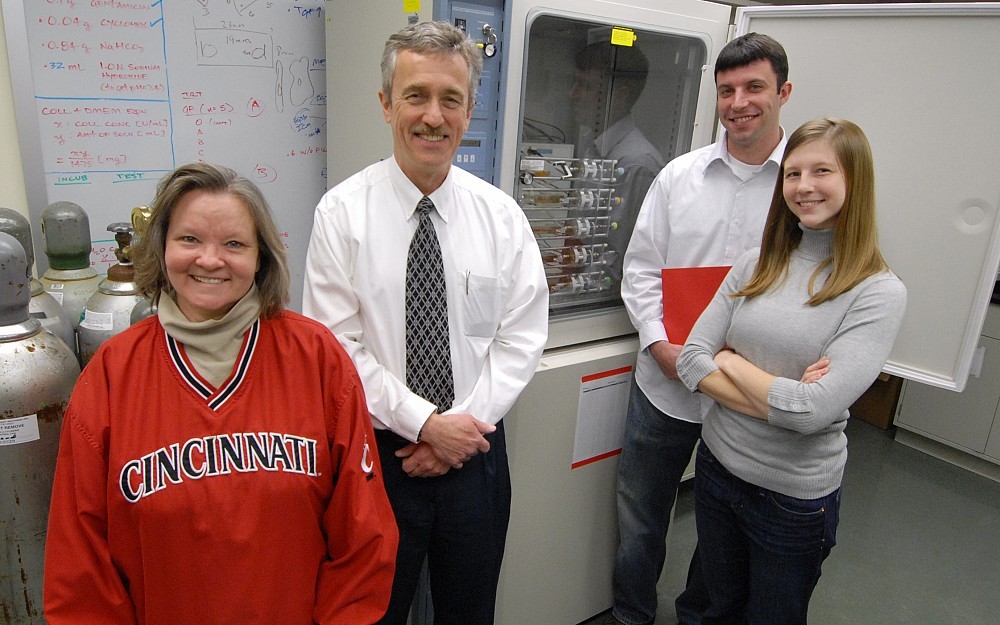
$3.75 Million Grant Advances Tissue Engineering Partnership

CINCINNATIAn award from the National Institute of Arthritis and Musculoskeletal and Skin Diseases (NIAMS) will aid a partnership between the University of Cincinnati (UC) and Cincinnati Childrens Hospital Medical Center in finding new ways to use adult stem cells to speed repair of musculoskeletal soft tissue injuries.
The five-year grant is for $3.75 million and involves collaboration between UCs Department of Biomedical Engineering and the Division of Developmental Biology at Cincinnati Children's.
David Butler, PhD, UC professor of biomedical engineering, says the award is designated as a Bioengineering Research Partnership (BRP) to support a multidisciplinary research team applying an integrative approach to solving a major biomedical problem.
For more than a decade, Butlers lab has focused on developing better repairs for the patellar tendon, the site where surgeons harvest tissue when reconstructing a torn anterior cruciate ligament (ACL). Because surgeons remove about a third of the tendon for the ACL, the site remains a problem for many patients. It also could be a source of another graft if the site could be repaired.
A lot of times patients say their pain doesnt come from the ACL graft, but from the donor site where the graft was harvested, says Butler. So that motivated us to look at tendon repair and tendon healing, and to use this model to investigate tissue engineering principles and ways in which we can more effectively repair any damaged tendon.
Butler and his team have previously used a paradigm they developed called Functional Tissue Engineering (FTE) where researchers first study the normal structure and in vivo activity levels of tissues as they function within the body. By using the forces measured in the tendon during normal activity as design parameters, they can better evaluate the function of tissue engineered constructs, or TECs.
A combination of adult stem cells and biomaterials, TECs exhibit promise as a treatment after tendon injury. By mechanically stimulating TECs prior to surgery, Butler says UC researchers have created TECs that almost exactly match the functional stiffness of the normal tendon. But, he says, these TEC-based repairs cant completely recreate the exact tendon architecture, especially where it inserts into bone.
That led to the partnership between Butlers lab and the lab of Christopher Wylie, PhD, professor and director of the division of developmental biology at Cincinnati Children's.
We want to understand how the tendon normally develops, says Butler, because we might then be able to introduce or precondition these TECs biologically in a way thats even more effective than what weve done using mechanical stimulation. We actually hope to introduce some of these signals that we measure during growth and development during the repair process that occurs after injury in the adult tendon.
Using multi-functional tissue engineering, Butler and Wylie will identify which genes and signaling pathways are expressed at different stages of normal tendon development. Then, they will work to experimentally manipulate the expression of those target genes and signals in TECs prior to introducing them at surgery.
They hope that the research will not only lead to better TECs for soft tissue repair, but a maturation of tissue engineering principles that can be applied for bone or cartilage repair.
In order to share those principles, Butler and Wylie will present their work to a consortium of clinical and basic science investigators as well as an industry panel at a one-day conference at UC in April.
"These BRPs are not about just doing fundamental research, Butler says, theyre about translating that research to more rapidly bring treatments to patients.
Tags
Related Stories
UC radiation oncologist speaks with Local 12 news about clinical trial for head and neck cancer treatment
August 10, 2026

Dr. Sara Medek, a UC radiation oncology professor, speaks with Local 12 news about a new clinical trial aimed at reducing radiation in certain areas while still treating cancer effectively but with fewer painful side effects.
Cancer Center director charts future based on collaboration, AI
August 10, 2026

David Gius, MD, PhD, was featured in a Cincinnati Business Courier article and The Cancer Letter’s “The Directors" podcast discussing his priorities and goals as he recently took the helm as director of the University of Cincinnati Cancer Center.
Bidirectional link between oral, kidney health calls for patient education, access
August 4, 2026

Despite growing awareness of the connection between oral health and chronic health conditions, patient awareness and access to dental care remain limited, according to University of Cincinnati experts who recently spoke with Healio | Nephrology News & Issues.