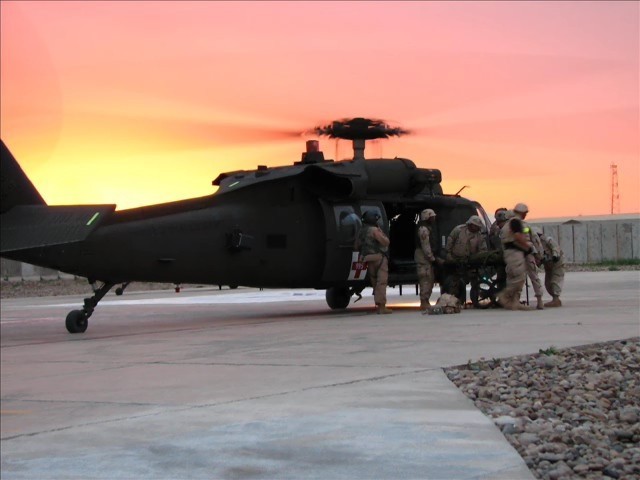
UC Studies Conditions of Medical Evacuation for Injured Troops

CINCINNATI
With new funding from the United States Air Force, researchers at the University of Cincinnati's Institute of Military Medicine will continue to investigate the best ways to treat injured soldiers in the theater of combat.
The two-year, $900,000 award provides funds for researchers to study the effects of hypobaric hypoxia on the bacterial colonization of complex musculoskeletal wounds.
Hypobaric hypoxia, or conditions of low air pressure and low oxygen content, describes the unique environment of air medical evacuation at high altitudes, says Timothy Pritts, MD, PhD, assistant professor of surgery and study co-investigator. Col. Warren Dorlac, MD, associate professor of surgery and director of the Cincinnati Center for Sustainment and Readiness Skills (C-STARS) program, is also co-principal investigator.
Using an altitude chamber at the Brooks City-Base in San Antonio, Texas, UC and Air Force researchers will place bacteria inside an experimental wound model. They'll then measure how low oxygen, low pressure and a combination of the two affect bacterial growth in the wound, before looking at possible ways to control the growth.
Pritts says initial measures could include putting the patient on oxygen to counteract the effect of altitude, or pressurization of the environment.
The next phase, says Alex Lentsch, PhD, director of UCs surgical research division and study co-principal investigator, will seek to determine the effect of a recent development in wound care, negative pressure wound therapy (NPWT), on the bacterial growth. In NPWT, a combination of a sponge attached to a suction source replaces packed gauze on the wound.
"Negative pressure wound therapy is a relatively modern evolution in wound care, says Pritts. "It seems to work well to help wounds heal, to keep them clean and non-infected. Its come into very common use in the surgical world over the last eight years and its now in use in the theater of combat with extremity wounds.
But, he says, it's unknown whether the altitude and conditions of air medical evacuation change the therapy's efficacy.
"Its really a question of viability in that environment, says Lentsch. "Does the therapy work in that environment and does it have any effect on the wounds, other than the reason its being used?
Pritts says the active collaborative relationship between UC and the Air Force will allow residents from Dayton's Wright-Patterson Air Force Base to work on the research through the length of the grant. Past Air Force funding has allowed UC to study the effect of early evacuation on the body's inflammatory response and traumatic brain injury.
Tags
Related Stories
UC radiation oncologist speaks with Local 12 news about clinical trial for head and neck cancer treatment
August 10, 2026

Dr. Sara Medek, a UC radiation oncology professor, speaks with Local 12 news about a new clinical trial aimed at reducing radiation in certain areas while still treating cancer effectively but with fewer painful side effects.
Cancer Center director charts future based on collaboration, AI
August 10, 2026

David Gius, MD, PhD, was featured in a Cincinnati Business Courier article and The Cancer Letter’s “The Directors" podcast discussing his priorities and goals as he recently took the helm as director of the University of Cincinnati Cancer Center.
Bidirectional link between oral, kidney health calls for patient education, access
August 4, 2026

Despite growing awareness of the connection between oral health and chronic health conditions, patient awareness and access to dental care remain limited, according to University of Cincinnati experts who recently spoke with Healio | Nephrology News & Issues.