'Bone Shock Absorbance' Technology Is Impetus Behind New Company

CINCINNATIA technology developed by two UC professors is the impetus behind the new company OsteoDynamics, Inc.
The life-science company, founded by UCs Amit Bhattacharya, PhD, and Nelson Watts, MD, and formed with the help of Integrated BioScience Solutions, LLC, (IGBS) and the business incubator BIOSTART, will develop a new diagnostic tool to test a patients risk of bone fracture based on the concept of "Bone Shock Absorbance.
The company will be based out of BIOSTART and David Ralph of IGBS will serve as the chief executive officer.
Bone Shock Absorbance is a non-invasive and painless test that measures how the energy associated with simple heel strike by a patient is propagated, absorbed and dissipated as its shock wave moves up a patients skeleton. The test provides information that measures a patients bone quality and appears to be a better indicator of fracture risk than the commonly used methods that simply measures the mineral density of a patients bones.
On Feb. 3, 2010, OsteoDynamics signed an option agreement to license the Bone Shock Absorbance technology and its associated know-how from the university. The company also received $125,000 of seed financing from Southern Ohio Creates Companies (SOCC) on March 8, 2010.
"Osteoporosis is a terrible disease afflicting ten million patients in the United States, resulting in approximately two million bone fractures each year and enormous health care costs, says Watts, professor of medicine and director of the Bone Health and Osteoporosis Center at UC. "Our Bone Shock Absorbance technology has the potential to more accurately identify patients who will suffer an osteoporosis-related bone fracture than is currently possible with alternative diagnostic techniques.
"The key to reducing the number of osteoporosis-related fractures and their associated health care costs is the availability of a diagnostic test that can better determine which patients are most likely to suffer these types of fractures, says Bhattacharya, a professor in the department of environmental health. "With that information, we can then provide them with more effective medications and other interventions that have already been proven to reduce fracture risk. Initial clinical data indicates that Bone Shock Absorbance may be the diagnostic technology that can achieve this goal.
Read more at http://dialedin.org/.

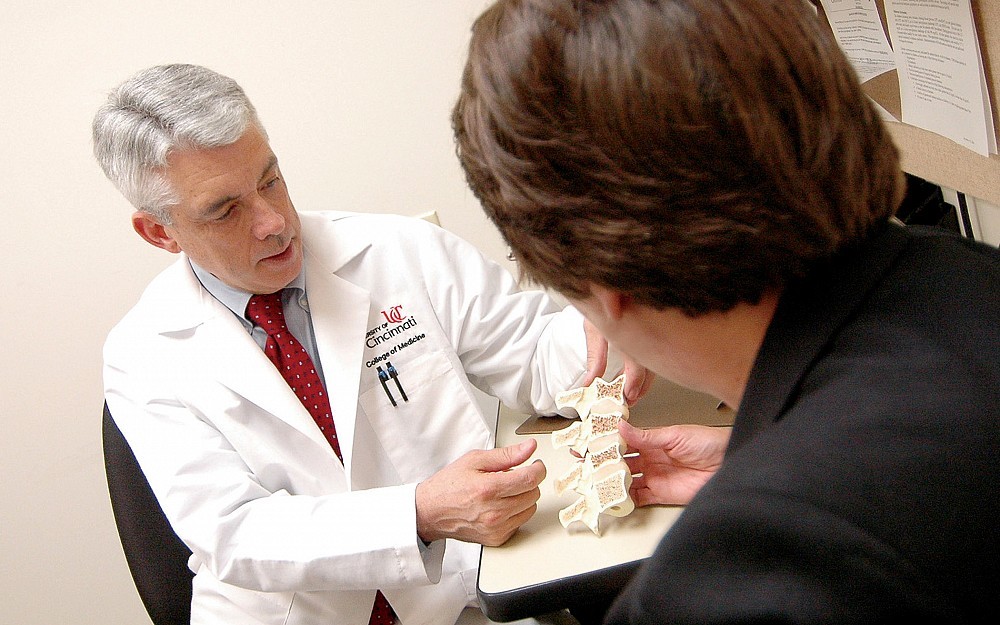
Amit Bhattacharya, PhD, is trying to determine if a new, noninvasive screening technique can effectively predict even prevent bone fractures in postmenopausal women with osteoporosis
Tags
Related Stories
UC radiation oncologist speaks with Local 12 news about clinical trial for head and neck cancer treatment
August 10, 2026

Dr. Sara Medek, a UC radiation oncology professor, speaks with Local 12 news about a new clinical trial aimed at reducing radiation in certain areas while still treating cancer effectively but with fewer painful side effects.
Cancer Center director charts future based on collaboration, AI
August 10, 2026

David Gius, MD, PhD, was featured in a Cincinnati Business Courier article and The Cancer Letter’s “The Directors" podcast discussing his priorities and goals as he recently took the helm as director of the University of Cincinnati Cancer Center.
Bidirectional link between oral, kidney health calls for patient education, access
August 4, 2026

Despite growing awareness of the connection between oral health and chronic health conditions, patient awareness and access to dental care remain limited, according to University of Cincinnati experts who recently spoke with Healio | Nephrology News & Issues.