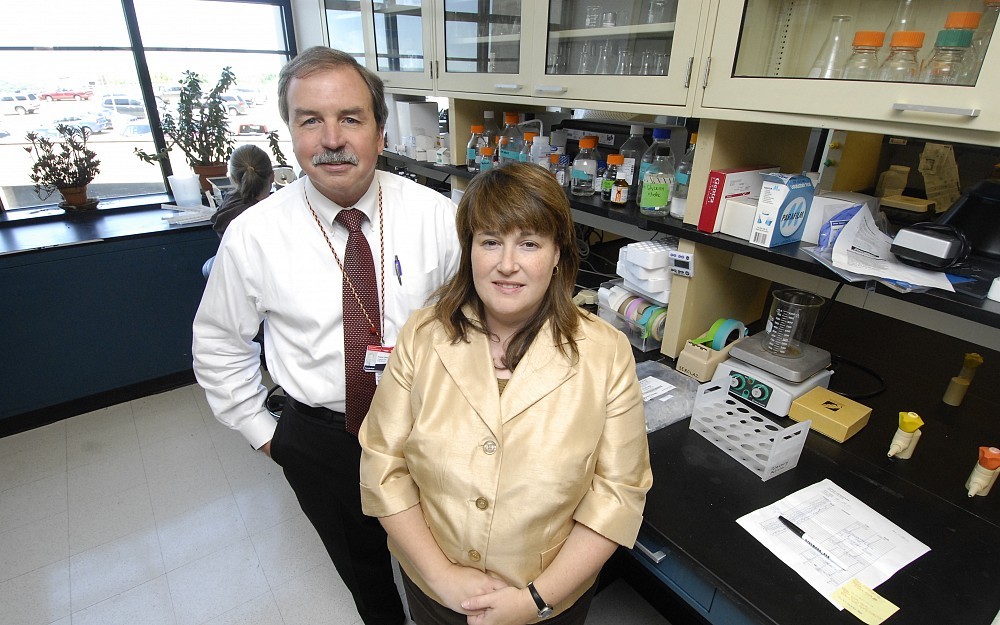
Diagnostic Blood Test Can Identify Rare Lung Disease

CINCINNATIResearchers at the University of Cincinnati and Cincinnati Childrens Hospital Medical Center have found that a certain blood test can successfully identify lymphangioleiomyomatosis (LAM) in some patients, eliminating the need for surgical lung biopsy to make a diagnosis.
These findings are being published in the July 6, 2010, edition of the journal CHEST.
LAM is a rare but serious lung disease that affects women, causing shortness of breath and lung collapse, called a pneumothorax. The disease occurs when an unusual type of cell invades the lungs and causes tissue destruction by creating holes or cysts in the lung. It can be fatal.
Lisa Young, MD, lead author on the study and researcher at UC and Cincinnati Childrens, says that these findings will help with diagnosing LAM and may also be helpful in screening for LAM in women with Tuberous Sclerosis Complex (TSC), a genetic disorder that causes tumors to form in many different organs. TSC is a risk factor for the development of LAM.
In this study, the test was used to analyze the amount of a specific proteinvascular endothelial growth factor-D, or VEGF-Din patients blood. VEGF-D promotes the growth of lymphatic vessels and blood vessels and can be involved in the spread of cancer.
Researchers performed VEGF-D testing in 195 women and found that serum VEGF-D levels were significantly greater in women with LAM than in women with other lung diseases or healthy individuals. When they prospectively evaluated the VEGF-D test performance in women prior to knowing their diagnosis, the test showed high accuracy for diagnosis of LAM.
"We concluded that a serum VEGF-D level of greater than 800 pg/mL (picograms, or one-trillionth of a gram, per milliliter) in women with typical cystic changes on a high-resolution computed tomography (CT) scan is diagnostically specific for sporadic LAM and identifies LAM in women with TSC, Young says. "However, negative VEGF-D results do not exclude the diagnosis of LAM.
Frank McCormack, MD, senior author and director of pulmonary, critical care and sleep medicine at UC, says that Serum VEGF-D measurement is currently performed as part of a research protocol but will soon be available for clinical application.
"This was a team effort by clinicians around the world to collect blood samples and clinical data from patients with very rare lung diseases, he says. "Through their efforts and the generosity of patients who participated, we are optimistic that serum VEGF-D will join the ranks of diagnostic tests for lung disease, reduce the need for surgical lung biopsy and allow for intervention and trial recruitment earlier in the disease course.
This study was funded by a pilot project grant from The LAM Foundation, The Tante Mela Foundation and a grant from the National Heart, Lung, and Blood Institute.
To learn more about LAM and ongoing research, visit www.thelamfoundation.org.
Tags
Related Stories
UC radiation oncologist speaks with Local 12 news about clinical trial for head and neck cancer treatment
August 10, 2026

Dr. Sara Medek, a UC radiation oncology professor, speaks with Local 12 news about a new clinical trial aimed at reducing radiation in certain areas while still treating cancer effectively but with fewer painful side effects.
Cancer Center director charts future based on collaboration, AI
August 10, 2026

David Gius, MD, PhD, was featured in a Cincinnati Business Courier article and The Cancer Letter’s “The Directors" podcast discussing his priorities and goals as he recently took the helm as director of the University of Cincinnati Cancer Center.
Bidirectional link between oral, kidney health calls for patient education, access
August 4, 2026

Despite growing awareness of the connection between oral health and chronic health conditions, patient awareness and access to dental care remain limited, according to University of Cincinnati experts who recently spoke with Healio | Nephrology News & Issues.