Researchers Receive $1 Million to Study Effects of Cancer Drug on Rare Lung Disorder

CINCINNATIResearchers at the University of Cincinnati have received a $1 million award from the U.S. Department of Defense to study the effects of a cancer drug on certain patients with lymphangioleiomyomatosis (LAM).
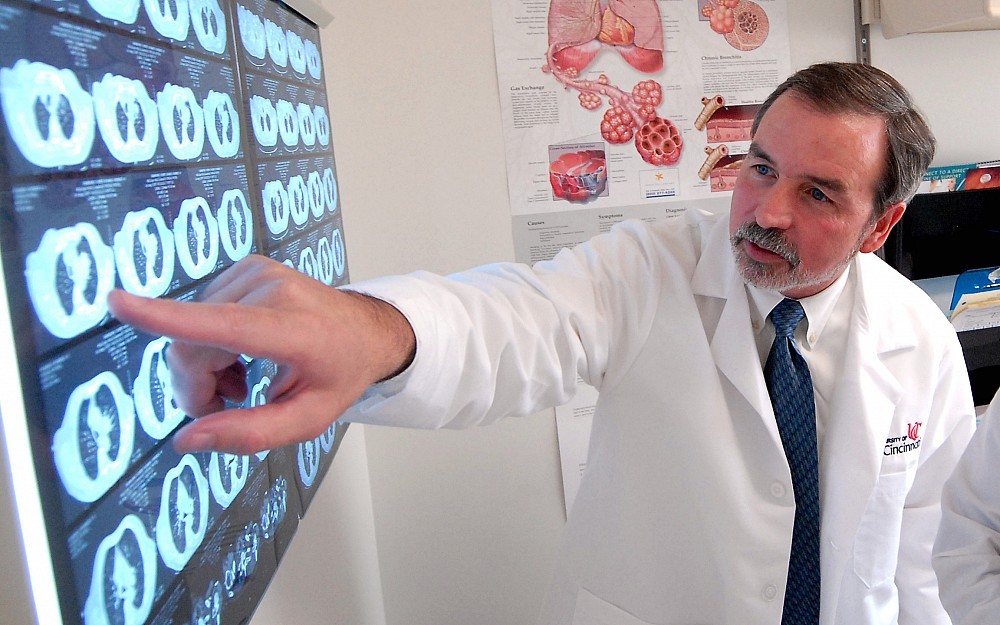
LAM is a rare but serious lung disease that affects women, causing shortness of breath and recurrent lung collapses, or pneumothoraces. The disease is caused by atypical smooth muscle cells invading the lung, causing tissue destruction by creating holes or cysts. It can be fatal.
Frank McCormack, MD, a UC Health pulmonologist and principal investigator of the study, says although there is no cure for LAM, there are a number of promising candidate drugs available, many of which are approved by the Food and Drug Administration (FDA) for other indications.
"Letrozole, trade name Femara, is an oral non-steroidal aromatase inhibitor used for the treatment of hormonally responsive breast cancer after surgery, says McCormack. "Aromatase inhibitors block the synthesis of estrogen, lowering the serum estrogen level and slowing the growth of cells that are driven by estrogen.
"Like breast cancer, LAM appears to be hormonally modulated. We want to see if letrozole can slow the growth rate of LAM cells in the lungs of patients, reducing the rate of decline in lung function.
The national, multi-center study, known as the Trial of Aromatase Inhibition in Lymphangioleiomyomatosis (TRAIL), will take place over a two-year period.
Sixty participants, all of whom must be post-menopausal women who have been diagnosed with LAM, will be randomized to either receive letrozole treatment2.5 milligrams/per day for 12 monthsor a placebo.
McCormack says researchers will be using the LAM Foundation Clinical Research Network (LFCRN) sites across the country to implement this study and gather data. Additional members of the team at UC include Lisa Young, MD, Brent Kinder, MD, and Tammy Roads, project manager.
"The primary objective of this trial is to find an effective treatment for LAM, but the benefits of TRAIL will extend beyond this rare disease, says McCormack. "Studying LAM, a very simple and slow-moving form of cancer caused by a single gene mutation, can teach us a lot about diagnosis and treatment of more aggressive malignancies."
Volunteers, staff and resources provided by the Tuberous Sclerosis

Frank McCormack, MD, and Lisa Young, MD, pulmonologists
Tags
Related Stories
UC radiation oncologist speaks with Local 12 news about clinical trial for head and neck cancer treatment
August 10, 2026

Dr. Sara Medek, a UC radiation oncology professor, speaks with Local 12 news about a new clinical trial aimed at reducing radiation in certain areas while still treating cancer effectively but with fewer painful side effects.
Cancer Center director charts future based on collaboration, AI
August 10, 2026

David Gius, MD, PhD, was featured in a Cincinnati Business Courier article and The Cancer Letter’s “The Directors" podcast discussing his priorities and goals as he recently took the helm as director of the University of Cincinnati Cancer Center.
Bidirectional link between oral, kidney health calls for patient education, access
August 4, 2026

Despite growing awareness of the connection between oral health and chronic health conditions, patient awareness and access to dental care remain limited, according to University of Cincinnati experts who recently spoke with Healio | Nephrology News & Issues.