UC Neurotrauma Team Awarded $2.1M to Test 'Lab on a Tube'

CINCINNATIThe U.S. Department of Defense has awarded researchers at the University of Cincinnati (UC) a $2.1 million Advanced Technology/Therapeutic Development Award to develop the next generation of brain monitors.
The researchers novel, multitasking "lab on a tube is designed to provide continuous brain monitoring of patients who have suffered brain injury or other neurological emergencies and is capable of simultaneously draining cerebrospinal fluid.
The ultra-thin, spirally rolled tubealso known as a "smart catheter or "smart sensorwould allow real-time monitoring of seven different parameters with a single catheter placed inside the brain through a hole in the skull. The seven parameters are intracranial pressure, temperature, brain oxygenation, cerebral blood flow, EEG, cerebral lactate and glucose. In current practice, only two or three of these parameters are measured in most patients.
"Its extremely exciting, says Jed Hartings, PhD, research assistant professor in the department of neurosurgery at the UC College of Medicine and director of clinical monitoring for the Mayfield Clinic. "Most advances in the treatment of brain injury during the last 30 years have come from clinical observational science. Our ability to make such advances is based on our ability to monitor different aspects of the changing physiology of the brain as it recovers from injury.
"There are currently several methods for monitoring different aspects of brain physiology, but they involve separate devices, made largely by different companies, continues Hartings, the co-principal investigator. "The devices require placement of separate probes in the brain, which increases the risk of complications, is more expensive, and is logistically difficult. In addition, many of those modalities require expert training to operate the monitors and interpret the results.
The new lab-on-a-tube, Hartings says, would make all of the information accessible on a single probe.
The end goal is for the device to further reduce invasiveness by doubling as a ventricular drainage tube. Such tubes are widely used to drain excess cerebrospinal fluid from the brain to relieve intracranial pressure.
The smart catheters dual use as monitor and drainage tube, Hartings believes, could result in the tubes being widely adopted by neuroscience intensive care units throughout the
"It will greatly accelerate research and clinical insight into the disease process, Hartings says. "There will be huge databases generated by these parameterssome of which we already know what to do with, and some of which we need to gain more experience with.
Clinical availability of the smart sensor is likely at least a decade away, Hartings says.
The five-year Advanced Technology/Therapeutic Development Award is part of the Department of Defenses Psychological Health and Traumatic Brain Injury Research Program. The program reflects the militarys heightened commitment to neurological research in response to the survival of large numbers of soldiers who suffered head injuries in the wars in
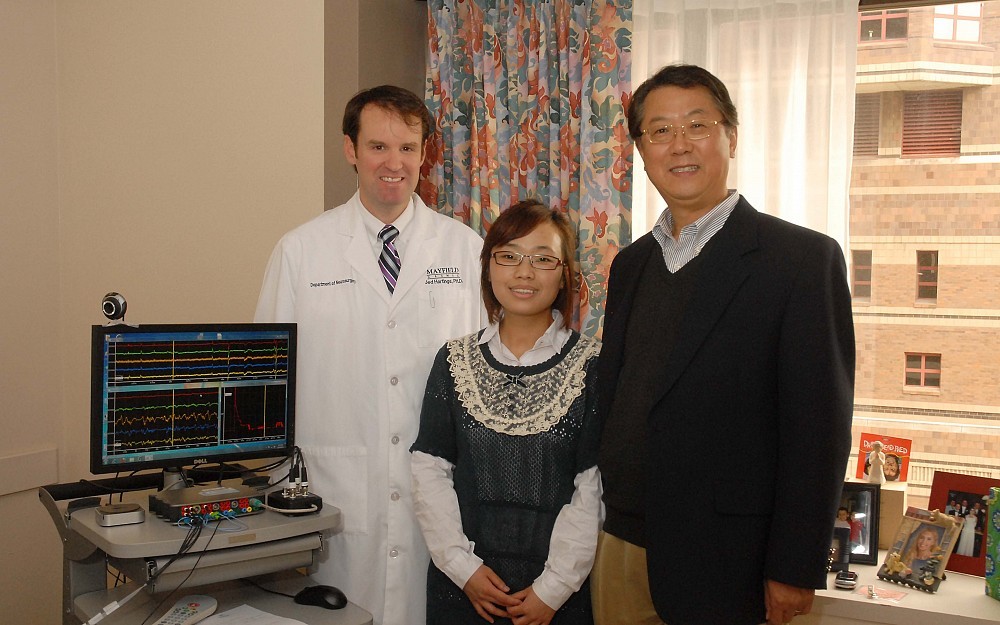
Researchers in UCs department of neurosurgery will collaborate with colleagues at the North Shore University HospitalLong Island Jewish Medical Center, who received a $2.6 million grant. Hartings co-principal investigator is Raj Narayan, MD, chairman of the department of neurosurgery at North Shore-LIJ and director of the Harvey Cushing Institutes of Neuroscience. Narayan led development of the smart sensor while serving as department chair at UC through 2009. Additional co-investigators are Lori Shutter, MD, director of neurocritical care at the UC Neuroscience Institute; Chong Ahn, PhD, professor in the department of electrical and computer engineering at UC; and Chunyan Li, PhD, of North Shore-LIJ.
The grants first phase will involve further development and testing of the engineering design and sensor technology. The second phase will involve testing the sensor in animals against gold-standard, FDA-approved technologies. During the final phase, researchers will assess the devices safety in a clinical trial involving about 40 patients.
Physicians currently achieve the accepted standard of care by monitoring three parameters in the NSICU at UC Health University Hospital: intracranial pressure, brain oxygen and temperature. Intracranial EEG is monitored in some patients who are enrolled in a clinical research study.
Development of the smart catheter began when members of the department of neurosurgery and Neurotrauma Center at the UC Neuroscience Institute expressed the need for a multimodality monitoring device for neurotrauma patients. UC engineers, working to fulfill this need, developed the preliminary working model of the multimodal tube in 2009. The prototype for a smart neuro-catheter was engineered by Li, then a postdoctoral fellow in the UC department of neurosurgery who was training under Ahn. Concepts for a lab-on-a-tube device with multimodality sensors were developed in the microsystems and bioMEMS laboratory headed by Ahn. A patent is pending for the tube.
Also contributing to the tubes development were Pei-Ming Wu and WooSeok Jung of the microsystems and bioMEMS laboratory in UCs department of electrical and computer engineering.
The work was initially supported by the Integra Lifesciences Foundation, based in
Related Stories
UC radiation oncologist speaks with Local 12 news about clinical trial for head and neck cancer treatment
August 10, 2026

Dr. Sara Medek, a UC radiation oncology professor, speaks with Local 12 news about a new clinical trial aimed at reducing radiation in certain areas while still treating cancer effectively but with fewer painful side effects.
Cancer Center director charts future based on collaboration, AI
August 10, 2026

David Gius, MD, PhD, was featured in a Cincinnati Business Courier article and The Cancer Letter’s “The Directors" podcast discussing his priorities and goals as he recently took the helm as director of the University of Cincinnati Cancer Center.
UC graduates cross finish line at commencement
August 7, 2026
The University of Cincinnati recognized 2,125 graduates in two ceremonies at summer commencement Friday on campus at Fifth Third Arena.